Mudar Raksha A, Chiang Hsueh-Sheng, Maguire Mandy J, Spence Jeffrey S, Eroh Justin, Kraut Michael A, Hart John
Department of Speech and Hearing Science, University of Illinois at Urbana-Champaign, 901 South Sixth Street, Champaign, IL 61820, USA; Center for BrainHealth, The University of Texas at Dallas, 2200 West Mockingbird Lane, Dallas, TX 75235, USA.
Center for BrainHealth, The University of Texas at Dallas, 2200 West Mockingbird Lane, Dallas, TX 75235, USA.
Behav Brain Res. 2015;287:285-93. doi: 10.1016/j.bbr.2015.03.042. Epub 2015 Mar 28.
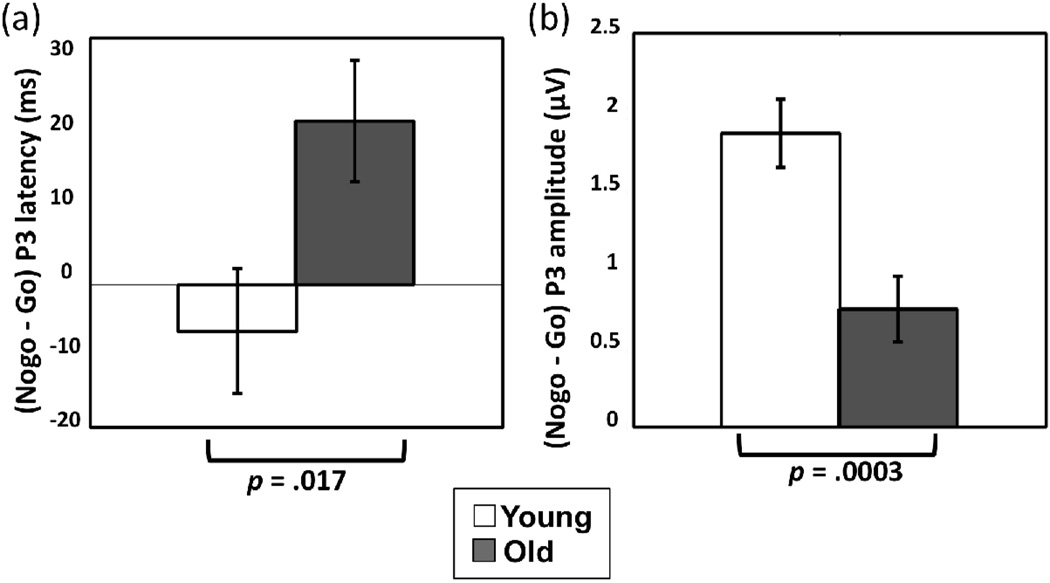
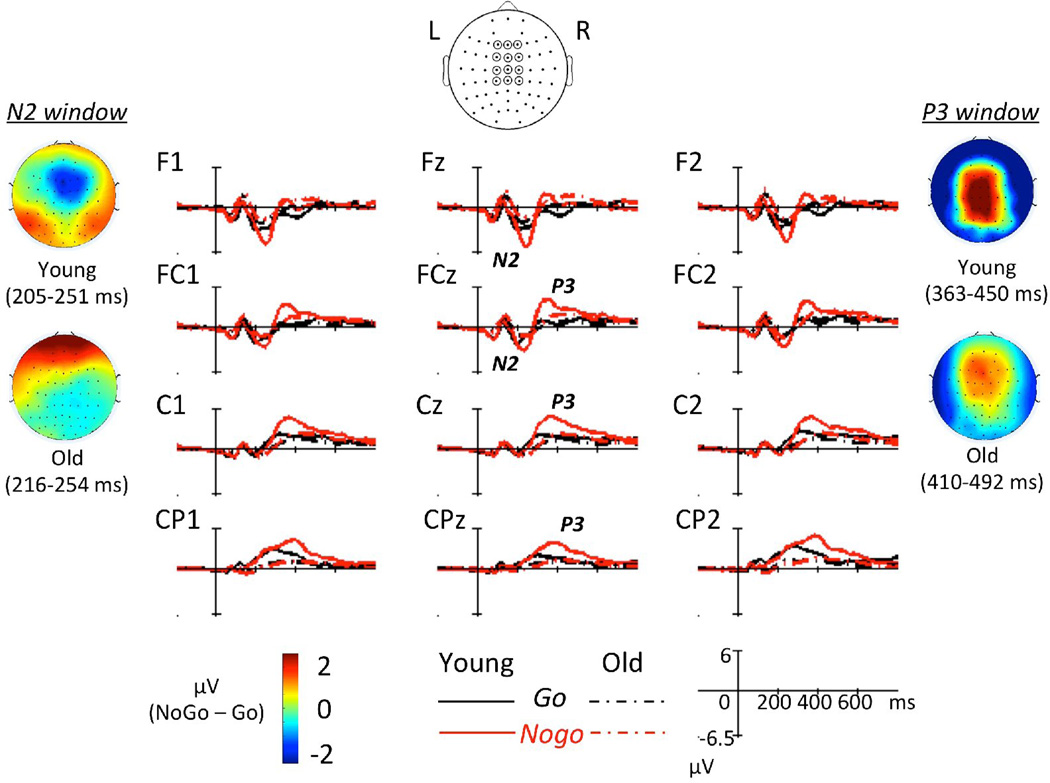
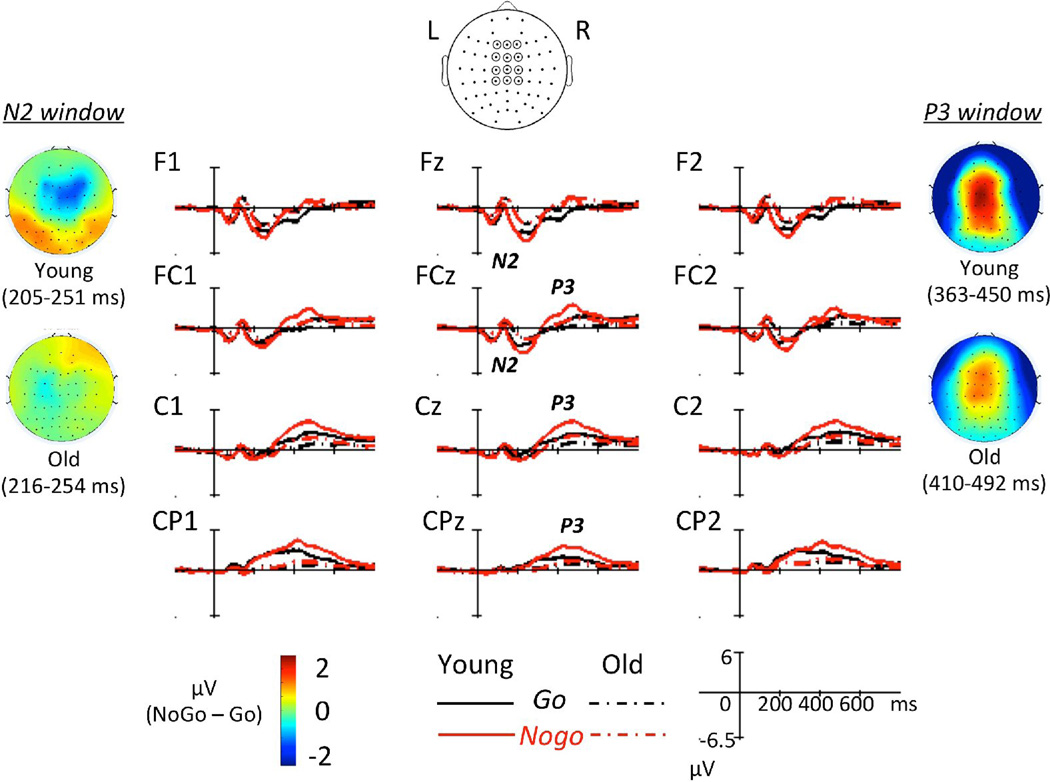
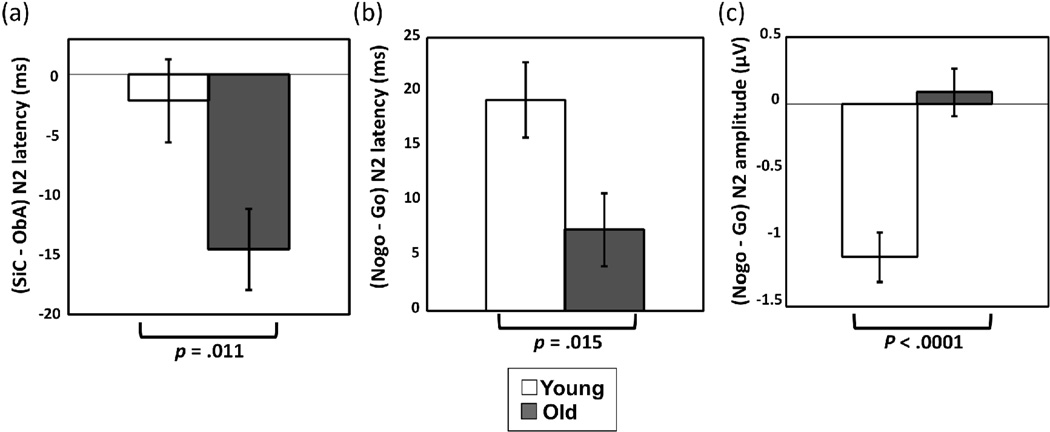
We used event-related potentials (ERPs) to study age effects of perceptual (basic-level) vs. perceptual-semantic (superordinate-level) categorization on cognitive control using the go/nogo paradigm. Twenty-two younger (11 M; 21 ± 2.2 years) and 22 older adults (9 M; 63 ± 5.8 years) completed two visual go/nogo tasks. In the single-car task (SiC) (basic), go/nogo responses were made based on single exemplars of a car (go) and a dog (nogo). In the object animal task (ObA) (superordinate), responses were based on multiple exemplars of objects (go) and animals (nogo). Each task consisted of 200 trials: 160 (80%) 'go' trials that required a response through button pressing and 40 (20%) 'nogo' trials that required inhibition/withholding of a response. ERP data revealed significantly reduced nogo-N2 and nogo-P3 amplitudes in older compared to younger adults, whereas go-N2 and go-P3 amplitudes were comparable in both groups during both categorization tasks. Although the effects of categorization levels on behavioral data and P3 measures were similar in both groups with longer response times, lower accuracy scores, longer P3 latencies, and lower P3 amplitudes in ObA compared to SiC, N2 latency revealed age group differences moderated by the task. Older adults had longer N2 latency for ObA compared to SiC, in contrast, younger adults showed no N2 latency difference between SiC and ObA. Overall, these findings suggest that age differentially affects neural processing related to cognitive control during semantic categorization. Furthermore, in older adults, unlike in younger adults, levels of categorization modulate neural processing related to cognitive control even at the early stages (N2).
我们使用事件相关电位(ERP),通过执行/不执行范式,研究了感知(基本水平)与感知语义(上级水平)分类对认知控制的年龄效应。22名年轻人(11名男性;21±2.2岁)和22名老年人(9名男性;63±5.8岁)完成了两项视觉执行/不执行任务。在单辆车任务(SiC)(基本水平)中,根据汽车(执行)和狗(不执行)的单个范例做出执行/不执行反应。在物体-动物任务(ObA)(上级水平)中,反应基于物体(执行)和动物(不执行)的多个范例。每个任务由200次试验组成:160次(80%)“执行”试验需要通过按键做出反应,40次(20%)“不执行”试验需要抑制/不做出反应。ERP数据显示,与年轻人相比,老年人的不执行-N2和不执行-P3波幅显著降低,而在两项分类任务中,两组的执行-N2和执行-P3波幅相当。尽管分类水平对行为数据和P3测量的影响在两组中相似,与SiC相比,ObA的反应时间更长、准确率得分更低、P3潜伏期更长且P3波幅更低,但N2潜伏期显示出受任务调节的年龄组差异。与SiC相比,老年人在ObA中的N2潜伏期更长,相反,年轻人在SiC和ObA之间未显示出N2潜伏期差异。总体而言,这些发现表明年龄对语义分类过程中与认知控制相关的神经处理有不同影响。此外,在老年人中,与年轻人不同,分类水平即使在早期阶段(N2)也会调节与认知控制相关的神经处理。