Raichle Marcus E
Mallinckrodt Institute of Radiology, Washington University School of Medicine, 4525 Scott Avenue, Room 2116, St Louis, MO 63110, USA
Philos Trans R Soc Lond B Biol Sci. 2015 May 19;370(1668). doi: 10.1098/rstb.2014.0172.
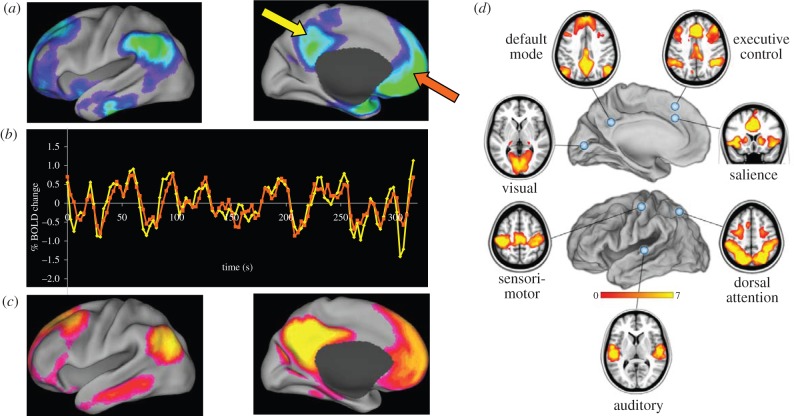
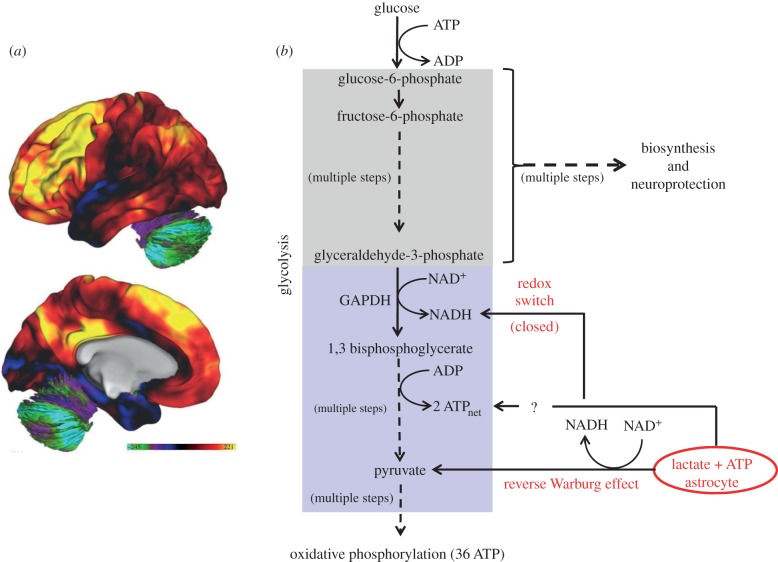
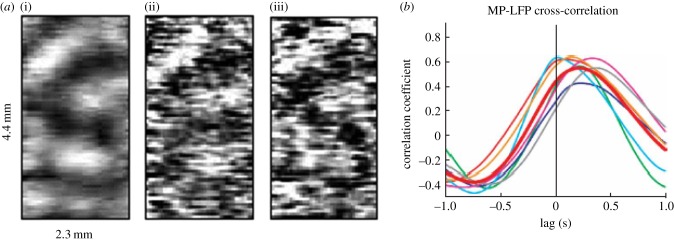
Traditionally studies of brain function have focused on task-evoked responses. By their very nature such experiments tacitly encourage a reflexive view of brain function. While such an approach has been remarkably productive at all levels of neuroscience, it ignores the alternative possibility that brain functions are mainly intrinsic and ongoing, involving information processing for interpreting, responding to and predicting environmental demands. I suggest that the latter view best captures the essence of brain function, a position that accords well with the allocation of the brain's energy resources, its limited access to sensory information and a dynamic, intrinsic functional organization. The nature of this intrinsic activity, which exhibits a surprising level of organization with dimensions of both space and time, is revealed in the ongoing activity of the brain and its metabolism. As we look to the future, understanding the nature of this intrinsic activity will require integrating knowledge from cognitive and systems neuroscience with cellular and molecular neuroscience where ion channels, receptors, components of signal transduction and metabolic pathways are all in a constant state of flux. The reward for doing so will be a much better understanding of human behaviour in health and disease.
传统上,对大脑功能的研究一直聚焦于任务诱发反应。就其本质而言,此类实验默认鼓励对大脑功能持一种反射性观点。虽然这种方法在神经科学的各个层面都取得了显著成效,但它忽略了另一种可能性,即大脑功能主要是内在的且持续存在的,涉及用于解释、响应和预测环境需求的信息处理。我认为后一种观点最能抓住大脑功能的本质,这一立场与大脑能量资源的分配、其对感官信息的有限获取以及动态的内在功能组织相契合。这种内在活动的本质,在大脑的持续活动及其新陈代谢中得以揭示,它在空间和时间维度上展现出惊人的组织程度。展望未来,理解这种内在活动的本质将需要把认知神经科学和系统神经科学的知识与细胞和分子神经科学相结合,在细胞和分子神经科学中,离子通道、受体、信号转导组件和代谢途径都处于不断变化的状态。这样做的回报将是对健康和疾病状态下人类行为有更深入的理解。