Chen Guohao, Zhao Xinru, Wang Xiaozhi, Jin Hao, Li Shijian, Dong Shurong, Flewitt A J, Milne W I, Luo J K
Department of Information Science and Electronic Engineering, Zhejiang University and Cyrus Tang Center for Sensor Materials and Applications, Zhejiang University, Hangzhou 310027, China.
College of Computer Science, Zhejiang University, Hangzhou. 310027, China.
Sci Rep. 2015 Mar 31;5:9510. doi: 10.1038/srep09510.
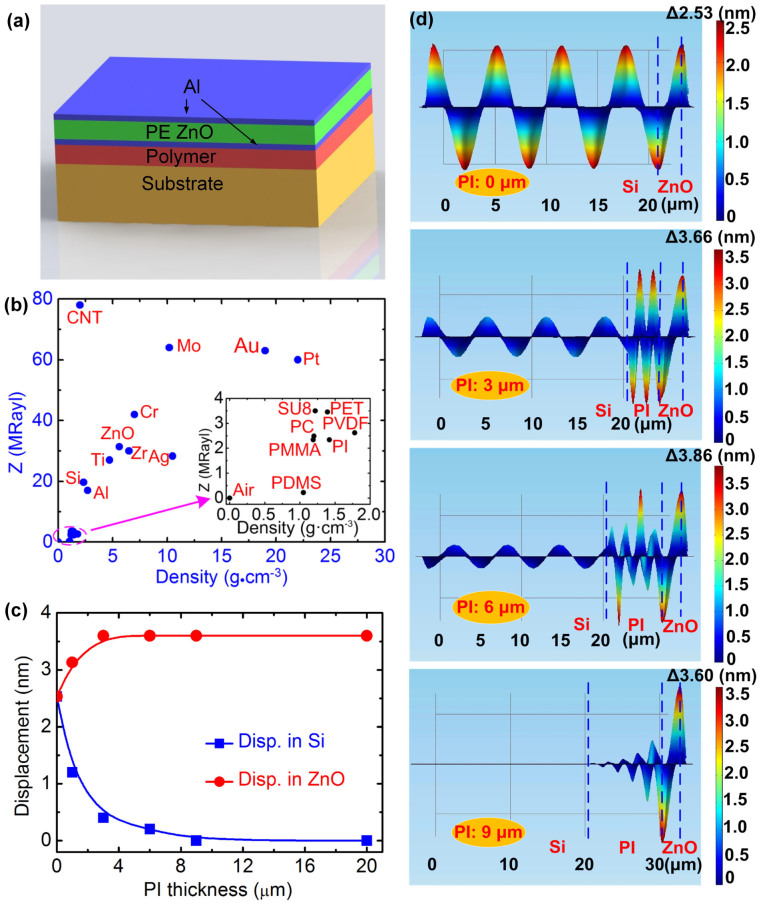
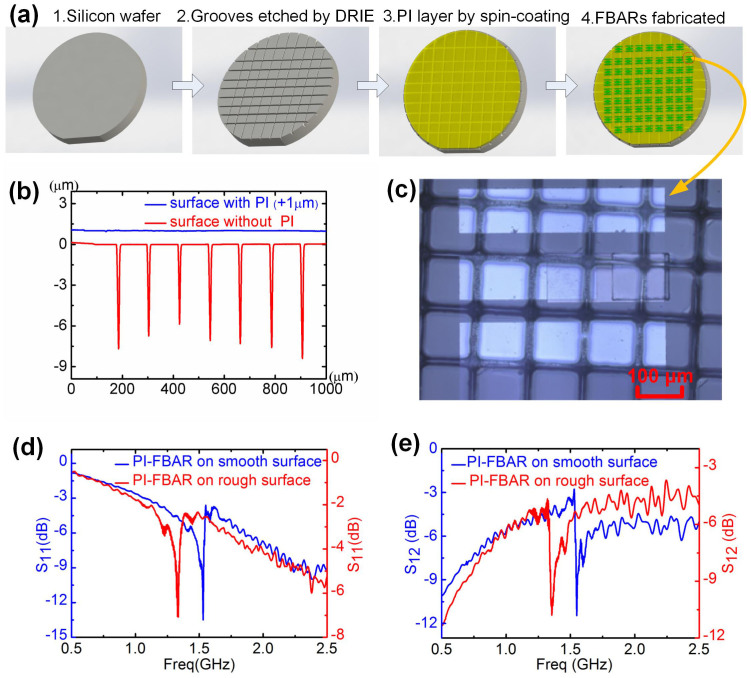
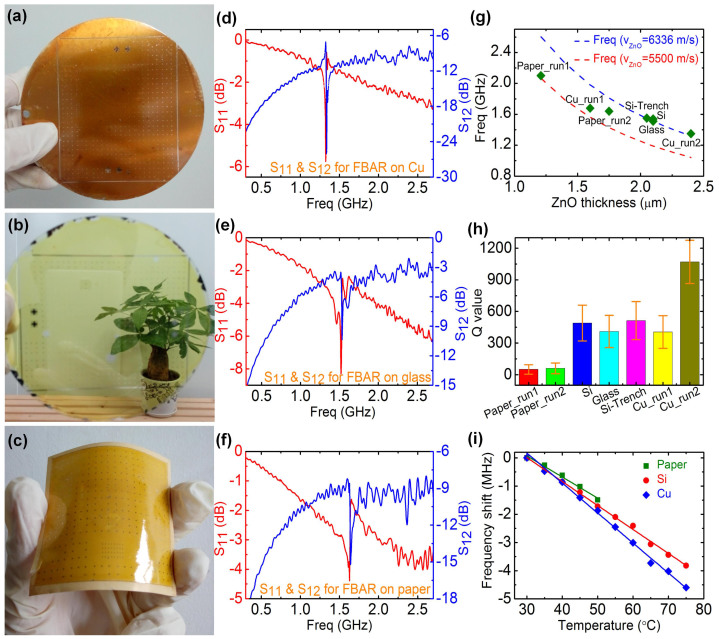
The film bulk acoustic resonator (FBAR) is a widely-used MEMS device which can be used as a filter, or as a gravimetric sensor for biochemical or physical sensing. Current device architectures require the use of an acoustic mirror or a freestanding membrane and are fabricated as discrete components. A new architecture is demonstrated which permits fabrication and integration of FBARs on arbitrary substrates. Wave confinement is achieved by fabricating the resonator on a polyimide support layer. Results show when the polymer thickness is greater than a critical value, d, the FBARs have similar performance to devices using alternative architectures. For ZnO FBARs operating at 1.3-2.2 GHz, d is ~9 μm, and the devices have a Q-factor of 470, comparable to 493 for the membrane architecture devices. The polymer support makes the resonators insensitive to the underlying substrate. Yields over 95% have been achieved on roughened silicon, copper and glass.
薄膜体声波谐振器(FBAR)是一种广泛应用的微机电系统(MEMS)器件,可作为滤波器,或用作生化或物理传感的重量传感器。当前的器件架构需要使用声镜或独立膜,并作为离散组件制造。本文展示了一种新的架构,该架构允许在任意衬底上制造和集成FBAR。通过在聚酰亚胺支撑层上制造谐振器来实现波限制。结果表明,当聚合物厚度大于临界值d时,FBAR的性能与使用其他架构的器件相似。对于工作在1.3 - 2.2 GHz的ZnO FBAR,d约为9μm,器件的品质因数为470,与膜架构器件的493相当。聚合物支撑使谐振器对底层衬底不敏感。在粗糙的硅、铜和玻璃上已实现超过95%的成品率。