Moradi Ali, Ebrahimzadeh Mohammad Hosein, Soroush Mohamad Reza
Janbazan Medical and Engineering Research Center, Tehran, IR Iran.
Orthopedic Research Center, Ghaem Hospital, Mashhad University of Medical Sciences, Mashhad, IR Iran.
Trauma Mon. 2015 Feb;20(1):e21891. doi: 10.5812/traumamon.21891. Epub 2015 Jan 18.
Providing care for patients with chronic disability affects caregivers' social lives and relationships and can lead to poor health and lower quality of life.
In this study, our goal was to assess the quality of life in spouses of war veterans with bilateral lower limb amputations to find factors affecting caregivers' quality of life.
In a cross-sectional study, spouses of 244 veterans with war-related bilateral lower limb amputations for at least one year were invited to participate in this study; 189 couples accepted to participate. Information about age, gender, education level, duration of time since amputation, duration of care provided by the spouses and SF-36 questionnaire for both veterans and their spouses were collected.
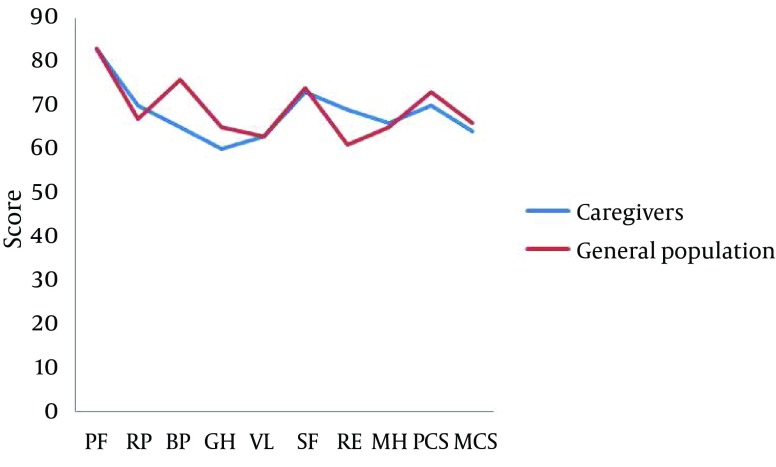
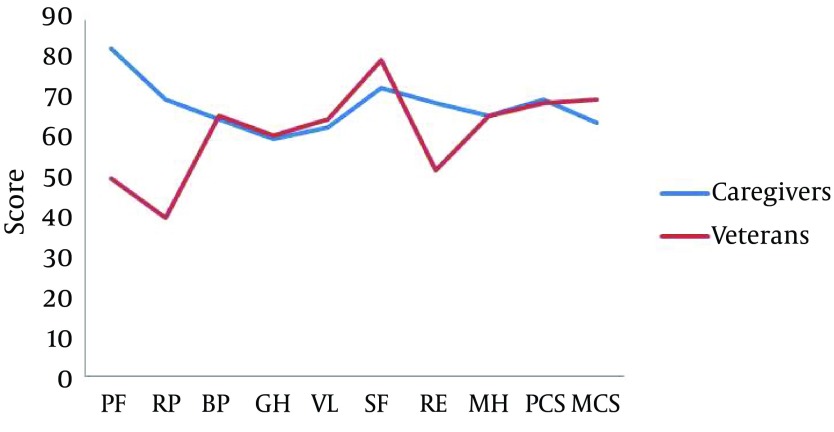
The average age of spouses was 47 years and duration of care provided by spouses was 25 years. We found lower scores for general health domains in amputees' spouses compared to the general population. Factors correlated with both Physical Component Summary (PCS) and Mental Component Summary (MCS) included the duration of care, duration of marriage, spouses' education level and the veterans' PCS and MCS scores. Veterans' age, spouses' age and the number of children only correlated with PCS. Veterans' education level only correlated with MCS. In multivariable analysis, only spouses' education level correlated with MCS and the veterans' PCS only correlated with that of spouses.
The quality of life of amputees and their spouses were closely correlated; therefore, any improvement in one is likely to improve the other. In addition, lower education level should be considered as a risk factor for poorer quality of life in amputees' spouses.
为慢性残疾患者提供护理会影响护理人员的社交生活和人际关系,并可能导致健康状况不佳和生活质量下降。
在本研究中,我们的目标是评估双侧下肢截肢的退伍军人配偶的生活质量,以找出影响护理人员生活质量的因素。
在一项横断面研究中,邀请了244名因战争导致双侧下肢截肢至少一年的退伍军人的配偶参与本研究;189对夫妇同意参与。收集了有关年龄、性别、教育水平、截肢后时间、配偶提供护理的时间以及退伍军人及其配偶的SF-36问卷的信息。
配偶的平均年龄为47岁,配偶提供护理的时间为25年。我们发现截肢者配偶的总体健康领域得分低于一般人群。与身体成分总结(PCS)和心理成分总结(MCS)均相关的因素包括护理时间、婚姻持续时间、配偶的教育水平以及退伍军人的PCS和MCS得分。退伍军人的年龄、配偶的年龄和子女数量仅与PCS相关。退伍军人的教育水平仅与MCS相关。在多变量分析中,只有配偶的教育水平与MCS相关,而退伍军人的PCS仅与配偶的PCS相关。
截肢者及其配偶的生活质量密切相关;因此,一方的任何改善都可能改善另一方。此外,较低的教育水平应被视为截肢者配偶生活质量较差的一个风险因素。