Clement R Carter, Welander Adina, Stowell Caleb, Cha Thomas D, Chen John L, Davies Michelle, Fairbank Jeremy C, Foley Kevin T, Gehrchen Martin, Hagg Olle, Jacobs Wilco C, Kahler Richard, Khan Safdar N, Lieberman Isador H, Morisson Beth, Ohnmeiss Donna D, Peul Wilco C, Shonnard Neal H, Smuck Matthew W, Solberg Tore K, Stromqvist Bjorn H, Hooff Miranda L Van, Wasan Ajay D, Willems Paul C, Yeo William, Fritzell Peter
a 1 Department of Orthopaedic Surgery, University of North Carolina Hospitals , Chapel Hill, NC, USA.
b 2 Boston Consulting Group , Stockholm, Sweden.
Acta Orthop. 2015;86(5):523-33. doi: 10.3109/17453674.2015.1036696.
Outcome measurement has been shown to improve performance in several fields of healthcare. This understanding has driven a growing interest in value-based healthcare, where value is defined as outcomes achieved per money spent. While low back pain (LBP) constitutes an enormous burden of disease, no universal set of metrics has yet been accepted to measure and compare outcomes. Here, we aim to define such a set.
An international group of 22 specialists in several disciplines of spine care was assembled to review literature and select LBP outcome metrics through a 6-round modified Delphi process. The scope of the outcome set was degenerative lumbar conditions.
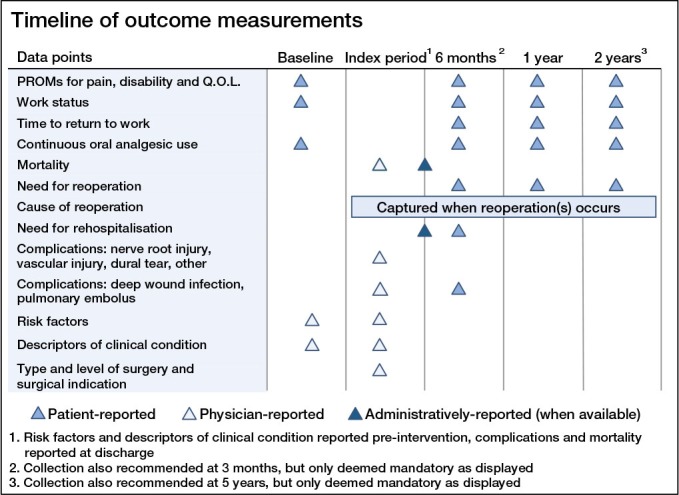
Patient-reported metrics include numerical pain scales, lumbar-related function using the Oswestry disability index, health-related quality of life using the EQ-5D-3L questionnaire, and questions assessing work status and analgesic use. Specific common and serious complications are included. Recommended follow-up intervals include 6, 12, and 24 months after initiating treatment, with optional follow-up at 3 months and 5 years. Metrics for risk stratification are selected based on pre-existing tools.
The outcome measures recommended here are structured around specific etiologies of LBP, span a patient's entire cycle of care, and allow for risk adjustment. Thus, when implemented, this set can be expected to facilitate meaningful comparisons and ultimately provide a continuous feedback loop, enabling ongoing improvements in quality of care. Much work lies ahead in implementation, revision, and validation of this set, but it is an essential first step toward establishing a community of LBP providers focused on maximizing the value of the care we deliver.
结果测量已被证明可改善医疗保健多个领域的绩效。这种认识推动了对基于价值的医疗保健的兴趣日益增长,其中价值被定义为每花费的金钱所实现的结果。虽然腰痛(LBP)构成了巨大的疾病负担,但尚未有一套通用的指标被接受用于测量和比较结果。在此,我们旨在定义这样一套指标。
组建了一个由22名脊柱护理多个学科的国际专家组成的小组,通过6轮改良德尔菲法审查文献并选择LBP结果指标。结果集的范围是退行性腰椎疾病。
患者报告的指标包括数字疼痛量表、使用奥斯威斯利残疾指数的腰部相关功能、使用EQ-5D-3L问卷的健康相关生活质量,以及评估工作状态和镇痛药物使用的问题。包括特定的常见和严重并发症。推荐的随访间隔包括开始治疗后的6、12和24个月,可选择在3个月和5年进行随访。基于现有的工具选择风险分层指标。
此处推荐的结果测量指标围绕LBP的特定病因构建,涵盖患者的整个护理周期,并允许进行风险调整。因此,当实施时,这套指标有望促进有意义的比较,并最终提供一个持续的反馈循环,实现护理质量的持续改进。在这套指标的实施、修订和验证方面还有很多工作要做,但这是朝着建立一个专注于最大化我们所提供护理价值的LBP提供者群体迈出的重要第一步。