Wright Fay, D'Eramo Melkus Gail, Hammer Marilyn, Schmidt Brian L, Knobf M Tish, Paul Steven M, Cartwright Frances, Mastick Judy, Cooper Bruce A, Chen Lee-May, Melisko Michelle, Levine Jon D, Kober Kord, Aouizerat Bradley E, Miaskowski Christine
Florence S. Downs PhD Program in Nursing Research and Theory Development, College of Nursing, New York University, New York, New York, USA.
Department of Oral and Maxillofacial Surgery, School of Dentistry, New York University, New York, New York, USA.
J Pain Symptom Manage. 2015 Aug;50(2):176-89. doi: 10.1016/j.jpainsymman.2015.02.016. Epub 2015 Mar 28.
Fatigue is the most common symptom in oncology patients during chemotherapy. Little is known about the predictors of interindividual variability in initial levels and trajectories of morning fatigue severity in these patients.
An evaluation was done to determine which demographic, clinical, and symptom characteristics were associated with initial levels as well as the trajectories of morning fatigue and to compare findings with our companion paper on evening fatigue.
A sample of outpatients with breast, gastrointestinal, gynecological, and lung cancer (n = 586) completed demographic and symptom questionnaires a total of six times over two cycles of chemotherapy. Fatigue severity was evaluated using the Lee Fatigue Scale. Hierarchical linear modeling was used to answer the study objectives.
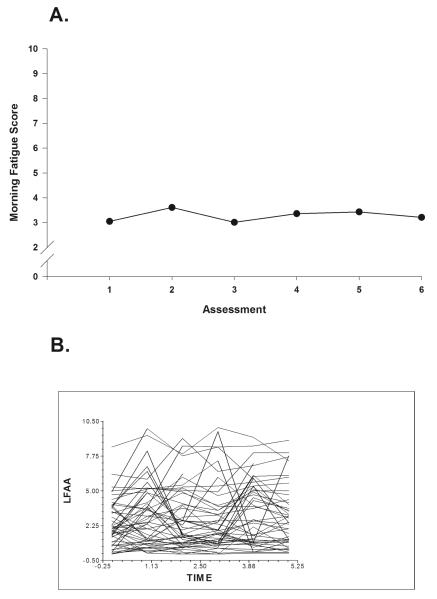
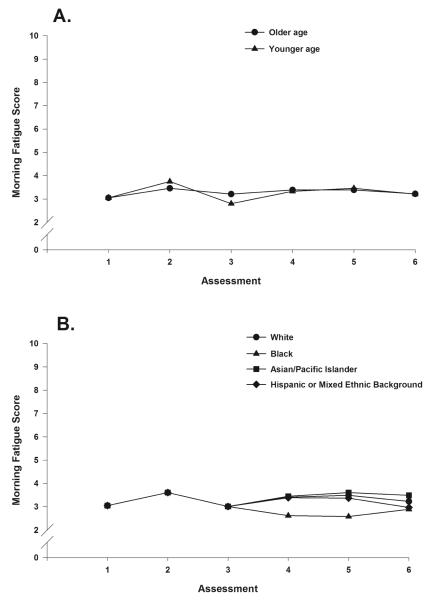
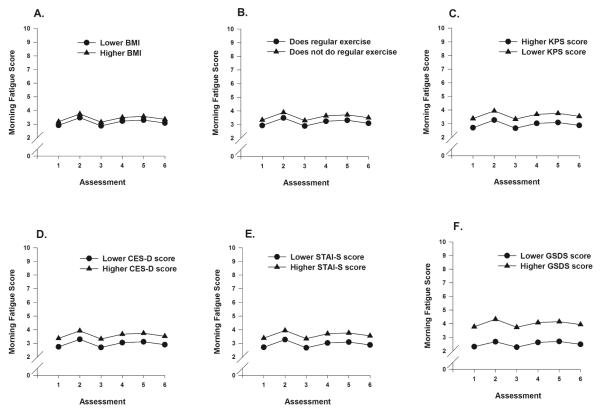
A large amount of interindividual variability was found in the morning fatigue trajectories. A piecewise model fit the data best. Patients with higher body mass index, who did not exercise regularly, with a lower functional status, and who had higher levels of state anxiety, sleep disturbance, and depressive symptoms reported higher levels of morning fatigue at enrollment. Variations in the trajectories of morning fatigue were predicted by the patients' ethnicity and younger age.
The modifiable risk factors that were associated with only morning fatigue were body mass index, exercise, and state anxiety. Modifiable risk factors that were associated with both morning and evening fatigue included functional status, depressive symptoms, and sleep disturbance. Using this information, clinicians can identify patients at higher risk for more severe morning fatigue and evening fatigue, provide individualized patient education, and tailor interventions to address the modifiable risk factors.
疲劳是肿瘤患者化疗期间最常见的症状。对于这些患者早晨疲劳严重程度的初始水平和变化轨迹的个体差异预测因素知之甚少。
进行评估以确定哪些人口统计学、临床和症状特征与早晨疲劳的初始水平以及变化轨迹相关,并将结果与我们关于晚间疲劳的配套论文进行比较。
一组患有乳腺癌、胃肠道癌、妇科癌和肺癌的门诊患者(n = 586)在两个化疗周期内共完成了六次人口统计学和症状问卷调查。使用李氏疲劳量表评估疲劳严重程度。采用分层线性模型来回答研究目的。
在早晨疲劳变化轨迹中发现了大量个体差异。分段模型最适合该数据。体重指数较高、不经常锻炼、功能状态较低、状态焦虑、睡眠障碍和抑郁症状水平较高的患者在入组时报告的早晨疲劳水平较高。早晨疲劳变化轨迹的差异由患者的种族和较年轻的年龄预测。
仅与早晨疲劳相关的可改变风险因素是体重指数、运动和状态焦虑。与早晨和晚间疲劳均相关的可改变风险因素包括功能状态、抑郁症状和睡眠障碍。利用这些信息,临床医生可以识别出早晨和晚间疲劳更严重风险较高的患者,提供个性化的患者教育,并针对可改变的风险因素制定干预措施。