Moore Theresa Helen Mazzarello, King Anna Jyoti Louise, Evans Maggie, Sharp Debbie, Persad Raj, Huntley Alyson Louise
Academic Unit of Primary Care, School of Social and Community Medicine, University of Bristol, Canynge Hall, Bristol, BS8 2PA, UK.
Cancer Med. 2015 Aug;4(8):1240-51. doi: 10.1002/cam4.446. Epub 2015 Apr 1.
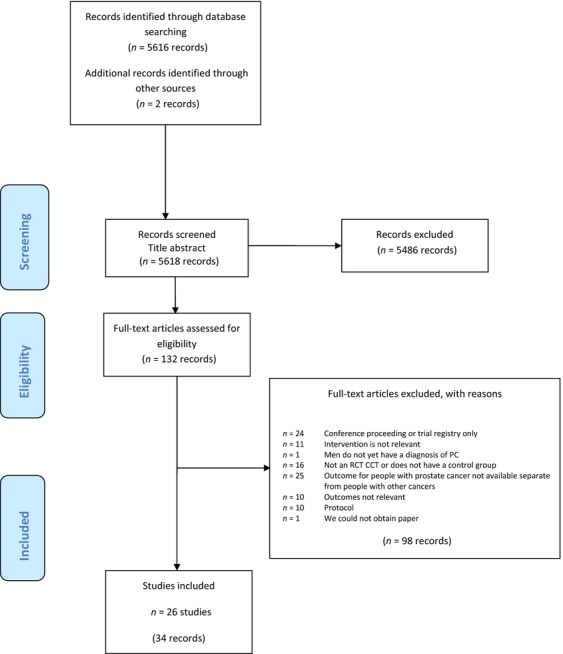
Men with prostate cancer are likely to have a long illness and experience psychological distress for which supportive care may be helpful. This systematic review describes the evidence for effectiveness and cost-effectiveness of supportive care for men with prostate cancer, taking into account treatment pathway and components of interventions. MEDLINE, EMBASE, CINAHL, CENTRAL, and Psychinfo were searched from inception--July 2013 for randomized controlled trials and controlled trials. Two authors independently assessed risk of bias and extracted data. Twenty-six studies were included (2740 participants). Interventions were delivered pre and during (n = 12), short-term (n = 8), and longer term (18 months) (n = 5) after primary treatment. No interventions were delivered beyond this time. Few trials recruited ethnic minorities and none recruited men in same sex relationships. Intervention components included information, education, health professional discussion, homework, peer discussion, buddy support, cognitive behavioral therapy, cognitive restructuring, psychoeducation, Reiki and relaxation. Most interventions were delivered for 5-10 weeks. Risk of bias of trials was assessed as unclear for most domains due to lack of information. The majority of trials measuring quality of life and depression found no effect. Relatively few trials measured anxiety, coping skills and self-efficacy, and the majority found no effect. No cost data were available. Trials of supportive care for men with prostate cancer cover a range of interventions but are limited by population diversity, inconsistent measurement and reporting of outcomes, and inability to assess risk of bias. Recommendations on design and conduct of future trials are presented.
前列腺癌男性患者可能病程较长,并经历心理困扰,支持性护理可能对此有所帮助。本系统评价描述了前列腺癌男性患者支持性护理的有效性和成本效益证据,同时考虑了治疗途径和干预措施的组成部分。检索了MEDLINE、EMBASE、CINAHL、CENTRAL和Psychinfo数据库,从建库至2013年7月,查找随机对照试验和对照试验。两位作者独立评估偏倚风险并提取数据。纳入了26项研究(2740名参与者)。干预措施在初次治疗前及治疗期间实施(n = 12)、短期实施(n = 8)以及长期(18个月)实施(n = 5)。在此之后未实施任何干预措施。很少有试验招募少数族裔,没有试验招募处于同性关系中的男性。干预措施的组成部分包括信息、教育、与医疗专业人员讨论、家庭作业、同伴讨论、伙伴支持、认知行为疗法、认知重构、心理教育、灵气疗法和放松疗法。大多数干预措施实施5 - 10周。由于信息不足,大多数领域试验的偏倚风险评估为不清楚。大多数测量生活质量和抑郁的试验未发现有效果。相对较少的试验测量了焦虑、应对技能和自我效能感,且大多数未发现有效果。没有成本数据。前列腺癌男性患者支持性护理的试验涵盖了一系列干预措施,但受到人群多样性、结果测量和报告不一致以及无法评估偏倚风险的限制。本文提出了关于未来试验设计和实施的建议。