Griffiths Derek, Clarkson Becky, Tadic Stasa D, Resnick Neil M
Department of Medicine (Geriatrics), University of Pittsburgh, Pittsburgh, Pennsylvania.
Department of Medicine (Geriatrics), University of Pittsburgh, Pittsburgh, Pennsylvania.
J Urol. 2015 Sep;194(3):708-15. doi: 10.1016/j.juro.2015.03.102. Epub 2015 Mar 28.
Urge urinary incontinence is a major problem, especially in the elderly, and to our knowledge the underlying mechanisms of disease and therapy are unknown. We used biofeedback assisted pelvic floor muscle training and functional brain imaging (functional magnetic resonance imaging) to investigate cerebral mechanisms, aiming to improve the understanding of brain-bladder control and therapy.
Before receiving biofeedback assisted pelvic floor muscle training functionally intact, older community dwelling women with urge urinary incontinence as well as normal controls underwent comprehensive clinical and bladder diary evaluation, urodynamic testing and brain functional magnetic resonance imaging. Evaluation was repeated after pelvic floor muscle training in those with urge urinary incontinence. Functional magnetic resonance imaging was done to determine the brain reaction to rapid bladder filling with urgency.
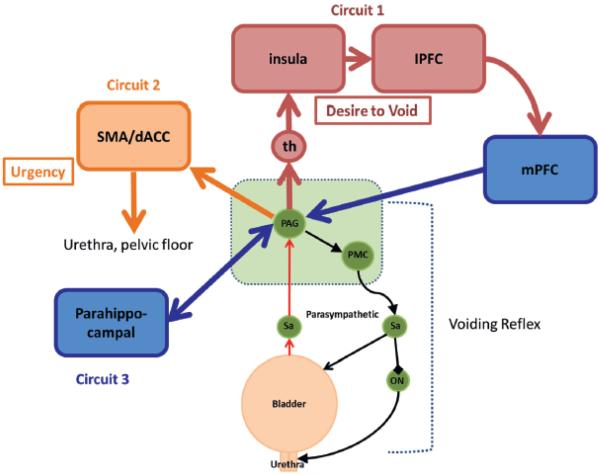
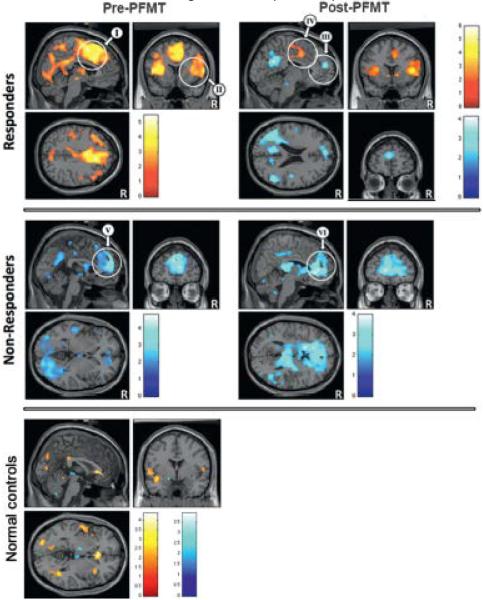
Of 65 subjects with urge urinary incontinence 28 responded to biofeedback assisted pelvic floor muscle training with 50% or greater improvement of urge urinary incontinence frequency on diary. However, responders and nonresponders displayed 2 patterns of brain reaction. In pattern 1 in responders before pelvic floor muscle training the dorsal anterior cingulate cortex and the adjacent supplementary motor area were activated as well as the insula. After the training dorsal anterior cingulate cortex/supplementary motor area activation diminished and there was a trend toward medial prefrontal cortex deactivation. In pattern 2 in nonresponders before pelvic floor muscle training the medial prefrontal cortex was deactivated, which changed little after the training.
In older women with urge urinary incontinence there appears to be 2 patterns of brain reaction to bladder filling and they seem to predict the response and nonresponse to biofeedback assisted pelvic floor muscle training. Moreover, decreased cingulate activation appears to be a consequence of the improvement in urge urinary incontinence induced by training while prefrontal deactivation may be a mechanism contributing to the success of training. In nonresponders the latter mechanism is unavailable, which may explain why another form of therapy is required.
急迫性尿失禁是一个主要问题,尤其在老年人中,据我们所知,该疾病的潜在机制和治疗方法尚不清楚。我们使用生物反馈辅助盆底肌训练和功能性脑成像(功能磁共振成像)来研究大脑机制,旨在增进对脑-膀胱控制及治疗的理解。
功能正常的老年社区居住的急迫性尿失禁女性以及正常对照在接受生物反馈辅助盆底肌训练前,均接受了全面的临床和膀胱日记评估、尿动力学检测及脑功能磁共振成像。急迫性尿失禁患者在盆底肌训练后重复进行评估。通过功能磁共振成像来确定大脑对快速膀胱充盈伴尿急的反应。
65例急迫性尿失禁患者中,28例对生物反馈辅助盆底肌训练有反应,日记记录显示急迫性尿失禁频率改善50%或更多。然而,有反应者和无反应者表现出两种大脑反应模式。在模式1中,有反应者在盆底肌训练前,背侧前扣带回皮质和相邻的辅助运动区以及脑岛被激活。训练后,背侧前扣带回皮质/辅助运动区的激活减弱,内侧前额叶皮质有失活趋势。在模式2中,无反应者在盆底肌训练前内侧前额叶皮质失活,训练后变化不大。结论:在老年急迫性尿失禁女性中,对膀胱充盈似乎存在两种大脑反应模式,并似乎可预测对生物反馈辅助盆底肌训练的反应和无反应情况。此外,扣带回激活减少似乎是训练诱导的急迫性尿失禁改善的结果,而前额叶失活可能是训练成功的一种机制。在无反应者中,后一种机制不存在,这可能解释了为何需要另一种治疗形式。