Dube Surya Kumar, Pandia Mihir Prakash, Chaturvedi Arvind, Bithal Parmod, Dash Hari Hara
Department of Neuroanesthesiology, All India Institute of Medical Sciences, New Delhi, India.
Department of Anesthesiology, Fortis Memorial Research Institute, Gurgaon, Haryana, India.
Saudi J Anaesth. 2015 Apr-Jun;9(2):167-73. doi: 10.4103/1658-354X.152866.
Post operative recovery has been reported to be faster with desflurane than sevoflurane anesthesia in previous studies. The use of desflurane is often criticized in neurosurgery due to the concerns of cerebral vasodilation and increase in ICP and studies comparing desflurane and sevoflurane in neurosurgey are scarce. So we compared the intraoperative brain condition, hemodynamics and postoperative recovery in patients undergoing elective supratentorial craniotomy receiving either desflurane or sevoflurane.
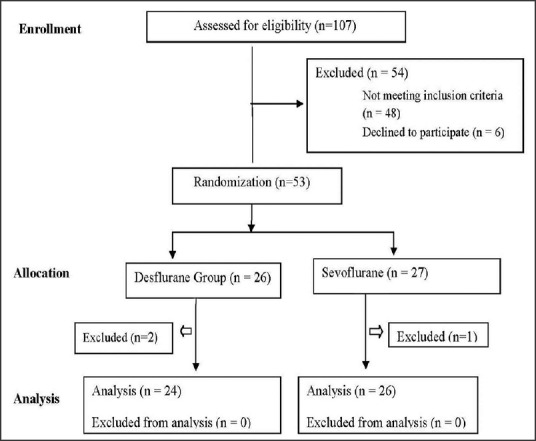
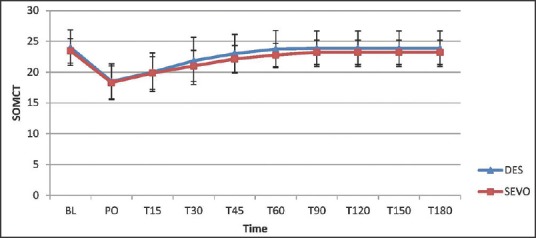
Fifty three patients between 18-60yr undergoing elective supratentorial craniotomy receiving N2O and oxygen (60%:40%) and 0.8-1.2 MAC of either desflurane or sevoflurane were randomized to group S (Sevoflurane) or group D (Desflurane). Subdural intra cranial pressure (ICP) was measured and brain condition was assessed.. Emergence time, tracheal extubation time and recovery time were recorded. Cognitive behavior was evaluated with Short Orientation Memory Concentration Test (SOMCT) and neurological outcome (at the time of discharge) was assessed using Glasgow Outcome Score (GOS) between the two groups.
The emergence time [Group D 7.4 ± 2.7 minutes vs. Group S 7.8 ± 3.7 minutes; P = 0.65], extubation time [Group D 11.8 ± 2.8 minutes vs. Group S 12.9 ± 4.9 minutes; P = 0.28] and recovery time [Group D 16.4 ± 2.6 minutes vs. Group S 17.1 ± 4.8 minutes; P = 0.50] were comparable between the two groups. There was no difference in ICP [Group D; 9.1 ± 4.3 mmHg vs. Group S; 10.9 ± 4.2 mmHg; P = 0.14] and brain condition between the two groups. Both groups had similar post-operative complications, hospital and ICU stay and GOS.
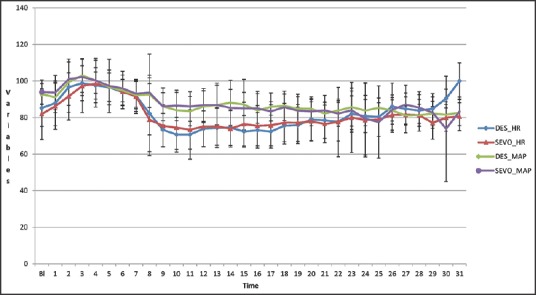
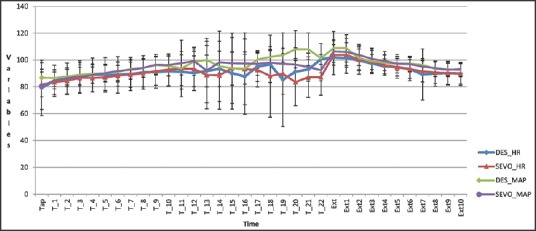
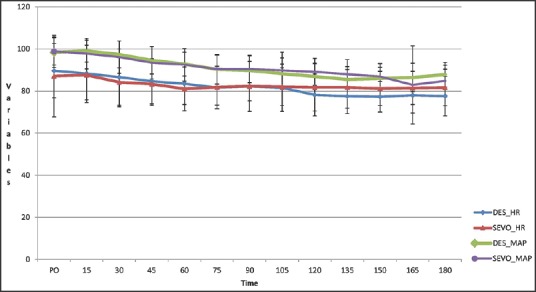
In patients undergoing elective supratentorial craniotomy both sevoflurane and desflurane had similar intra-operative brain condition, hemodynamics and post operative recovery profile.
在先前的研究中,据报道与七氟醚麻醉相比,地氟醚麻醉术后恢复更快。由于担心脑血管扩张和颅内压升高,地氟醚在神经外科手术中的使用常受到批评,并且在神经外科手术中比较地氟醚和七氟醚的研究很少。因此,我们比较了接受地氟醚或七氟醚的择期幕上开颅手术患者的术中脑状况、血流动力学和术后恢复情况。
53例年龄在18 - 60岁之间、接受择期幕上开颅手术、吸入氧化亚氮和氧气(60%:40%)以及0.8 - 1.2 MAC地氟醚或七氟醚的患者被随机分为S组(七氟醚)或D组(地氟醚)。测量硬膜下颅内压(ICP)并评估脑状况。记录苏醒时间、气管拔管时间和恢复时间。使用简短定向记忆集中测试(SOMCT)评估认知行为,并使用格拉斯哥预后评分(GOS)评估两组患者出院时的神经学结果。
两组之间的苏醒时间[D组7.4 ± 2.7分钟 vs. S组7.8 ± 3.7分钟;P = 0.65]、拔管时间[D组11.8 ± 2.8分钟 vs. S组12.9 ± 4.9分钟;P = 0.28]和恢复时间[D组16.4 ± 2.6分钟 vs. S组17.1 ± 4.8分钟;P = 0.50]具有可比性。两组之间的颅内压[D组;9.1 ± 4.3 mmHg vs. S组;10.9 ± 4.2 mmHg;P = 0.14]和脑状况无差异。两组术后并发症、住院时间和重症监护病房停留时间以及GOS相似。
在接受择期幕上开颅手术的患者中,七氟醚和地氟醚在术中脑状况、血流动力学和术后恢复情况方面相似。