Ishiyama Hiromichi, Satoh Takefumi, Sekiguchi Akane, Tabata Ken-Ichi, Komori Shouko, Tsumura Hideyasu, Kawakami Shogo, Soda Itaru, Takenaka Kouji, Iwamura Masatsugu, Hayakawa Kazushige
Department of Radiology and Radiation Oncology.
Department of Urology, Kitasato University School of Medicine, Kitasato, Sagamihara, Japan.
J Contemp Brachytherapy. 2015 Feb;7(1):3-9. doi: 10.5114/jcb.2015.48603. Epub 2015 Jan 26.
Three different techniques of low-dose-rate seed implantation for prostate cancer have been used since its use started in our hospital. The purpose of this study was to compare the results of the three different techniques.
The data of 305 prostate cancer patients who underwent low-dose-rate seed implantation were retrospectively analyzed. Pre-plan technique (n = 27), intraoperative pre-plan technique (n = 86), and interactive plan technique (n = 192) were tried in chronological order. The prescribed dose was set at 145 Gy.
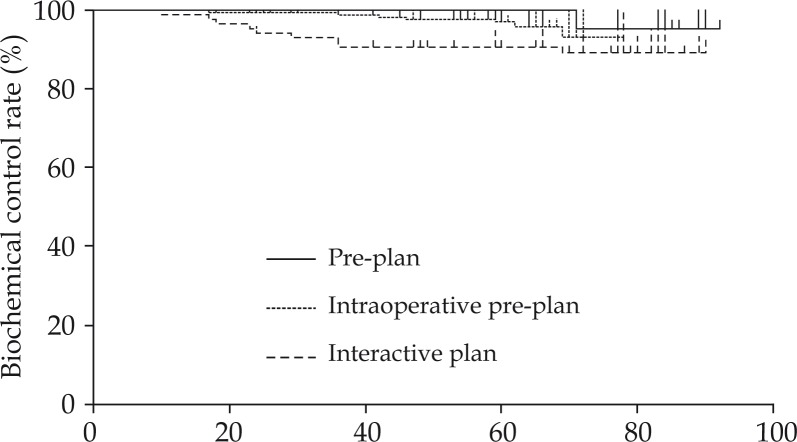
Median follow-up was 66 months (range: 12-94 months). The 5-year biochemical control rate was 95.5% (pre-plan group: 100%, intraoperative pre-plan group: 90.7%, interactive plan group: 97.0%; p = 0.08). Dosimetric parameters were generally increased from the pre-plan group to the interactive group. The differences in some dosimetric parameters between the planning phase and the CT analysis were significantly reduced with the interactive plan compared to the other techniques. The interactive plan showed a significant reduction of the seed migration rate compared to the two other groups. Acute genitourinary toxicity, acute gastrointestinal toxicity, frequency, and urinary retention increased gradually from the pre-plan period to the interactive plan period.
There was no significant difference in biochemical control among the three groups. Dose-volume parameters were increased from the pre-plan technique to the interactive plan technique. However, this may not necessarily be due to technical improvements, since dose escalation was started during the same period. Lower seed migration rates and the smaller differences between the planning phase and CT analysis with the interactive plan technique suggest the superiority of this technique to the two other techniques.
自我院开始应用低剂量率粒子植入治疗前列腺癌以来,已采用三种不同技术。本研究旨在比较这三种不同技术的治疗效果。
回顾性分析305例行低剂量率粒子植入治疗的前列腺癌患者的数据。按时间顺序依次尝试了预计划技术(n = 27)、术中预计划技术(n = 86)和交互式计划技术(n = 192)。规定剂量设定为145 Gy。
中位随访时间为66个月(范围:12 - 94个月)。5年生化控制率为95.5%(预计划组:100%,术中预计划组:90.7%,交互式计划组:97.0%;p = 0.08)。剂量学参数一般从预计划组到交互式计划组呈增加趋势。与其他技术相比,交互式计划在计划阶段和CT分析之间某些剂量学参数的差异显著减小。与其他两组相比,交互式计划显示粒子迁移率显著降低。急性泌尿生殖系统毒性、急性胃肠道毒性、尿频和尿潴留从预计划阶段到交互式计划阶段逐渐增加。
三组之间生化控制无显著差异。剂量体积参数从预计划技术到交互式计划技术呈增加趋势。然而,这不一定是由于技术改进,因为同期开始了剂量递增。较低的粒子迁移率以及交互式计划技术在计划阶段和CT分析之间较小的差异表明该技术优于其他两种技术。