Tanrıverdi Hakan, Tor Müge Meltem, Kart Levent, Altın Remzi, Atalay Figen, SumbSümbüloğlu Vildan
Department of Chest Diseases, Bülent Ecevit University, Faculty of Medicine, Zonguldak, Turkey.
Department of Chest Diseases, Fatih University, Faculty of Medicine, İstanbul, Turkey.
Ann Thorac Med. 2015 Apr-Jun;10(2):137-42. doi: 10.4103/1817-1737.151442.
Ventilator-associated pneumonia (VAP) is an important cause of mortality and morbidity in critically ill patients. We sought to determine the prognostic value of procalcitonin (PCT) and C-reactive protein (CRP) kinetics in critically ill patients who developed VAP.
Patients who were admitted to the intensive care unit (ICU) and developed VAP were eligible. Patients were followed for 28 days after the pneumonia diagnosis and blood samples for PCT and CRP were collected on the day of the pneumonia diagnosis (D0), and days 3 (D3) and 7 (D7) after the diagnosis. Patients were grouped as survivors and non-survivors, and the mean PCT and CRP values and their kinetics were assessed.
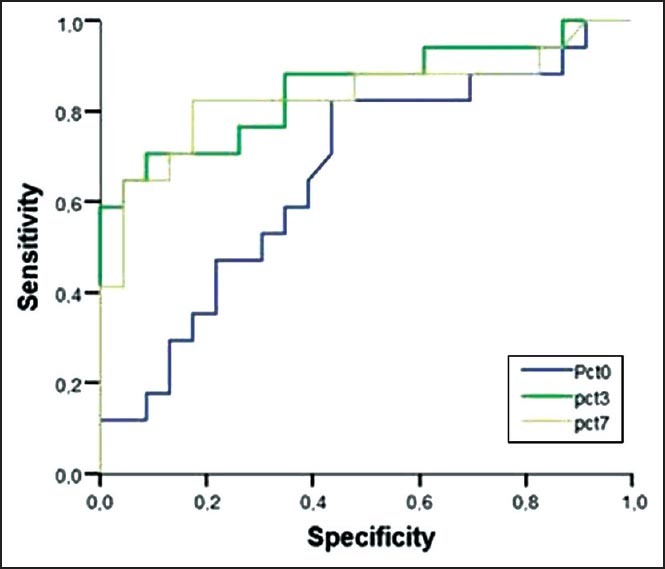
In total, 45 patients were enrolled. Of them, 22 (48.8%) died before day 28 after the pneumonia diagnosis. There was no significant difference between the survivor and non-survivor groups in terms of PCT on the day of pneumonia diagnosis or CRP levels at any point. However, the PCT levels days 3 and 7 were significantly higher in the non-survivor group than the survivor group. Whereas PCT levels decreased significantly from D0 to D7 in the survivor group, CRP did not. A PCT level above 1 ng/mL on day 3 was the strongest predictor of mortality, with an odds ratio of 22.6.
Serum PCT was found to be a superior prognostic marker compared to CRP in terms of predicting mortality in critically ill patients who developed VAP. The PCT level on D3 was the strongest predictor of mortality in VAP.
呼吸机相关性肺炎(VAP)是危重症患者死亡和发病的重要原因。我们试图确定降钙素原(PCT)和C反应蛋白(CRP)动力学在发生VAP的危重症患者中的预后价值。
纳入入住重症监护病房(ICU)并发生VAP的患者。在肺炎诊断后对患者进行28天随访,并在肺炎诊断当天(D0)、诊断后第3天(D3)和第7天(D7)采集PCT和CRP血样。将患者分为存活组和非存活组,评估PCT和CRP的平均水平及其动力学。
共纳入45例患者。其中,22例(48.8%)在肺炎诊断后28天内死亡。在肺炎诊断当天的PCT或任何时间点的CRP水平方面,存活组和非存活组之间无显著差异。然而,非存活组第3天和第7天的PCT水平显著高于存活组。存活组PCT水平从D0到D7显著下降,而CRP则没有。第3天PCT水平高于1 ng/mL是最强的死亡预测指标,比值比为22.6。
在预测发生VAP的危重症患者的死亡率方面,血清PCT被发现是比CRP更好的预后标志物。VAP中第3天的PCT水平是最强的死亡预测指标。