Cheifetz Oren, Dorsay Jan Park, MacDermid Joy C
Hematology/Oncology Program, Hamilton Health Sciences, Hamilton, Ontario, Canada ; School of Rehabilitation Sciences, McMaster University, Hamilton, Ontario, Canada.
Oncology Rehabilitation Program, Hamilton Health Sciences, Hamilton, Ontario, Canada.
J Exerc Rehabil. 2015 Feb 28;11(1):20-9. doi: 10.12965/jer.150183. eCollection 2015 Feb.
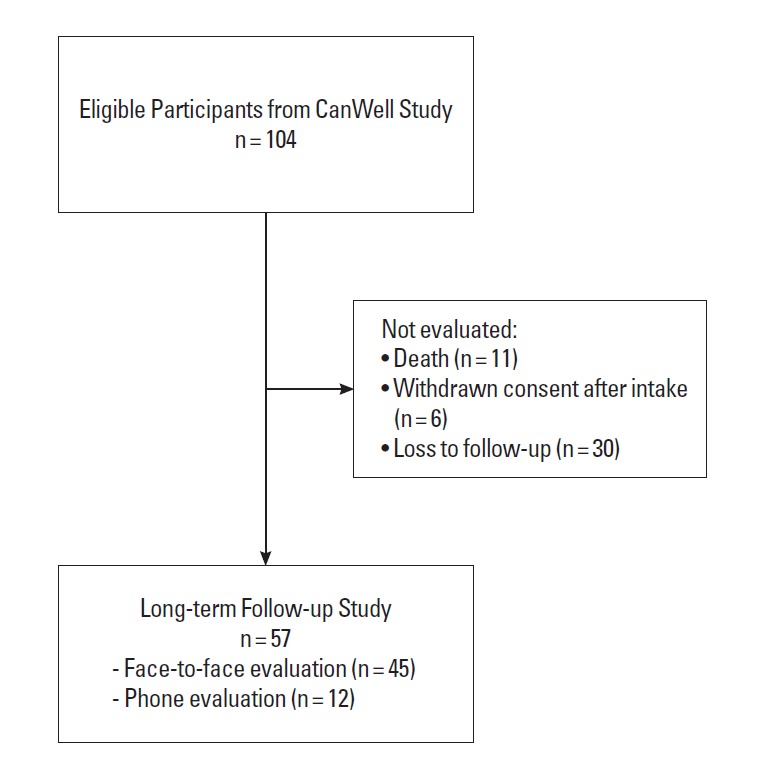
Cancer survivors participating in supervised exercise programs learn to exercise safely with oversight from care providers who monitor and facilitate their progress. This study investigated the long-term exercise participation levels and identified exercise barriers for graduates from a specialized cancer exercise and education program. Subjects were graduates from a 12-week supervised exercise program (www.canwellprogram.ca) who participated in a, prospective, long-term evaluation. Measures included: six-minute walk test (6-MWT), STEEP treadmill test, Functional Assessment Cancer Therapy-General (FACT-G), Edmonton Symptom Assessment System (ESAS), Godin Leisure-Time Exercise Questionnaire, and exercise barriers survey. Analysis was performed using the paired t -test. Fifty-seven (55% of eligible cohort) CanWell participants (mean age= 60; 74% females) were included in this study. Post program changes included statistically significant reductions in total min on the treadmill and a trend towards improvements in 6-MWT distance. No significant changes were recorded in total FACT-G or ESAS score, however functional well-being approached statistical significant improvements. The most commonly reported exercise barriers included fatigue, cost, and return to work. While most participants (86%) believed they were able to exercise, only 63% reported being able to progress their exercise. These finding demonstrated that although CanWell graduates have substantial support from exercise specialists and most have early success with exercise, environment-related factors diminish long-term independent adherence to exercise. Providing cancer survivors with the skills needed to monitor and progress their exercise routines, or access to "tune-ups" may increase exercise adherence and maximize benefits.
参加有监督的运动计划的癌症幸存者在护理人员的监督下学习安全地进行运动,护理人员会监测并促进他们的进展。本研究调查了长期运动参与水平,并确定了一个专门的癌症运动与教育计划毕业生的运动障碍。研究对象是一个为期12周的有监督运动计划(www.canwellprogram.ca)的毕业生,他们参与了一项前瞻性的长期评估。测量指标包括:六分钟步行测试(6-MWT)、STEEP跑步机测试、癌症治疗功能评估通用版(FACT-G)、埃德蒙顿症状评估系统(ESAS)、戈丁休闲时间运动问卷以及运动障碍调查。采用配对t检验进行分析。本研究纳入了57名(占符合条件队列的55%)CanWell参与者(平均年龄 = 60岁;74%为女性)。项目结束后的变化包括跑步机上总分钟数有统计学意义的减少,以及6-MWT距离有改善的趋势。FACT-G总分或ESAS评分没有显著变化,然而功能幸福感接近统计学意义上的改善。最常报告的运动障碍包括疲劳、费用和重返工作岗位。虽然大多数参与者(86%)认为他们能够运动,但只有63%的人报告能够增加运动量。这些发现表明,尽管CanWell毕业生得到了运动专家的大力支持,且大多数人在运动方面早期取得了成功,但与环境相关的因素会降低长期独立坚持运动的程度。为癌症幸存者提供监测和增加运动量所需的技能,或提供“调整”服务,可能会提高运动依从性并使益处最大化。