Wildevuur Sabine E, Simonse Lianne W L
Talma Institute, Social Sciences, VU University Amsterdam, Amsterdam, Netherlands.
J Med Internet Res. 2015 Mar 27;17(3):e77. doi: 10.2196/jmir.3687.
Person-centered information and communication technology (ICT) could encourage patients to take an active part in their health care and decision-making process, and make it possible for patients to interact directly with health care providers and services about their personal health concerns. Yet, little is known about which ICT interventions dedicated to person-centered care (PCC) and connected-care interactions have been studied, especially for shared care management of chronic diseases. The aim of this research is to investigate the extent, range, and nature of these research activities and identify research gaps in the evidence base of health studies regarding the "big 5" chronic diseases: diabetes mellitus, cardiovascular disease, chronic respiratory disease, cancer, and stroke.
The objective of this paper was to review the literature and to scope the field with respect to 2 questions: (1) which ICT interventions have been used to support patients and health care professionals in PCC management of the big 5 chronic diseases? and (2) what is the impact of these interventions, such as on health-related quality of life and cost efficiency?
This research adopted a scoping review method. Three electronic medical databases were accessed: PubMed, EMBASE, and Cochrane Library. The research reviewed studies published between January 1989 and December 2013. In 5 stages of systematic scanning and reviewing, relevant studies were identified, selected, and charted. Then we collated, summarized, and reported the results.
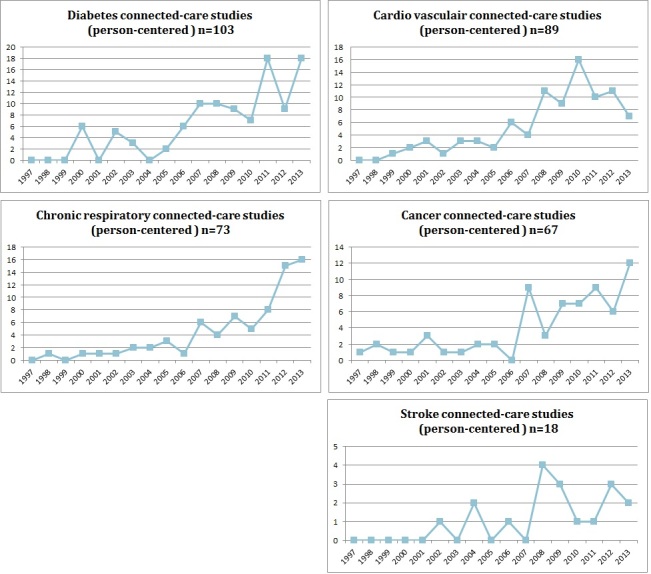
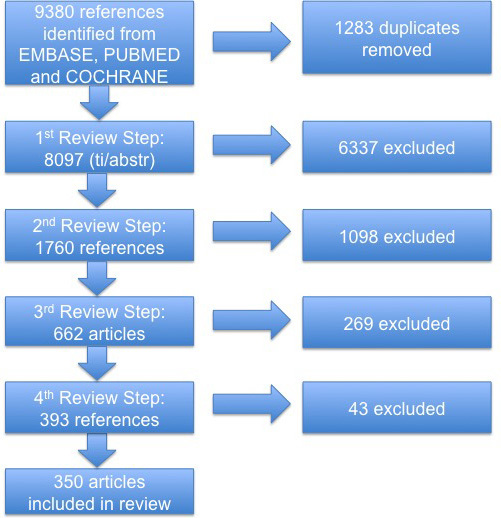
From the initial 9380 search results, we identified 350 studies that qualified for inclusion: diabetes mellitus (n=103), cardiovascular disease (n=89), chronic respiratory disease (n=73), cancer (n=67), and stroke (n=18). Persons with one of these chronic conditions used ICT primarily for self-measurement of the body, when interacting with health care providers, with the highest rates of use seen in chronic respiratory (63%, 46/73) and cardiovascular (53%, 47/89) diseases. We found 60 relevant studies (17.1%, 60/350) on person-centered shared management ICT, primarily using telemedicine systems as personalized ICT. The highest impact measured related to the increase in empowerment (15.4%, 54/350). Health-related quality of life accounted for 8%. The highest impact connected to health professionals was an increase in clinical outcome (11.7%, 41/350). The impacts on organization outcomes were decrease in hospitalization (12.3%, 43/350) and increase of cost efficiency (10.9%, 38/350).
This scoping review outlined ICT-enabled PCC in chronic disease management. Persons with a chronic disease could benefit from an ICT-enabled PCC approach, but ICT-PCC also yields organizational paybacks. It could lead to an increase in health care usage, as reported in some studies. Few interventions could be regarded as "fully" addressing PCC. This review will be especially helpful to those deciding on areas where further development of research or implementation of ICT-enabled PCC may be warranted.
以患者为中心的信息通信技术(ICT)能够鼓励患者积极参与自身医疗保健及决策过程,并使患者能够就个人健康问题直接与医疗保健提供者及服务进行互动。然而,对于哪些专门用于以患者为中心的护理(PCC)及互联护理互动的ICT干预措施已得到研究,尤其是针对慢性病的共享护理管理,人们所知甚少。本研究的目的是调查这些研究活动的范围、广度及性质,并找出健康研究证据基础中关于“五大”慢性病(糖尿病、心血管疾病、慢性呼吸道疾病、癌症和中风)的研究空白。
本文的目的是回顾文献并围绕两个问题界定该领域:(1)哪些ICT干预措施已被用于支持患者及医疗保健专业人员对“五大”慢性病进行PCC管理?(2)这些干预措施有何影响,例如对健康相关生活质量和成本效益的影响?
本研究采用了范围综述方法。检索了三个电子医学数据库:PubMed、EMBASE和Cochrane图书馆。该研究回顾了1989年1月至2013年12月期间发表的研究。在系统检索和回顾的五个阶段中,识别、选择并绘制了相关研究。然后我们整理、总结并报告了结果。
从最初的9380条搜索结果中,我们确定了350项符合纳入标准的研究:糖尿病(n = 103)、心血管疾病(n = 89)、慢性呼吸道疾病(n = 73)、癌症(n = 67)和中风(n = 18)。患有这些慢性病之一的患者在与医疗保健提供者互动时,主要将ICT用于身体自我测量,其中慢性呼吸道疾病(63%,46/73)和心血管疾病(53%,47/89)的使用率最高。我们发现了60项关于以患者为中心的共享管理ICT的相关研究(17.1%,60/350),主要使用远程医疗系统作为个性化ICT。所测量到的最高影响与赋权增加有关(15.4%,54/350)。健康相关生活质量占8%。与医疗专业人员相关的最高影响是临床结果改善(11.7%,41/350)。对组织结果的影响是住院率降低(12.3%,43/350)和成本效益提高(10.9%,38/350)。
本范围综述概述了慢性病管理中基于ICT的PCC。患有慢性病的患者可以从基于ICT的PCC方法中受益,但ICT - PCC也能带来组织回报。正如一些研究报告的那样,它可能导致医疗保健利用率增加。很少有干预措施可被视为“全面”解决了PCC问题。本综述对于那些决定在哪些领域可能需要进一步开展基于ICT的PCC研究或实施的人将特别有帮助。