You D-Y, Wu Z-Y, Wan J-X, Cui J, Zou Z-H
Department of Nephrology, The First Affiliated Hospital of Fujian Medical University, Fuzhou, 350005, China.
J Endocrinol Invest. 2015 Aug;38(8):901-8. doi: 10.1007/s40618-015-0272-0. Epub 2015 Apr 2.
To investigate the prevalence of obesity in young adults and to analyze the influencing factors on renal functions and proteinuria in this population.
This study comprised civil servants between 20 and 39 years old, who received physical examinations at the First Affiliated Hospital of Fujian Medical University. The subjects were categorized into four groups based on age (20-24, 25-29, 30-34 and 35-39 years) and the number of risk factors they had (hypertension, dyslipidemia, hyperglycemia and hyperuricemia). The relationships between obesity and the prevalence of proteinuria, between obesity and risk factors and between estimated glomerular filtration rate (eGFR) and proteinuria were analyzed.
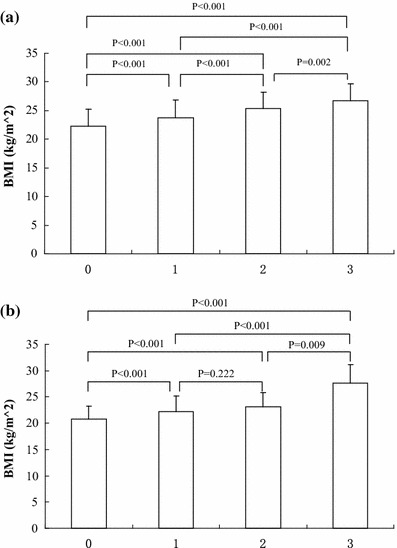
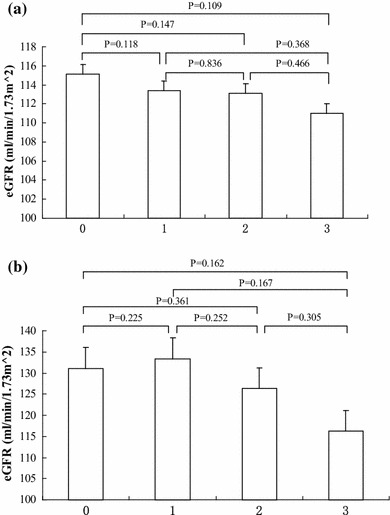
Among the 2293 young civil servants, in men the prevalence of obesity was 33.3 % and proteinuria was 2.5 %. However in women the prevalence of obesity and proteinuria was 7.5 % and 1.7 %, respectively. The levels of blood pressure, serum uric acid (UA), cholesterol (TC), triglyceride (TG), fasting glucose (FBG) and low-density lipoprotein cholesterol (LDL-C) were lower and the level of serum high-density lipoprotein cholesterol (HDL-C) was higher in nonobese groups compared with obese groups. There were no significant differences in eGFR between the two groups. The eGFR in male subjects was associated with age, UA, body mass index (BMI), FBG, TC, TG, LDL and HDL, and in female subjects associated with UA, age, BMI, diastolic blood pressure, FBG and LDL. BMI in both males and females increased with the higher number of risk factors. Multiple regression analysis revealed that hypertension, dyslipidemia, hyperglycemia and hyperuricemia were independently associated with obesity. eGFR decreased with a higher number of risk factors. Obesity, blood pressure, dyslipidemia, hyperglycemia and hyperuricemia were independently associated with proteinuria.
Obesity can pose an independent risk factor for proteinuria in young adults. Hypertension, dyslipidemia, hyperglycemia and hyperuricemia were independently associated with obesity. eGFR decreased with a higher number of risk factors.
调查年轻成年人肥胖的患病率,并分析该人群中影响肾功能和蛋白尿的因素。
本研究纳入了年龄在20至39岁之间、在福建医科大学附属第一医院接受体检的公务员。根据年龄(20 - 24岁、25 - 29岁、30 - 34岁和35 - 39岁)以及他们所具有的危险因素(高血压、血脂异常、高血糖和高尿酸血症)的数量,将受试者分为四组。分析肥胖与蛋白尿患病率之间的关系、肥胖与危险因素之间的关系以及估计肾小球滤过率(eGFR)与蛋白尿之间的关系。
在2293名年轻公务员中,男性肥胖患病率为33.3%,蛋白尿患病率为2.5%。然而,女性肥胖和蛋白尿患病率分别为7.5%和1.7%。与肥胖组相比,非肥胖组的血压、血清尿酸(UA)、胆固醇(TC)、甘油三酯(TG)、空腹血糖(FBG)和低密度脂蛋白胆固醇(LDL - C)水平较低,而血清高密度脂蛋白胆固醇(HDL - C)水平较高。两组之间的eGFR无显著差异。男性受试者的eGFR与年龄、UA、体重指数(BMI)、FBG、TC、TG、LDL和HDL相关,女性受试者的eGFR与UA、年龄、BMI、舒张压、FBG和LDL相关。男性和女性的BMI均随着危险因素数量的增加而升高。多元回归分析显示,高血压、血脂异常、高血糖和高尿酸血症与肥胖独立相关。eGFR随着危险因素数量的增加而降低。肥胖、血压、血脂异常、高血糖和高尿酸血症与蛋白尿独立相关。
肥胖可能是年轻成年人蛋白尿的独立危险因素。高血压、血脂异常、高血糖和高尿酸血症与肥胖独立相关。eGFR随着危险因素数量的增加而降低。