Boston Children's Hospital, Harvard Medical School, 300 Longwood Avenue, Boston, MA 02115, United States.
First Affiliated Hospital, Xinjiang Medical University, Urumqi, Xinjiang 830054, China.
FEBS Open Bio. 2015 Mar 7;5:182-90. doi: 10.1016/j.fob.2015.03.001. eCollection 2015.
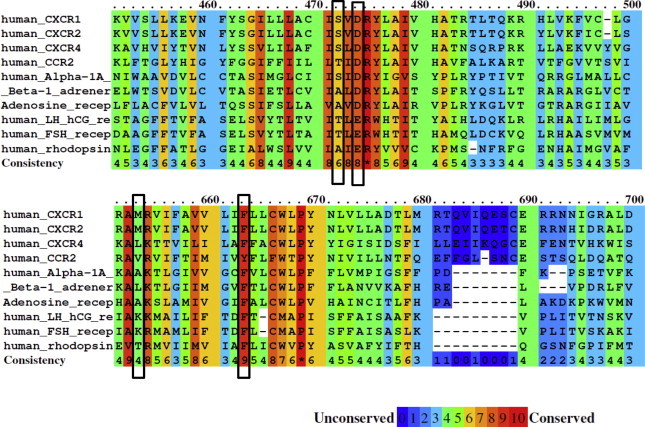
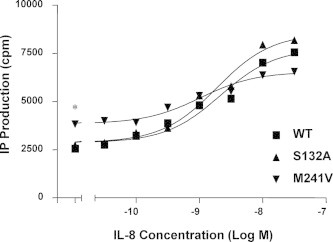
CXCR1, a receptor for interleukin-8 (IL-8), plays an important role in defending against pathogen invasion during neutrophil-mediated innate immune response. Human CXCR1 is a G protein-coupled receptor (GPCR) with its characteristic seven transmembrane domains (TMs). Functional and structural analyses of several GPCRs have revealed that conserved residues on TM3 (including the highly conserved Asp-Arg-Tyr (DRY) motif) and TM6 near intracellular loops contain domains critical for G protein coupling as well as GPCR activation. The objective of this study was to elucidate the role of critical amino acid residues on TM3 near intracellular loop 2 (i2) and TM6 near intracellular loop 3 (i3), including S132(3.47) (Baldwin location), D134(3.49), M241(6.34), and F251(6.44), in G protein coupling and CXCR1 activation. The results demonstrate that mutations of D134(3.49) at DRY motif of CXCR1 (D134N and D134V) completely abolished the ligand binding and functional response of the receptor. Additionally, point mutations at positions 241 and 251 between TM6 and i3 loop generated mutant receptors with modest constitutive activity via Gα15 signaling activation. Our results show that D134(3.49) on the highly conserved DRY motif has a distinct role for CXCR1 compared to its homologues (CXCR2 and KSHV-GPCR) in G protein coupling and receptor activation. In addition, M241(6.34) and F251(6.44) along with our previously identified V247(6.40) on TM6 are spatially located in a "hot spot" likely essential for CXCR1 activation. Identification of these amino acid residues may be useful for elucidating mechanism of CXCR1 activation and designing specific antagonists for the treatment of CXCR1-mediated diseases.
趋化因子受体 1(CXCR1)是白细胞介素 8(IL-8)的受体,在中性粒细胞介导的固有免疫反应中抵抗病原体入侵方面发挥着重要作用。人 CXCR1 是一种 G 蛋白偶联受体(GPCR),具有其特征性的七个跨膜结构域(TM)。对几种 GPCR 的功能和结构分析表明,TM3 上的保守残基(包括高度保守的天冬氨酸-精氨酸-酪氨酸(DRY)基序)和 TM6 附近的细胞内环包含对 G 蛋白偶联和 GPCR 激活至关重要的结构域。本研究的目的是阐明 TM3 上细胞内环 2(i2)附近和 TM6 上细胞内环 3(i3)附近的关键氨基酸残基(包括位置 132(3.47)的 S132(Baldwin 位置)、D134(3.49)、M241(6.34)和 F251(6.44))在 G 蛋白偶联和 CXCR1 激活中的作用。结果表明,CXCR1 的 DRY 基序中 D134(3.49)的突变(D134N 和 D134V)完全消除了配体结合和受体的功能反应。此外,TM6 和 i3 环之间位置 241 和 251 的点突变产生了具有通过 Gα15 信号激活产生适度组成型活性的突变受体。我们的结果表明,DRY 基序上高度保守的 D134(3.49)在 G 蛋白偶联和受体激活方面与 CXCR1 的同源物(CXCR2 和 KSHV-GPCR)相比具有独特的作用。此外,M241(6.34)和 F251(6.44)以及我们之前在 TM6 上确定的 V247(6.40)在空间上位于“热点”,可能对 CXCR1 的激活至关重要。鉴定这些氨基酸残基可能有助于阐明 CXCR1 激活的机制,并设计用于治疗 CXCR1 介导的疾病的特异性拮抗剂。