Bailey Rachael, Priego Moreno Sara, Gambus Agnieszka
a School of Cancer Sciences; University of Birmingham ; Birmingham , UK.
Nucleus. 2015;6(3):187-96. doi: 10.1080/19491034.2015.1035843. Epub 2015 Apr 2.
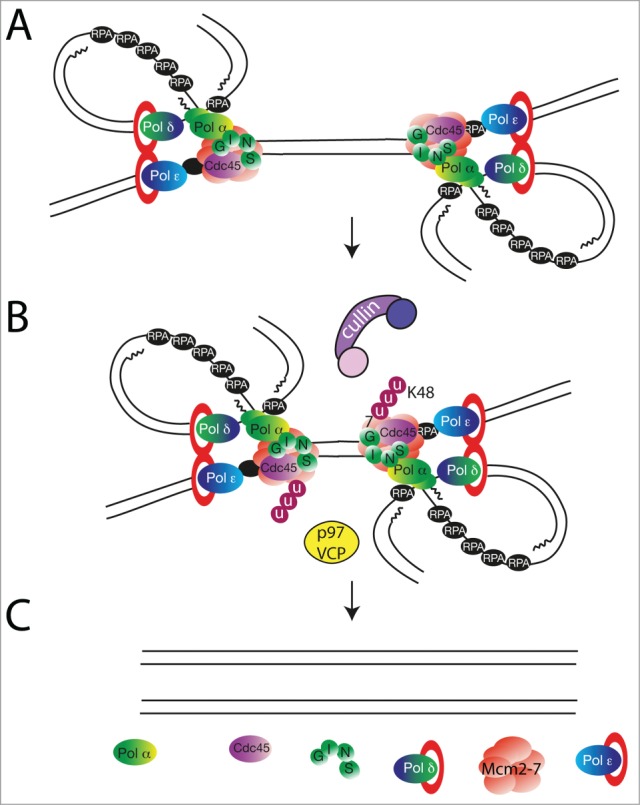
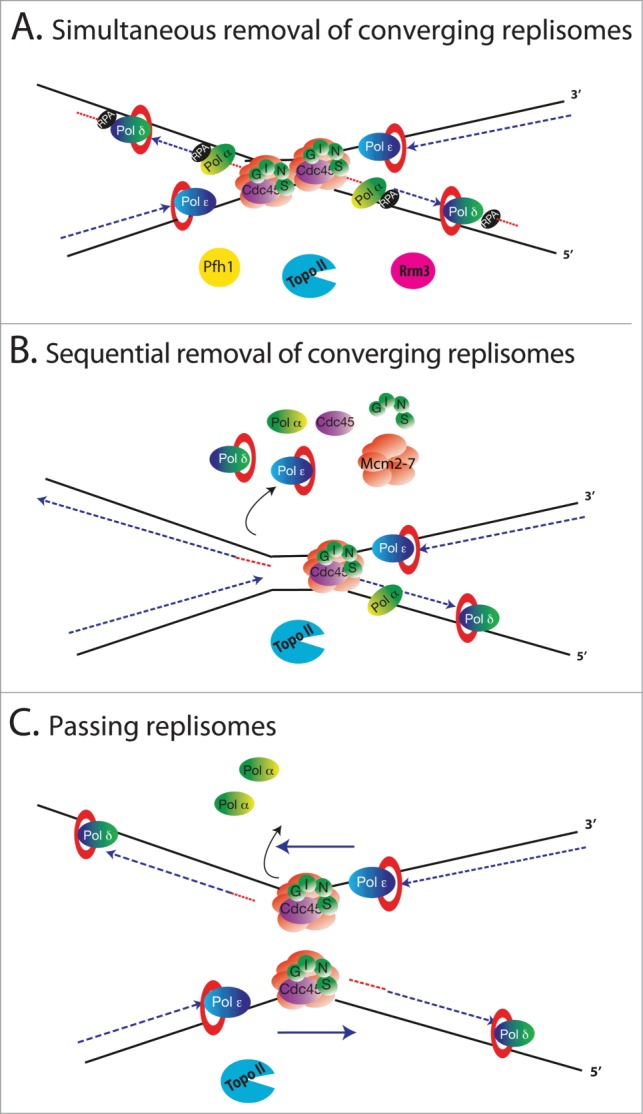
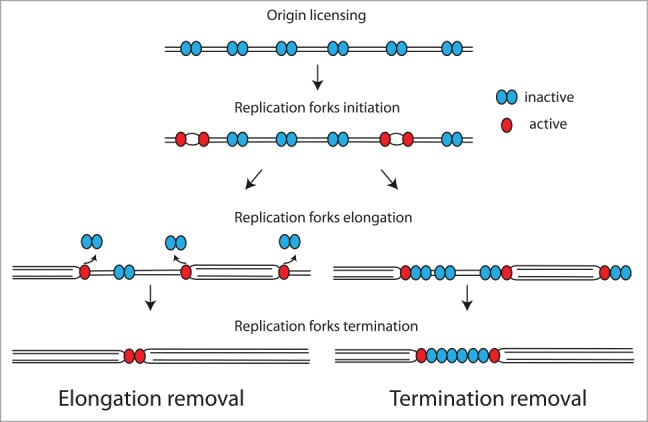
To ensure duplication of the entire genome, eukaryotic DNA replication initiates from thousands of replication origins. The replication forks move through the chromatin until they encounter forks from neighboring origins. During replication fork termination forks converge, the replisomes disassemble and topoisomerase II resolves the daughter DNA molecules. If not resolved efficiently, terminating forks result in genomic instability through the formation of pathogenic structures. Our recent findings shed light onto the mechanism of replisome disassembly upon replication fork termination. We have shown that termination-specific polyubiquitylation of the replicative helicase component - Mcm7, leads to dissolution of the active helicase in a process dependent on the p97/VCP/Cdc48 segregase. The inhibition of terminating helicase disassembly resulted in a replication termination defect. In this extended view we present hypothetical models of replication fork termination and discuss remaining and emerging questions in the DNA replication termination field.
为确保整个基因组的复制,真核生物的DNA复制从数千个复制起点起始。复制叉穿过染色质,直到遇到来自相邻起点的复制叉。在复制叉终止时,复制叉会合,复制体解体,拓扑异构酶II解开子代DNA分子。如果不能有效解决,终止的复制叉会通过形成致病结构导致基因组不稳定。我们最近的研究结果揭示了复制叉终止时复制体解体的机制。我们已经表明,复制性解旋酶组分Mcm7的终止特异性多聚泛素化,导致活性解旋酶在依赖于p97/VCP/Cdc48分离酶的过程中溶解。终止解旋酶解体的抑制导致复制终止缺陷。在这个扩展观点中,我们提出了复制叉终止的假设模型,并讨论了DNA复制终止领域中仍然存在和新出现的问题。