Ryan Jennifer M, Hensey Owen, McLoughlin Brenda, Lyons Alan, Gormley John
School of Medicine, Trinity College Dublin, Ireland; Institute of Environment, Health and Societies, Brunel University London, United Kingdom.
Central Remedial Clinic, Dublin, Ireland.
PLoS One. 2015 Apr 2;10(4):e0123267. doi: 10.1371/journal.pone.0123267. eCollection 2015.
Children with cerebral palsy (CP) have poor cardiorespiratory fitness in comparison to their peers with typical development, which may be due to low levels of physical activity. Poor cardiorespiratory fitness may contribute to increased cardiometabolic risk.
The aim of this study was to determine the association between sedentary behaviour, physical activity and cardiorespiratory fitness in children with CP. An objective was to determine the association between cardiorespiratory fitness, anthropometric measures and blood pressure in children with CP.
This study included 55 ambulatory children with CP [mean (SD) age 11.3 (0.2) yr, range 6-17 yr; Gross Motor Function Classification System (GMFCS) levels I and II]. Anthropometric measures (BMI, waist circumference and waist-height ratio) and blood pressure were taken. Cardiorespiratory fitness was measured using a 10 m shuttle run test. Children were classified as low, middle and high fitness according to level achieved on the test using reference curves. Physical activity was measured by accelerometry over 7 days. In addition to total activity, time in sedentary behaviour and light, moderate, vigorous, and sustained moderate-to-vigorous activity (≥10 min bouts) were calculated.
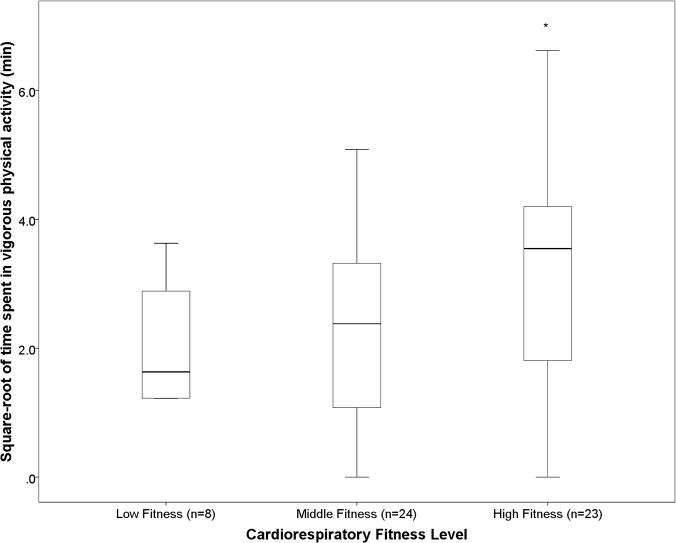
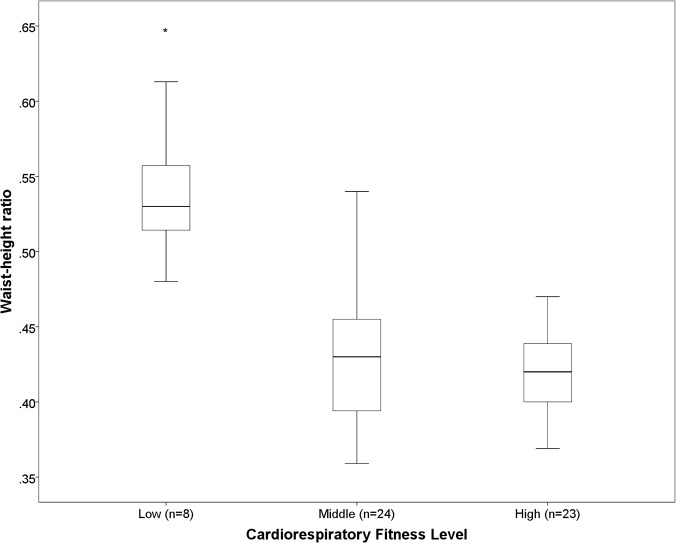
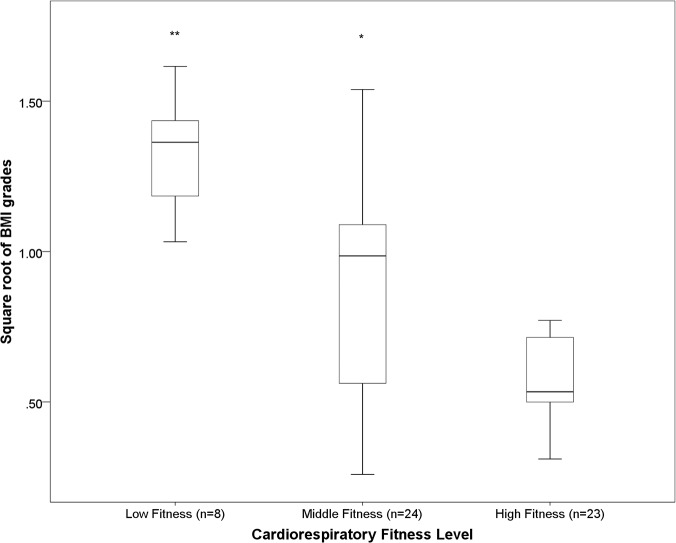
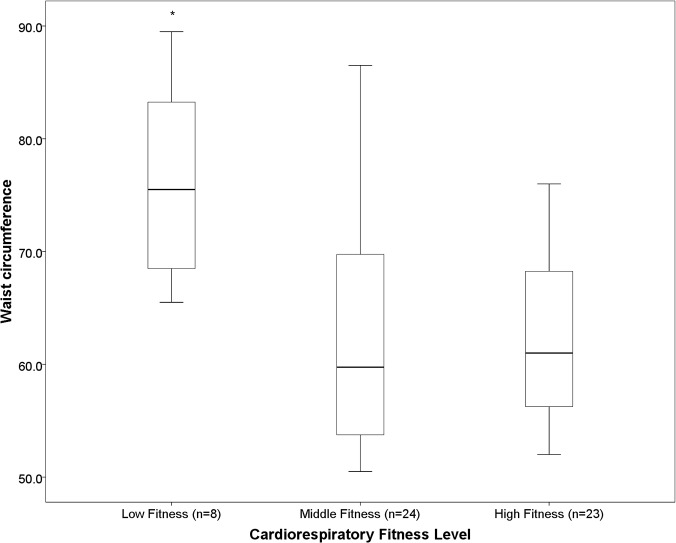
Multiple regression analyses revealed that vigorous activity (β = 0.339, p<0.01), sustained moderate-to-vigorous activity (β = 0.250, p<0.05) and total activity (β = 0.238, p<0.05) were associated with level achieved on the shuttle run test after adjustment for age, sex and GMFCS level. Children with high fitness spent more time in vigorous activity than children with middle fitness (p<0.05). Shuttle run test level was negatively associated with BMI (r2 = -0.451, p<0.01), waist circumference (r2 = -0.560, p<0.001), waist-height ratio (r2 = -0.560, p<0.001) and systolic blood pressure (r2 = -0.306, p<0.05) after adjustment for age, sex and GMFCS level.
Participation in physical activity, particularly at a vigorous intensity, is associated with high cardiorespiratory fitness in children with CP. Low cardiorespiratory fitness is associated with increased cardiometabolic risk.
与发育正常的同龄人相比,脑瘫(CP)患儿的心肺适能较差,这可能是由于身体活动水平较低所致。心肺适能差可能会增加心血管代谢风险。
本研究旨在确定脑瘫患儿久坐行为、身体活动与心肺适能之间的关联。另一个目的是确定脑瘫患儿心肺适能、人体测量指标与血压之间的关联。
本研究纳入了55名能行走的脑瘫患儿[平均(标准差)年龄11.3(0.2)岁,范围6 - 17岁;粗大运动功能分类系统(GMFCS)I级和II级]。测量了人体测量指标(体重指数、腰围和腰高比)和血压。采用10米往返跑测试来测量心肺适能。根据测试成绩使用参考曲线将患儿分为低、中、高适能组。通过加速度计测量7天的身体活动情况。除了总活动量外,还计算了久坐行为时间以及轻度、中度、剧烈和持续中度至剧烈活动(≥10分钟时段)的时间。
多元回归分析显示,在对年龄、性别和GMFCS水平进行调整后,剧烈活动(β = 0.339,p<0.01)、持续中度至剧烈活动(β = 0.250,p<0.05)和总活动量(β = 0.238,p<0.05)与往返跑测试成绩相关。高适能组患儿的剧烈活动时间比中适能组患儿更长(p<0.05)。在对年龄、性别和GMFCS水平进行调整后,往返跑测试成绩与体重指数(r2 = -0.451,p<0.01)、腰围(r2 = -0.560,p<0.001)、腰高比(r2 = -0.560,p<0.001)和收缩压(r2 = -0.306,p<0.05)呈负相关。
参与身体活动,尤其是高强度的身体活动,与脑瘫患儿的高心肺适能相关。心肺适能低与心血管代谢风险增加有关。