Tousignant Michel, Moffet Hélène, Nadeau Sylvie, Mérette Chantal, Boissy Patrick, Corriveau Hélène, Marquis François, Cabana François, Ranger Pierre, Belzile Étienne L, Dimentberg Ronald
Research Centre on Aging, University Institute of Geriatrics of Sherbrooke, Sherbrooke, QC, Canada.
J Med Internet Res. 2015 Mar 31;17(3):e83. doi: 10.2196/jmir.3844.
Rehabilitation provided through home visits is part of the continuum of care after discharge from hospital following total knee arthroplasty (TKA). As demands for rehabilitation at home are growing and becoming more difficult to meet, in-home telerehabilitation has been proposed as an alternate service delivery method. However, there is a need for robust data concerning both the effectiveness and the cost of dispensing in-home telerehabilitation.
The objective of this study was to document, analyze, and compare real costs of two service delivery methods: in-home telerehabilitation and conventional home visits.
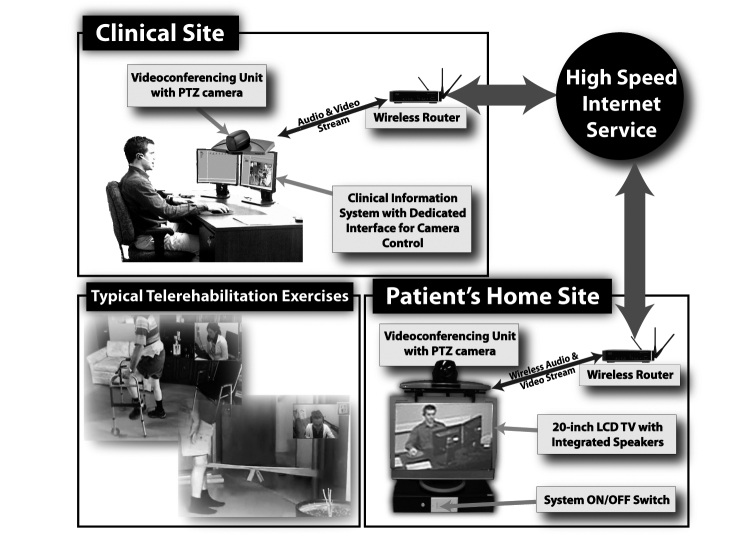
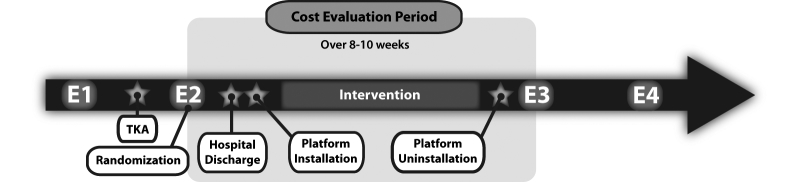
The economic analysis was conducted as part of a multicenter randomized controlled trial (RCT) on telerehabilitation for TKA, and involved data from 197 patients, post-TKA. Twice a week for 8 weeks, participants received supervised physiotherapy via two delivery methods, depending on their study group allocation: in-home telerehabilitation (TELE) and home-visit rehabilitation (VISIT). Patients were recruited from eight hospitals in the province of Quebec, Canada. The TELE group intervention was delivered by videoconferencing over high-speed Internet. The VISIT group received the same intervention at home. Costs related to the delivery of the two services (TELE and VISIT) were calculated. Student's t tests were used to compare costs per treatment between the two groups. To take distance into account, the two treatment groups were compared within distance strata using two-way analyses of variance (ANOVAs).
The mean cost of a single session was Can $93.08 for the VISIT group (SD $35.70) and $80.99 for the TELE group (SD $26.60). When comparing both groups, real total cost analysis showed a cost differential in favor of the TELE group (TELE minus VISIT: -$263, 95% CI -$382 to -$143). However, when the patient's home was located less than 30 km round-trip from the health care center, the difference in costs between TELE and VISIT treatments was not significant (P=.25, .26, and .11 for the <10, 10-19, and 20-29 km strata, respectively). The cost of TELE treatments was lower than VISIT treatments when the distance was 30 km or more (30-49 km: $81<$103, P=.002; ≥50 km: $90<$152, P<.001).
To our knowledge, this is the first study of the actual costs of in-home telerehabilitation covering all subcosts of telerehabilitation and distance between the health care center and the patient's home. The cost for a single session of in-home telerehabilitation compared to conventional home-visit rehabilitation was lower or about the same, depending on the distance between the patient's home and health care center. Under the controlled conditions of an RCT, a favorable cost differential was observed when the patient was more than 30 km from the provider. Stakeholders and program planners can use these data to guide decisions regarding introducing telerehabilitation as a new service in their clinic.
International Standard Registered Clinical Study Number (ISRCTN): 66285945; http://www.isrctn.com/ISRCTN66285945 (Archived by WebCite at http://www.webcitation.org/6WlT2nuX4).
通过家访提供康复服务是全膝关节置换术(TKA)出院后连续护理的一部分。由于对家庭康复的需求不断增加且越来越难以满足,家庭远程康复已被提议作为一种替代服务提供方式。然而,需要有关提供家庭远程康复的有效性和成本的可靠数据。
本研究的目的是记录、分析和比较两种服务提供方式的实际成本:家庭远程康复和传统家访。
经济分析作为TKA远程康复多中心随机对照试验(RCT)的一部分进行,涉及197例TKA术后患者的数据。参与者每周接受两次、为期8周的监督物理治疗,具体方式取决于其所在的研究组:家庭远程康复(TELE)和家访康复(VISIT)。患者从加拿大魁北克省的八家医院招募。TELE组的干预通过高速互联网视频会议进行。VISIT组在患者家中接受相同的干预。计算了与两种服务(TELE和VISIT)提供相关的成本。使用学生t检验比较两组每次治疗的成本。为了考虑距离因素,使用双向方差分析(ANOVA)在距离分层内比较两个治疗组。
VISIT组单次治疗的平均成本为93.08加元(标准差35.70加元),TELE组为80.99加元(标准差26.60加元)。比较两组时,实际总成本分析显示成本差异有利于TELE组(TELE减去VISIT:-263加元,95%CI -382至-143加元)。然而,当患者家与医疗中心的往返距离小于30公里时,TELE和VISIT治疗的成本差异不显著(<10公里、10 - 19公里和20 - 29公里分层的P值分别为0.25、0.26和0.11)。当距离为30公里或更远时,TELE治疗的成本低于VISIT治疗(30 - 49公里:81加元<103加元,P = 0.002;≥50公里:90加元<152加元,P < 0.001)。
据我们所知,这是第一项关于家庭远程康复实际成本的研究,涵盖了远程康复的所有子成本以及医疗中心与患者家之间的距离。与传统家访康复相比,单次家庭远程康复的成本更低或大致相同,这取决于患者家与医疗中心之间的距离。在RCT的受控条件下,当患者距离提供者超过30公里时,观察到有利的成本差异。利益相关者和项目规划者可以使用这些数据来指导关于在其诊所引入远程康复作为一项新服务的决策。
国际标准注册临床研究编号(ISRCTN):66285945;http://www.isrctn.com/ISRCTN66285945(由WebCite存档于http://www.webcitation.org/6WlT2nuX4)