Community Health Program, Eastern Health, Box Hill, VIC 3128, Australia.
Allied Health Clinical Research Office, Eastern Health, Box Hill, VIC 3128, Australia.
Age Ageing. 2023 Nov 2;52(11). doi: 10.1093/ageing/afad207.
Telerehabilitation can be an appropriate alternative to face-to-face rehabilitation for adults; however, it is uncertain whether it is safe and effective for older adults.
This review aimed to determine the effect of physiotherapist-led, exercise-based telerehabilitation for older adults on patient outcomes (health-related quality of life, activity limitation, functional impairment) and health service costs.
Randomised or non-randomised controlled trials including community-dwelling older adults (mean age ≥ 65 years) who received exercise-based telerehabilitation led by a physiotherapist were eligible. Cumulative Index to Nursing and Allied Health Literature (CINAHL), Medline, PubMed and Cochrane Library were searched from the earliest available date to August 2022. Methodological quality was assessed using the Physiotherapy Evidence Database scale. Data were synthesised with inverse variance, random-effects meta-analyses to determine standardised mean differences and 95% confidence intervals. Certainty of evidence was determined by applying Grading of Recommendations, Assessment, Development and Evaluation criteria.
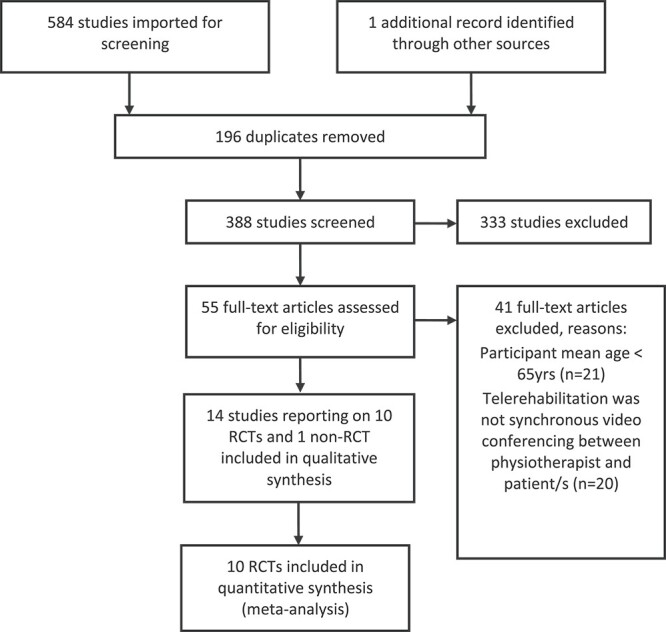
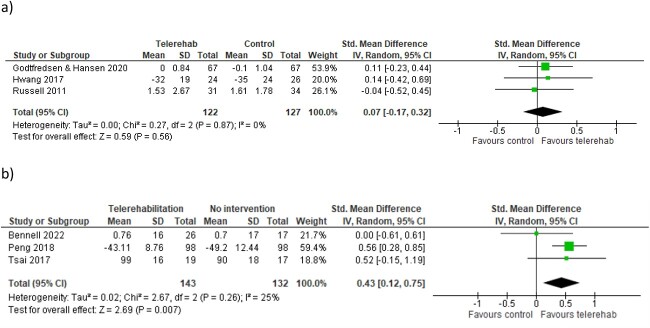
Eleven studies (10 randomised) with 1,400 participants (mean age 65-74 years) experiencing musculoskeletal and cardiopulmonary conditions were included. Telerehabilitation was safe, effective and well adhered to. Telerehabilitation was non-inferior to face-to-face physiotherapy in relation to range of movement, strength, 6-min walk distance (6MWD), timed up and go test (TUGT) and quality of life and had lower health-care costs compared with face-to-face physiotherapy. Compared with no intervention, telerehabilitation participants had significantly better range of motion, strength, quality of life, 6MWD and TUGT speed.
Physiotherapist-led, exercise-based telerehabilitation is non-inferior to face-to-face rehabilitation and better than no intervention for older adults with musculoskeletal and cardiopulmonary conditions.
远程康复对于成年人来说可能是一种替代面对面康复的合适方法,但对于老年人来说,其安全性和有效性尚不确定。
本综述旨在确定由物理治疗师主导的基于运动的远程康复对老年患者的疗效(健康相关生活质量、活动受限、功能障碍)和卫生服务成本的影响。
纳入了社区居住的老年患者(平均年龄≥65 岁)参与的基于运动的远程康复,这些患者由物理治疗师主导。从最早的可用日期到 2022 年 8 月,检索了 Cumulative Index to Nursing and Allied Health Literature(CINAHL)、Medline、PubMed 和 Cochrane Library。使用 Physiotherapy Evidence Database 量表评估方法学质量。使用Inverse Variance、Random-Effects 荟萃分析来确定标准化均数差和 95%置信区间,以综合数据。应用 Grading of Recommendations, Assessment, Development and Evaluation 标准来确定证据的确定性。
纳入了 11 项研究(10 项随机研究),共有 1400 名参与者(平均年龄 65-74 岁)患有肌肉骨骼和心肺疾病。远程康复是安全的、有效的且患者依从性良好。与面对面物理治疗相比,远程康复在关节活动度、力量、6 分钟步行距离(6MWD)、计时起立行走测试(TUGT)和生活质量方面非劣效,并且与面对面物理治疗相比成本更低。与无干预相比,远程康复组患者的关节活动度、力量、生活质量、6MWD 和 TUGT 速度明显更好。
对于患有肌肉骨骼和心肺疾病的老年人,由物理治疗师主导的基于运动的远程康复与面对面康复相当,优于无干预。