Tabet Anne-Claude, Verloes Alain, Pilorge Marion, Delaby Elsa, Delorme Richard, Nygren Gudrun, Devillard Françoise, Gérard Marion, Passemard Sandrine, Héron Delphine, Siffroi Jean-Pierre, Jacquette Aurelia, Delahaye Andrée, Perrin Laurence, Dupont Céline, Aboura Azzedine, Bitoun Pierre, Coleman Mary, Leboyer Marion, Gillberg Christopher, Benzacken Brigitte, Betancur Catalina
Department of Genetics, AP-HP, Robert Debré University Hospital, 48 boulevard Sérurier, 75019 Paris, France ; INSERM, UMR 1130, Neuroscience Paris Seine, 9 quai Saint Bernard, 75005 Paris, France ; CNRS, UMR 8246, Neuroscience Paris Seine, 9 quai Saint Bernard, 75005 Paris, France ; Sorbonne Universités, UPMC Univ Paris 6, Institut de Biologie Paris-Seine, 9 quai Saint Bernard, 75005 Paris, France.
Department of Genetics, AP-HP, Robert Debré University Hospital, 48 boulevard Sérurier, 75019 Paris, France ; INSERM, UMR 1141, Robert Debré University Hospital, 48 boulevard Sérurier, 75019 Paris, France.
Mol Autism. 2015 Mar 25;6:19. doi: 10.1186/s13229-015-0015-2. eCollection 2015.
Apparently balanced chromosomal rearrangements can be associated with an abnormal phenotype, including intellectual disability and autism spectrum disorder (ASD). Genome-wide microarrays reveal cryptic genomic imbalances, related or not to the breakpoints, in 25% to 50% of patients with an abnormal phenotype carrying a microscopically balanced chromosomal rearrangement. Here we performed microarray analysis of 18 patients with ASD carrying balanced chromosomal abnormalities to identify submicroscopic imbalances implicated in abnormal neurodevelopment.
Eighteen patients with ASD carrying apparently balanced chromosomal abnormalities were screened using single nucleotide polymorphism (SNP) arrays. Nine rearrangements were de novo, seven inherited, and two of unknown inheritance. Genomic imbalances were confirmed by fluorescence in situ hybridization and quantitative PCR.
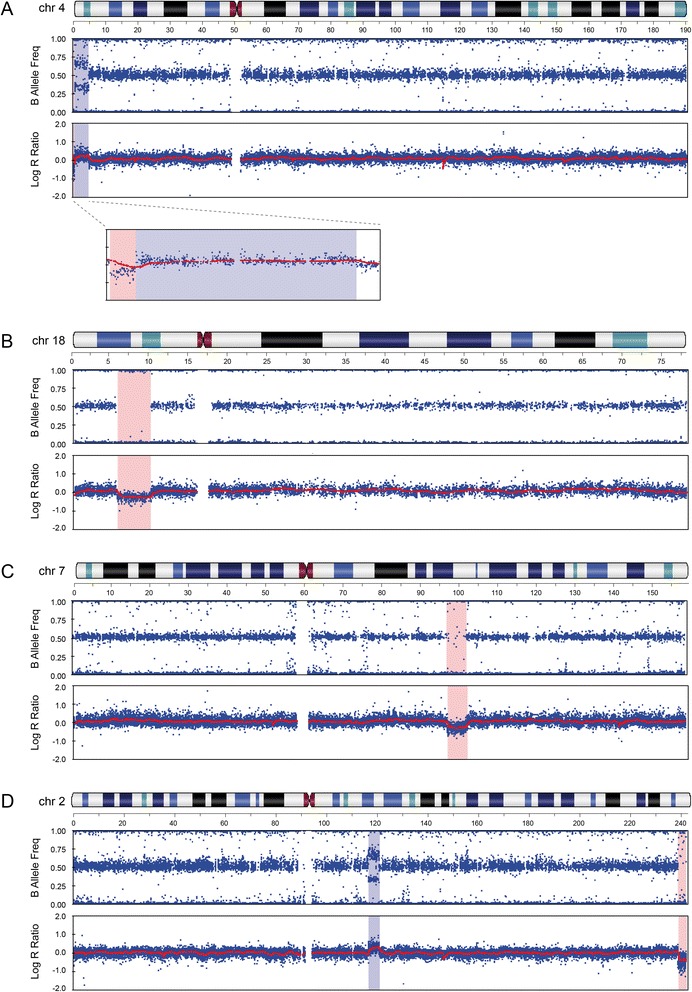
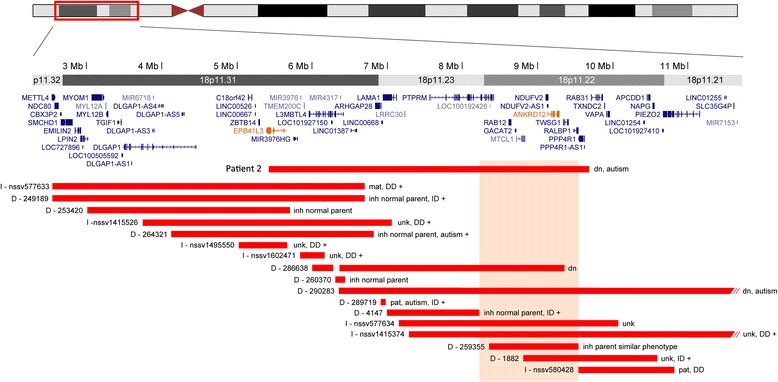
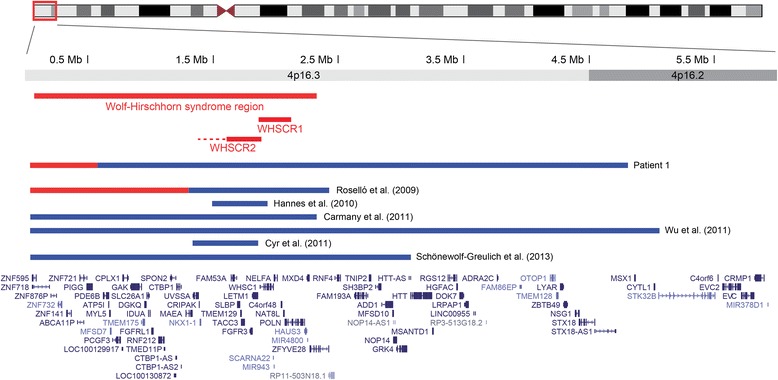
We detected clinically significant de novo copy number variants in four patients (22%), including three with de novo rearrangements and one with an inherited abnormality. The sizes ranged from 3.3 to 4.9 Mb; three were related to the breakpoint regions and one occurred elsewhere. We report a patient with a duplication of the Wolf-Hirschhorn syndrome critical region, contributing to the delineation of this rare genomic disorder. The patient has a chromosome 4p inverted duplication deletion, with a 0.5 Mb deletion of terminal 4p and a 4.2 Mb duplication of 4p16.2p16.3. The other cases included an apparently balanced de novo translocation t(5;18)(q12;p11.2) with a 4.2 Mb deletion at the 18p breakpoint, a subject with de novo pericentric inversion inv(11)(p14q23.2) in whom the array revealed a de novo 4.9 Mb deletion in 7q21.3q22.1, and a patient with a maternal inv(2)(q14.2q37.3) with a de novo 3.3 Mb terminal 2q deletion and a 4.2 Mb duplication at the proximal breakpoint. In addition, we identified a rare de novo deletion of unknown significance on a chromosome unrelated to the initial rearrangement, disrupting a single gene, RFX3.
These findings underscore the utility of SNP arrays for investigating apparently balanced chromosomal abnormalities in subjects with ASD or related neurodevelopmental disorders in both clinical and research settings.
明显平衡的染色体重排可能与异常表型相关,包括智力残疾和自闭症谱系障碍(ASD)。全基因组微阵列揭示,在25%至50%携带显微镜下平衡染色体重排的异常表型患者中,存在与断点相关或无关的隐匿性基因组失衡。在此,我们对18例携带平衡染色体异常的ASD患者进行了微阵列分析,以确定与异常神经发育相关的亚显微失衡。
使用单核苷酸多态性(SNP)阵列对18例携带明显平衡染色体异常的ASD患者进行筛查。9种重排为新发,7种为遗传,2种遗传情况未知。通过荧光原位杂交和定量PCR确认基因组失衡。
我们在4例患者(22%)中检测到具有临床意义的新发拷贝数变异,其中3例为新发重排,1例为遗传异常。大小范围为3.