Department of Orthopaedic Surgery, Mount Sinai Medical Center, New York, New York, United States.
Department of Orthopedic Surgery and Rehabilitation, University of Wisconsin, Madison, Wisconsin, United States.
Global Spine J. 2015 Apr;5(2):148-55. doi: 10.1055/s-0035-1544176. Epub 2015 Jan 30.
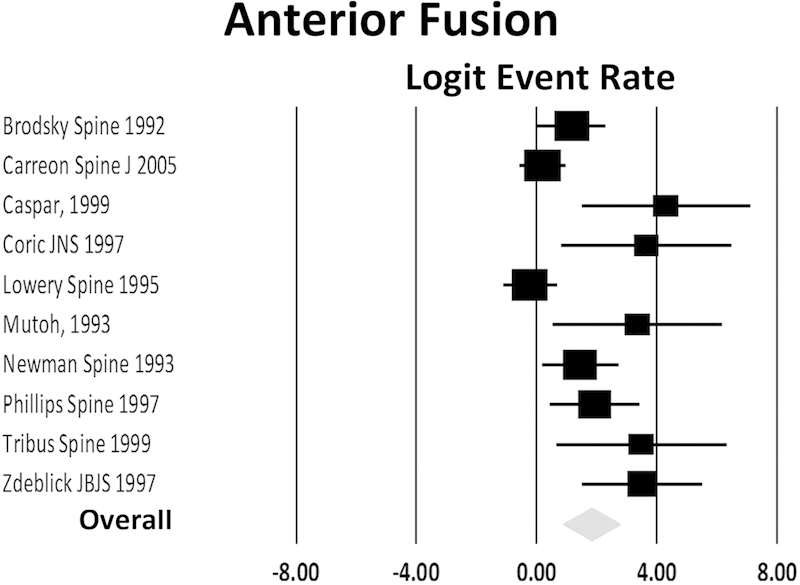
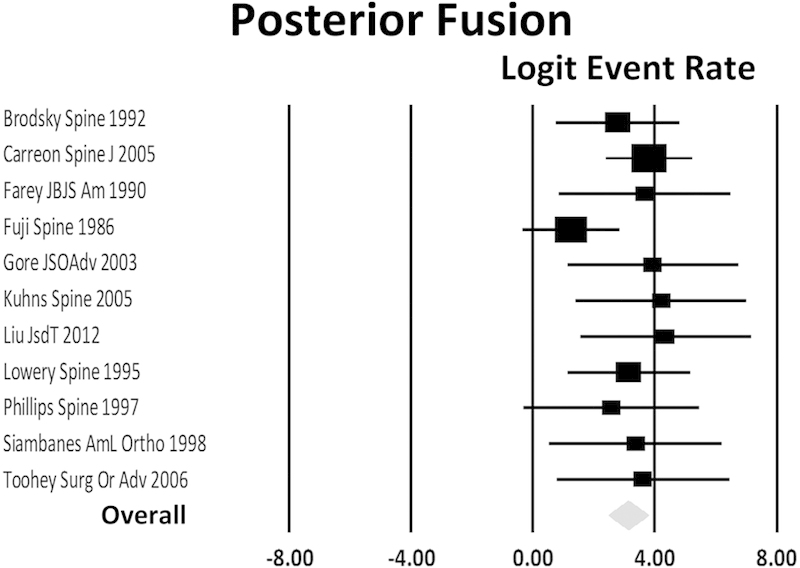
Study Design Systematic literature review and meta-analysis. Objective This study is a meta-analysis assessing the fusion rate and the clinical outcomes of cervical pseudarthrosis treated with either a posterior or a revision anterior approach. Methods A literature search of PubMed, Cochrane, and Embase was performed. Variables of interest included fusion rate and clinical success. The effect size based on logit event rate was calculated from the pooled results. The studies were weighted by the inverse of the variance, which included both within- and between-study error. The confidence intervals were reported at 95%. Heterogeneity was assessed using the Q statistic and I (2), where I (2) is the estimate of the percentage of error due to between-study variation. Results Sixteen studies reported fusion outcomes; 10 studies reported anterior and/or posterior results. The pooled fusion success was 86.4% in the anterior group and 97.1% in the posterior group (p = 0.028). The anterior group demonstrated significant heterogeneity with Q value of 34.2 and I (2) value of 73.7%; no heterogeneity was seen in the posterior group. The clinical outcomes were reported in 10 studies, with eight reporting results of anterior and posterior approaches. The pooled clinical success rate was 77.0% for anterior and 71.7% for posterior (p = 0.55) approaches. There was significant heterogeneity in both groups (I (2) 16.1; 19.2). Conclusions Symptomatic cervical pseudarthrosis can be effectively managed with either an anterior or a posterior approach. The posterior approach demonstrates a significantly greater fusion rate compared with the anterior approach, though the clinical outcome does not differ between the two groups.
系统文献回顾和荟萃分析。目的:本研究通过荟萃分析评估了后路或翻修前路治疗颈椎假关节融合率和临床结果。方法:对 PubMed、Cochrane 和 Embase 进行文献检索。感兴趣的变量包括融合率和临床成功率。从汇总结果中计算基于对数事件率的效应量。研究权重为方差的倒数,包括组内和组间误差。置信区间以 95%报告。使用 Q 统计量和 I²(I² 是由于研究间差异引起的误差的估计百分比)评估异质性。结果:16 项研究报告了融合结果;10 项研究报告了前路和/或后路结果。前路组融合成功率为 86.4%,后路组为 97.1%(p=0.028)。前路组 Q 值为 34.2,I² 值为 73.7%,存在显著异质性;后路组未见异质性。10 项研究报告了临床结果,其中 8 项报告了前路和后路的结果。前路组的总体临床成功率为 77.0%,后路组为 71.7%(p=0.55),两组均存在显著异质性(I² 16.1%;19.2%)。结论:症状性颈椎假关节可以通过前路或后路有效治疗。后路与前路相比,融合率显著更高,但两组的临床结果并无差异。