Bonnet Amandine, Bretes Hugo, Palancade Benoit
Institut Jacques Monod, CNRS, UMR 7592, Univ Paris Diderot, Sorbonne Paris Cité, F-75205 Paris, France.
Institut Jacques Monod, CNRS, UMR 7592, Univ Paris Diderot, Sorbonne Paris Cité, F-75205 Paris, France Ecole Doctorale Gènes Génomes Cellules, Université Paris Sud-11, 91400 Orsay, France.
Nucleic Acids Res. 2015 Apr 30;43(8):4249-61. doi: 10.1093/nar/gkv280. Epub 2015 Apr 6.
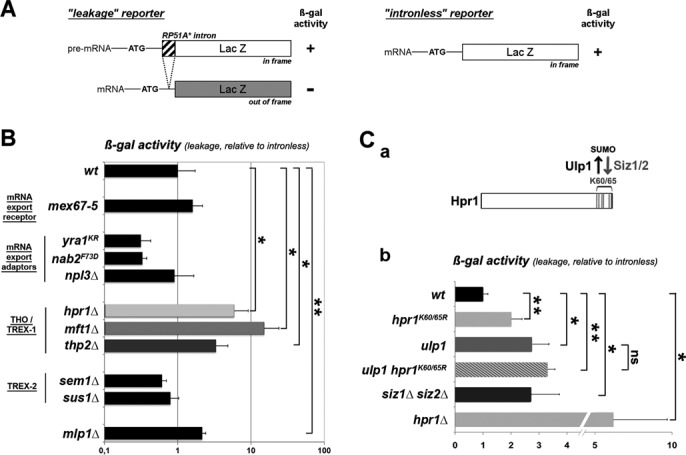
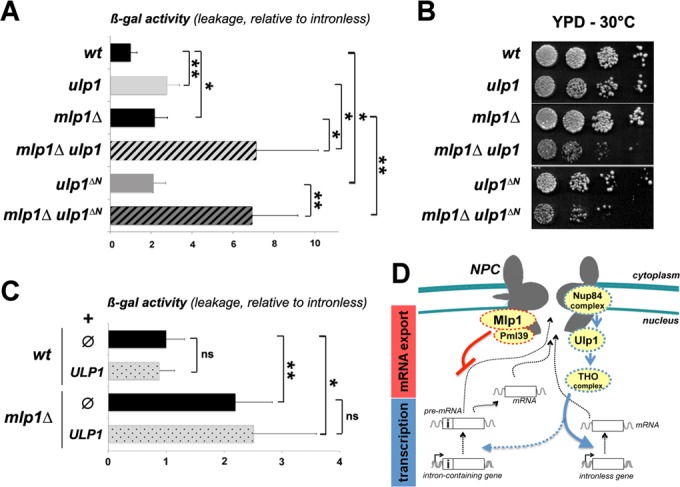
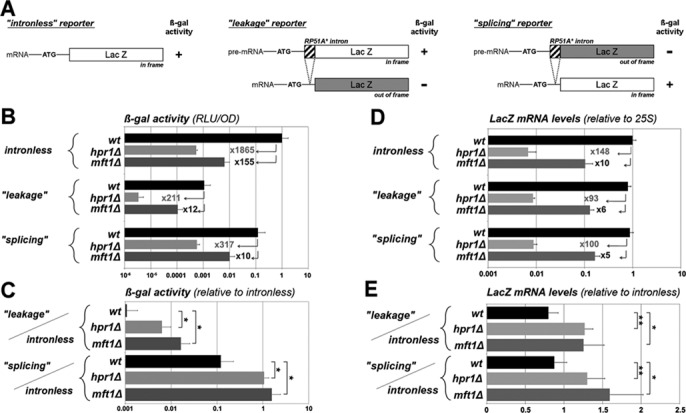
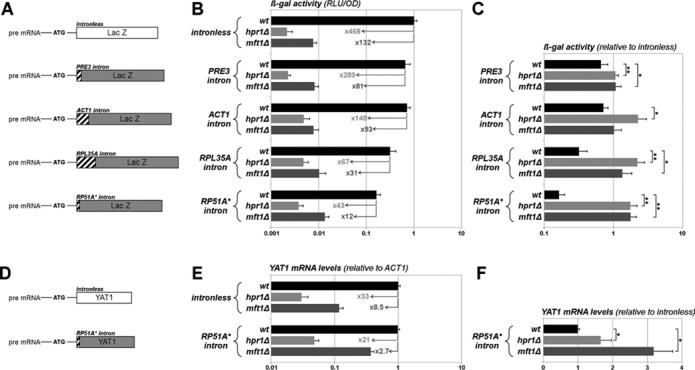
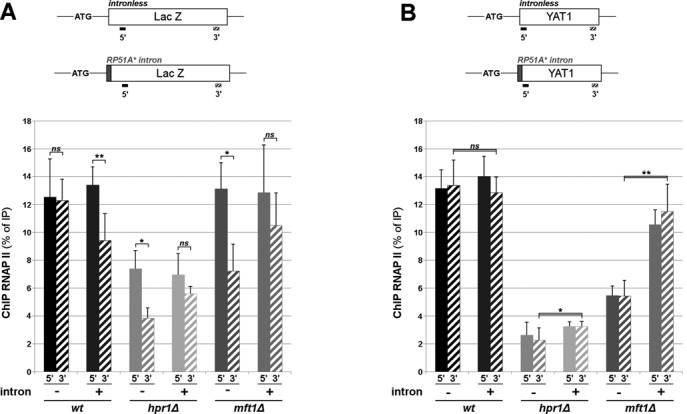
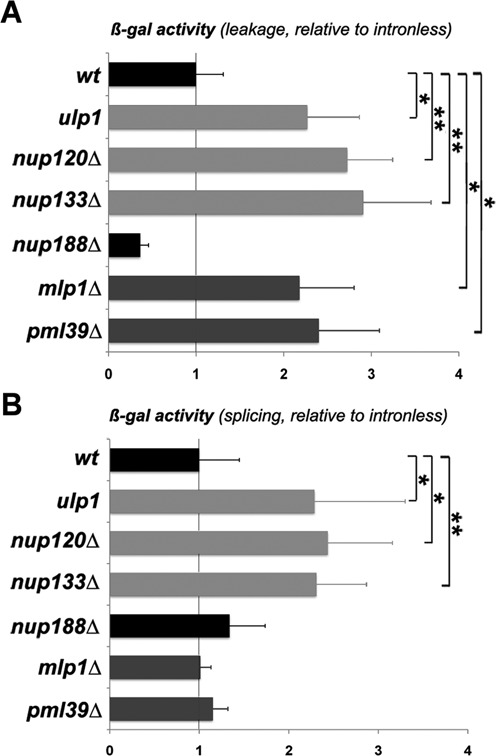
Several nuclear pore-associated factors, including the SUMO-protease Ulp1, have been proposed to prevent the export of intron-containing messenger ribonucleoparticles (mRNPs) in yeast. However, the molecular mechanisms of this nuclear pore-dependent mRNA quality control, including the sumoylated targets of Ulp1, have remained unidentified. Here, we demonstrate that the apparent 'pre-mRNA leakage' phenotype arising upon ULP1 inactivation is shared by sumoylation mutants of the THO complex, an early mRNP biogenesis factor. Importantly, we establish that alteration of THO complex activity differentially impairs the expression of intronless and intron-containing reporter genes, rather than triggering bona fide 'pre-mRNA leakage'. Indeed, we show that the presence of introns within THO target genes attenuates the effect of THO inactivation on their transcription. Epistasis analyses further clarify that different nuclear pore components influence intron-containing gene expression at distinct stages. Ulp1, whose maintenance at nuclear pores depends on the Nup84 complex, impacts on THO-dependent gene expression, whereas the nuclear basket-associated Mlp1/Pml39 proteins prevent pre-mRNA export at a later stage, contributing to mRNA quality control. Our study thus highlights the multiplicity of mechanisms by which nuclear pores contribute to gene expression, and further provides the first evidence that intronic sequences can alleviate early mRNP biogenesis defects.
包括SUMO蛋白酶Ulp1在内的几种核孔相关因子,被认为可阻止酵母中含内含子的信使核糖核蛋白颗粒(mRNP)的输出。然而,这种依赖核孔的mRNA质量控制的分子机制,包括Ulp1的SUMO化靶点,仍未明确。在这里,我们证明,ULP1失活时出现的明显“前体mRNA泄漏”表型,与早期mRNP生物合成因子THO复合物的SUMO化突变体相同。重要的是,我们证实,THO复合物活性的改变会不同程度地损害无内含子和含内含子报告基因的表达,而不是引发真正的“前体mRNA泄漏”。事实上,我们表明,THO靶基因中内含子的存在减弱了THO失活对其转录的影响。上位性分析进一步阐明,不同的核孔成分在不同阶段影响含内含子基因的表达。Ulp1在核孔处的维持依赖于Nup84复合物,它影响THO依赖的基因表达,而与核篮相关的Mlp1/Pml39蛋白在后期阻止前体mRNA输出,有助于mRNA质量控制。因此,我们的研究突出了核孔促进基因表达的多种机制,并进一步提供了首个证据,证明内含子序列可缓解早期mRNP生物合成缺陷。