Schirmer Uwe B, Steinert Tilman, Flammer Erich, Borbé Raoul
Centre for Psychiatry South-Wuerttemberg, Ravensburg, Germany.
Centre for Psychiatry South-Wuerttemberg, Ravensburg, Germany ; Ulm University, Department Psychiatry I, Ravensburg, Germany.
Patient Prefer Adherence. 2015 Apr 1;9:541-9. doi: 10.2147/PPA.S75616. eCollection 2015.
The long-term course of schizophrenia is often characterized by relapses, induced by poor medication adherence. Early nonadherence after discharge is frequent.
To evaluate a skills-based inpatient training program for medication intake.
We developed a manual-based inpatient medication training program to be carried out by nurses and focusing on practical skills enabling autonomous intake of medication. Medication adherence was measured by three different methods: pill count, determination of serum levels, and self-assessment by the patient. The raters were blinded.
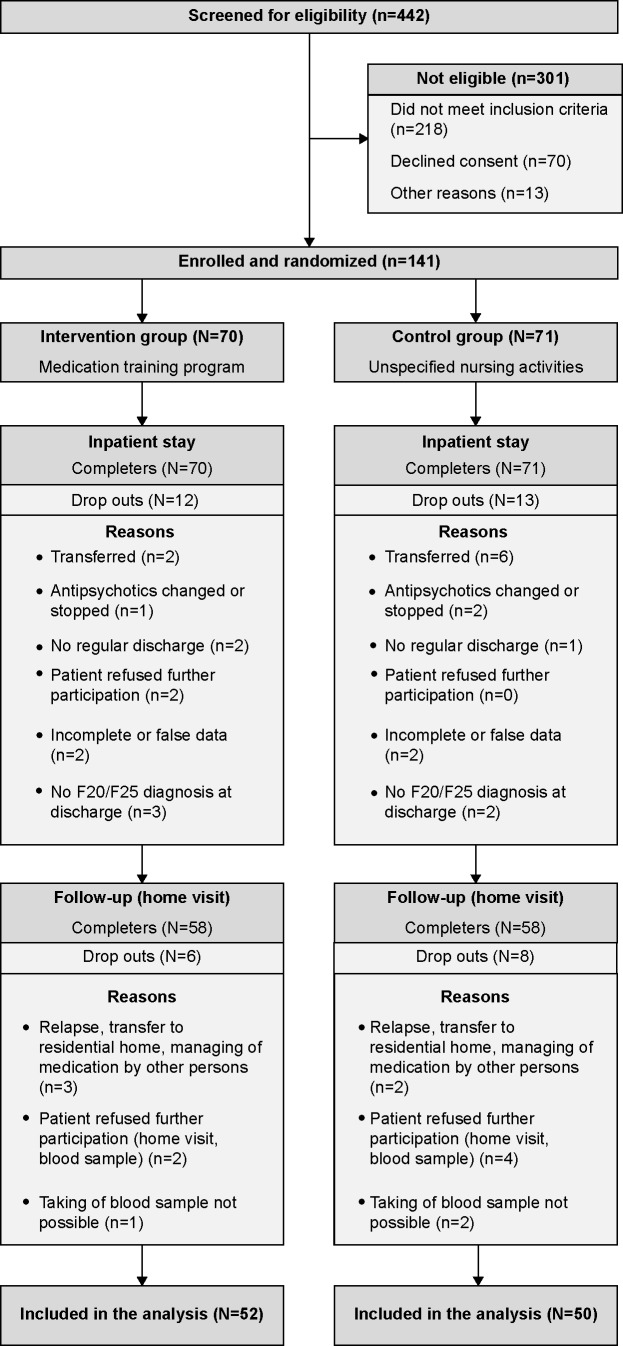
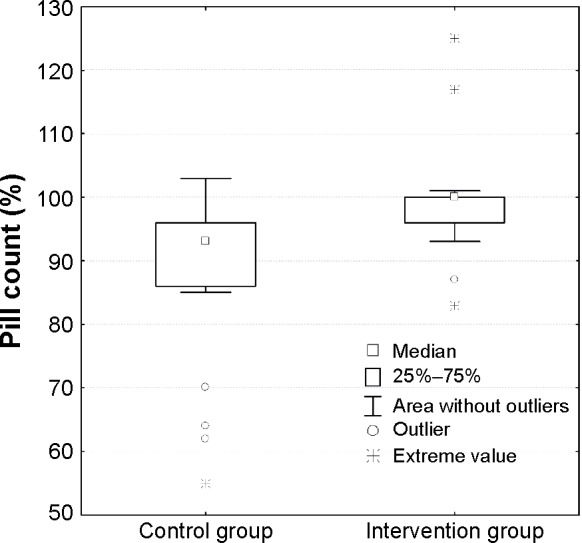
Four weeks after discharge, 98% of the patients in the intervention group (N=52) were rated as adherent by pill count versus 76% in the control group (N=50; P<0.01). By measurement of serum level, 88.5% versus 70% were adherent (P<0.05).
The inpatient medication training program carried out by nurses seems to be an effective intervention for enhancing medication adherence after hospital discharge.
精神分裂症的长期病程常以复发为特征,而复发是由药物依从性差所致。出院后早期不依从情况很常见。
评估一项基于技能的住院患者药物服用培训项目。
我们制定了一个由护士实施的、基于手册的住院患者药物培训项目,该项目侧重于使患者能够自主服药的实用技能。通过三种不同方法测量药物依从性:药片计数、血清水平测定以及患者自我评估。评估者处于盲态。
出院四周后,干预组(N = 52)中98%的患者通过药片计数被评定为依从,而对照组(N = 50)中这一比例为76%(P < 0.01)。通过血清水平测量,依从率分别为88.5%和70%(P < 0.05)。
护士实施的住院患者药物培训项目似乎是提高出院后药物依从性的有效干预措施。