Meng Meiling, Li Wei, Zhang Shaowei, Wang Hongyan, Sheng Jianhua, Wang Jijun, Li Chunbo
Shanghai Key Laboratory of Psychotic Disorders, Shanghai Mental Health Center, Shanghai Jiao Tong University School of Medicine, Shanghai, China.
Shanghai Arch Psychiatry. 2015 Feb 25;27(1):4-17. doi: 10.11919/j.issn.1002-0829.215014.
Hyperprolactinemia (HPL) is a common side effect of antipsychotic medications. Recent reports suggest that aripiprazole can ameliorate antipsychotic-induced HPL, but results are inconsistent and the single available systematic review only considered five studies.
Conduct an updated meta-analysis of all randomized controlled trials (RCTs) about the efficacy and safety of aripiprazole as an adjunctive treatment for antipsychotic-induced hyperprolactinemia.
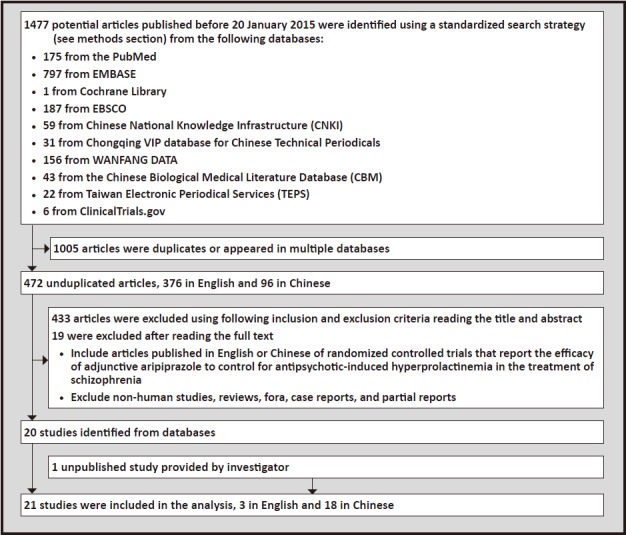
English and Chinese databases were searched for RCTs about the use of aripiprazole in treating antipsychotic-induced HPL published by January 20, 2015. Studies were selected using pre-defined inclusion and exclusion criteria. The Cochrane Risk of Bias tool was used to evaluate risk of biases, the Cochrane GRADE measure was used to assess the quality of evidence, and Review Manager 5.3 software was used for data analysis.
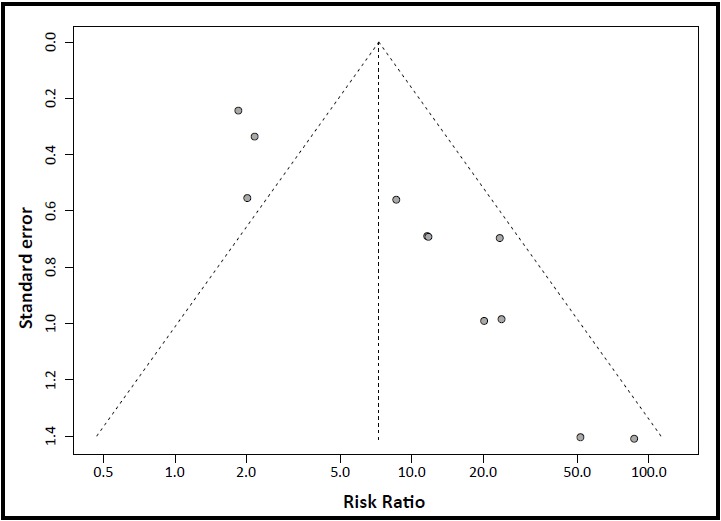
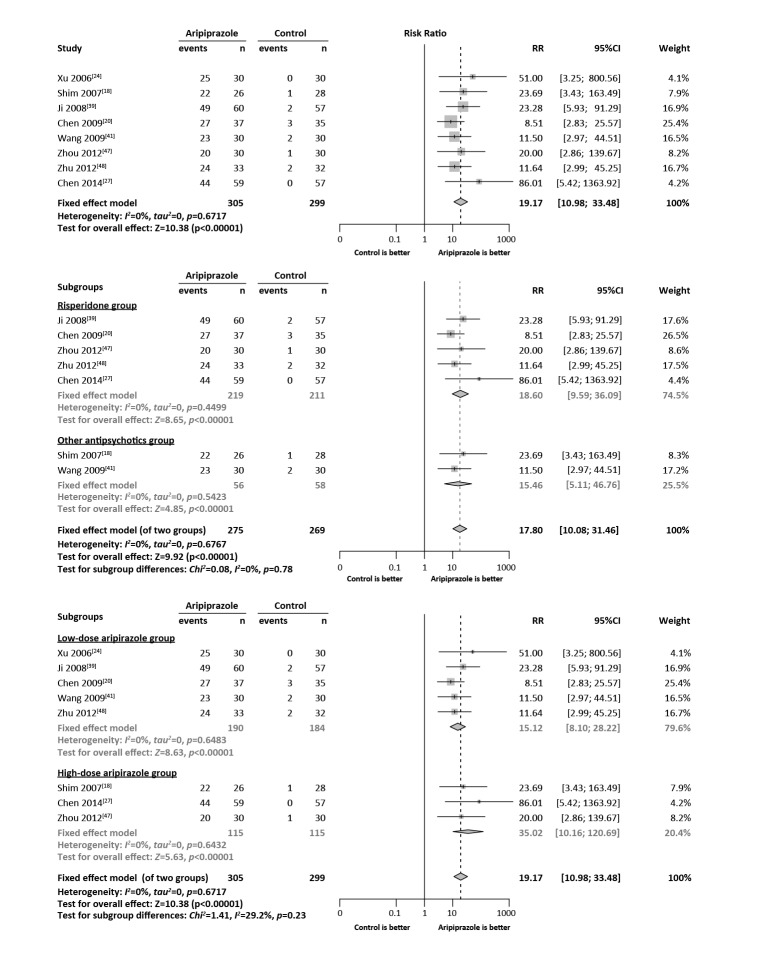
A total of 21 studies, 19 of which were conducted in mainland China, were included in the analysis. Meta-analysis of data from 8 of the studies with a pooled sample of 604 individuals found that compared to the control condition adjunctive aripiprazole significantly increased the proportion of participants who experienced HPL recovery (risk ratio [RR]=19.2, 95%CI=11.0-33.5). The proportion who experienced any adverse effect during follow-up did not differ between the two groups, but the aripiprazole group was more likely to report somnolence (RR=2.76, 95%CI=1.34-5.69) and headaches (RR=2.31, 95%CI=1.08-4.92). High-dose aripiprazole (>5mg/day) was more effective than low-dose (<5mg/day) aripiprazole (RR=30.0, 95%CI=10.2-120.7 v. RR=15.1, 95%CI=8.1-28.1), but this difference was not statistically significant. The risk of bias in the studies was rated as 'high' in 6 of the studies and 'unclear' in 15 studies, and the quality of evidence was rated as 'high' for only 7 of the 57 outcome measures assessed.
This study systematically reviewed and evaluated all relevant RCTs and found that adjunctive aripiprazole is effective and safe to use in the treatment of antipsychotic-induced HPL. However, the low quality of some of the studies, the incomplete methodological information provided for most of the studies, and the relatively short follow-up time of the studies raises question about the validity of the results. Further work that resolves these methodological and reporting issues is needed.
高催乳素血症(HPL)是抗精神病药物常见的副作用。近期报告表明,阿立哌唑可改善抗精神病药物所致的HPL,但结果并不一致,且仅有的一项系统评价仅纳入了五项研究。
对所有关于阿立哌唑作为抗精神病药物所致高催乳素血症辅助治疗的疗效和安全性的随机对照试验(RCT)进行更新的荟萃分析。
检索英文和中文数据库,查找截至2015年1月20日发表的关于使用阿立哌唑治疗抗精神病药物所致HPL的RCT。根据预先定义的纳入和排除标准选择研究。使用Cochrane偏倚风险工具评估偏倚风险,使用Cochrane GRADE方法评估证据质量,并使用Review Manager 5.3软件进行数据分析。
共纳入21项研究,其中19项在中国内地进行。对8项研究的数据进行荟萃分析,汇总样本量为604例个体,结果发现与对照条件相比,辅助使用阿立哌唑显著增加了HPL恢复的参与者比例(风险比[RR]=19.2,95%CI=11.0 - 33.5)。两组在随访期间出现任何不良反应的比例无差异,但阿立哌唑组更易报告嗜睡(RR=2.76,95%CI=1.34 - 5.69)和头痛(RR=2.31,95%CI=1.08 - 4.92)。高剂量阿立哌唑(>5mg/天)比低剂量(<5mg/天)阿立哌唑更有效(RR=30.0,95%CI=10.2 - 120.7对比RR=15.1,95%CI=8.1 - 28.1),但这种差异无统计学意义。6项研究的偏倚风险被评为“高”,15项研究被评为“不清楚”,在评估的57项结局指标中,只有7项的证据质量被评为“高”。
本研究系统回顾并评估了所有相关RCT,发现辅助使用阿立哌唑治疗抗精神病药物所致HPL有效且安全。然而,部分研究质量较低,大多数研究提供的方法学信息不完整,且研究的随访时间相对较短,这对结果的有效性提出了质疑。需要进一步开展工作来解决这些方法学和报告问题。