
野生动物体内的管圆线虫属(线虫纲:后圆线虫总科):综述
Species of Angiostrongylus (Nematoda: Metastrongyloidea) in wildlife: A review.
作者信息
Spratt David M
机构信息
Australian National Wildlife Collection, CSIRO National Research Collections, GPO Box 1700, Canberra, ACT 2601, Australia.
出版信息
Int J Parasitol Parasites Wildl. 2015 Mar 9;4(2):178-89. doi: 10.1016/j.ijppaw.2015.02.006. eCollection 2015 Aug.
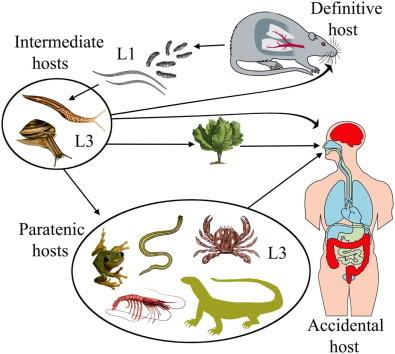
Twenty-one species of Angiostrongylus plus Angiostrongylus sp. (Nematoda: Metastrongyloidea) are known currently in wildlife. These occur naturally in rodents, tupaiids, mephitids, mustelids, procyonids, felids, and canids, and aberrantly in a range of avian, marsupial and eutherian hosts including humans. Adults inhabit the pulmonary arteries and right atrium, ventricle and vena cava, bronchioles of the lung or arteries of the caecum and mesentery. All species pass first-stage larvae in the faeces of the host and all utilise slugs and/or aquatic or terrestrial snails as intermediate hosts. Gastropods are infected by ingestion or penetration of first-stage larvae; definitive hosts by ingestion of gastropods or gastropod slime. Transmission of at least one species may involve ingestion of paratenic hosts. Five developmental pathways are identified in these life cycles. Thirteen species, including Angiostrongylus sp., are known primarily from the original descriptions suggesting limited geographic distributions. The remaining species are widespread either globally or regionally, and are continuing to spread. Small experimental doses of infective larvae (ca. 20) given to normal or aberrant hosts are tolerated, although generally eliciting a granulomatous histopathological response; large doses (100-500 larvae) often result in clinical signs and/or death. Two species, A. cantonensis and A. costaricensis, are established zoonoses causing neurological and abdominal angiostrongliasis respectively. The zoonotic potential of A. mackerrasae, A. malaysiensis and A. siamensis particularly warrant investigation. Angiostrongylus cantonensis occurs in domestic animals, mammalian and avian wildlife and humans in the metropolitan areas of Brisbane and Sydney, Australia, where it has been suggested that tawny frogmouths and brushtail possums may serve as biosentinels. A major conservation issue is the devastating role A. cantonensis may play around zoos and fauna parks where captive rearing of endangered species programmes may exist and where Rattus spp. are invariably a problem.
目前已知在野生动物中有21种广州管圆线虫属线虫以及广州管圆线虫未定种(线虫纲:后圆线虫总科)。它们自然存在于啮齿动物、树鼩、臭鼬、鼬科动物、浣熊科动物、猫科动物和犬科动物中,也会异常寄生于一系列鸟类、有袋动物和真兽类宿主(包括人类)体内。成虫栖息于肺动脉、右心房、心室和腔静脉、肺的细支气管或盲肠及肠系膜动脉中。所有种类都会在宿主粪便中排出第一期幼虫,并且都利用蛞蝓和/或水生或陆生蜗牛作为中间宿主。腹足纲动物通过摄入或被第一期幼虫穿透而被感染;终末宿主通过摄入腹足纲动物或腹足纲动物的黏液而被感染。至少有一种线虫的传播可能涉及摄入转续宿主。在这些生命周期中确定了五种发育途径。包括广州管圆线虫未定种在内的13个物种主要是根据最初的描述得知的,这表明其地理分布有限。其余物种在全球或区域广泛分布,并且仍在继续扩散。给正常或异常宿主注射少量感染性幼虫(约20条)通常能被耐受,尽管一般会引发肉芽肿性组织病理学反应;大剂量(100 - 500条幼虫)通常会导致临床症状和/或死亡。两种线虫,即广州管圆线虫和哥斯达黎加管圆线虫,是已确定的人兽共患病原,分别引起神经系统和腹部管圆线虫病。麦克拉斯广州管圆线虫、马来西亚广州管圆线虫和暹罗广州管圆线虫的人兽共患病潜力尤其值得研究。广州管圆线虫存在于澳大利亚布里斯班和悉尼大都市地区的家畜、哺乳动物和鸟类野生动物以及人类体内,有人认为在那里茶色蟆口鸱和帚尾袋貂可能是生物哨兵。一个主要的保护问题是广州管圆线虫可能在动物园和野生动物园中发挥的破坏作用,在这些地方可能存在濒危物种圈养繁殖计划,而褐家鼠种群始终是个问题。



 Zotero 插件