Kotthoff Matthias, Müller Josef, Jürling Heinrich, Schlummer Martin, Fiedler Dominik
Fraunhofer Institute for Molecular Biology and Applied Ecology, Fraunhofer IME, Auf dem Aberg 1, 57392, Schmallenberg, Germany.
Fraunhofer Institute for Process Engineering and Packaging, Fraunhofer IVV, Giggenhauser Straße 35, 85354, Freising, Germany.
Environ Sci Pollut Res Int. 2015 Oct;22(19):14546-59. doi: 10.1007/s11356-015-4202-7. Epub 2015 Feb 19.
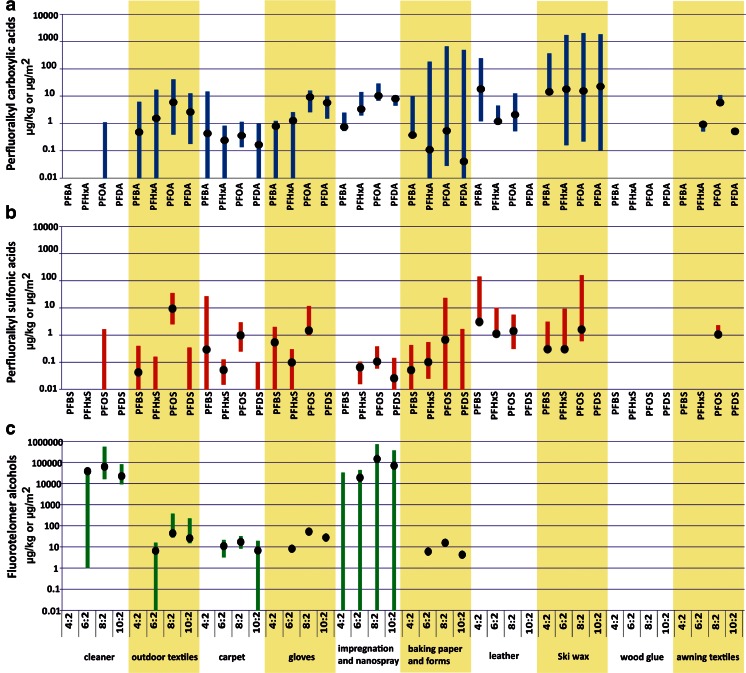
Perfluoroalkyl and polyfluoroalkyl substances (PFAS) are used in a wide range of products of all day life. Due to their toxicological potential, an emerging focus is directed towards their exposure to humans. This study investigated the PFAS load of consumer products in a broad perspective. Perfluoroalkyl sulfonic acids (C4, C6-C8, C10-PFSA), carboxylic acids (C4-C14-PFCA) and fluorotelomer alcohols (4:2, 6:2; 8:2 and 10:2 FTOH) were analysed in 115 random samples of consumer products including textiles (outdoor materials), carpets, cleaning and impregnating agents, leather samples, baking and sandwich papers, paper baking forms and ski waxes. PFCA and PFSA were analysed by HPLC-MS/MS, whereas FTOH were detected by GC/CI-MS. Consumer products such as cleaning agents or some baking and sandwich papers show low or negligible PFSA and PFCA contents. On the other hand, high PFAS levels were identified in ski waxes (up to about 2000 μg/kg PFOA), leather samples (up to about 200 μg/kg PFBA and 120 μg/kg PFBS), outdoor textiles (up to 19 μg/m(2) PFOA) and some other baking papers (up to 15 μg/m(2) PFOA). Moreover, some test samples like carpet and leather samples and outdoor materials exceeded the EU regulatory threshold value for PFOS (1 μg/m(2)). A diverse mixture of PFASs can be found in consumer products for all fields of daily use in varying concentrations. This study proves the importance of screening and monitoring of consumer products for PFAS loads and the necessity for an action to regulate the use of PFASs, especially PFOA, in consumer products.
全氟烷基和多氟烷基物质(PFAS)被广泛应用于各类日常生活用品中。鉴于其潜在的毒理学特性,人们开始越来越关注其对人类的暴露情况。本研究从广泛的角度调查了消费品中的PFAS含量。对115份随机抽取的消费品样本进行了分析,这些样本包括纺织品(户外材料)、地毯、清洁和浸渍剂、皮革样本、烘焙纸和三明治包装纸、纸质烘焙模具以及滑雪蜡,分析项目包括全氟烷基磺酸(C4、C6 - C8、C10 - PFSA)、羧酸(C4 - C14 - PFCA)和氟调聚物醇(4:2、6:2、8:2和10:2 FTOH)。PFCA和PFSA通过HPLC - MS/MS进行分析,而FTOH通过GC/CI - MS进行检测。诸如清洁剂或某些烘焙纸和三明治包装纸等消费品的PFSA和PFCA含量较低或可忽略不计。另一方面,在滑雪蜡(全氟辛酸含量高达约2000μg/kg)、皮革样本(全氟丁酸含量高达约200μg/kg,全氟丁烷磺酸含量高达120μg/kg)、户外纺织品(全氟辛酸含量高达19μg/m²)以及其他一些烘焙纸(全氟辛酸含量高达15μg/m²)中检测到了高含量的PFAS。此外,一些测试样本如地毯、皮革样本和户外材料超过了欧盟对全氟辛烷磺酸的监管阈值(1μg/m²)。在各类日常用品的消费品中,可以发现不同浓度的多种PFAS混合物。本研究证明了对消费品中PFAS含量进行筛查和监测的重要性,以及对消费品中PFAS特别是全氟辛酸的使用进行监管的必要性。