Bae Ji-Hoon, Hosseini Ali, Wang Yang, Torriani Martin, Gill Thomas J, Grodzinsky Alan J, Li Guoan
a 1 Bioengineering Laboratory, Department of Orthopaedic Surgery , Massachusetts General Hospital and Harvard Medical School, Boston.
e 5 Department of Orthopaedic Surgery, Korea University Guro Hospital , Korea University College of Medicine, Seoul, Republic of Korea.
Acta Orthop. 2015;86(5):605-10. doi: 10.3109/17453674.2015.1039426.
T1ρ or T2 relaxation imaging has been increasingly used to evaluate the cartilage of the knee. We investigated the cartilage of ACL-reconstructed knees 3 years after surgery using T2 relaxation times.
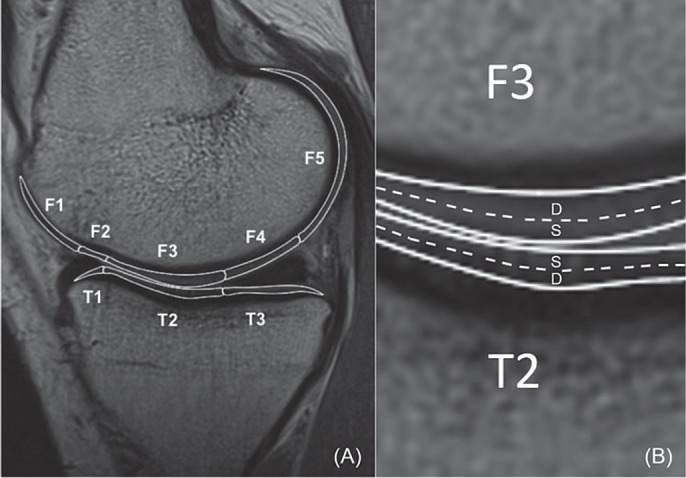
10 patients with a clinically successful unilateral ACL reconstruction were examined 3 years after surgery. Multiple-TE fast-spin echo sagittal images of both knees were acquired using a 3T MRI scanner for T2 mapping of the tibiofemoral cartilage. T2 values of the superficial and deep zones of the tibiofemoral cartilage were analyzed in sub-compartmental areas and compared between the ACL-reconstructed and uninjured contralateral knees.
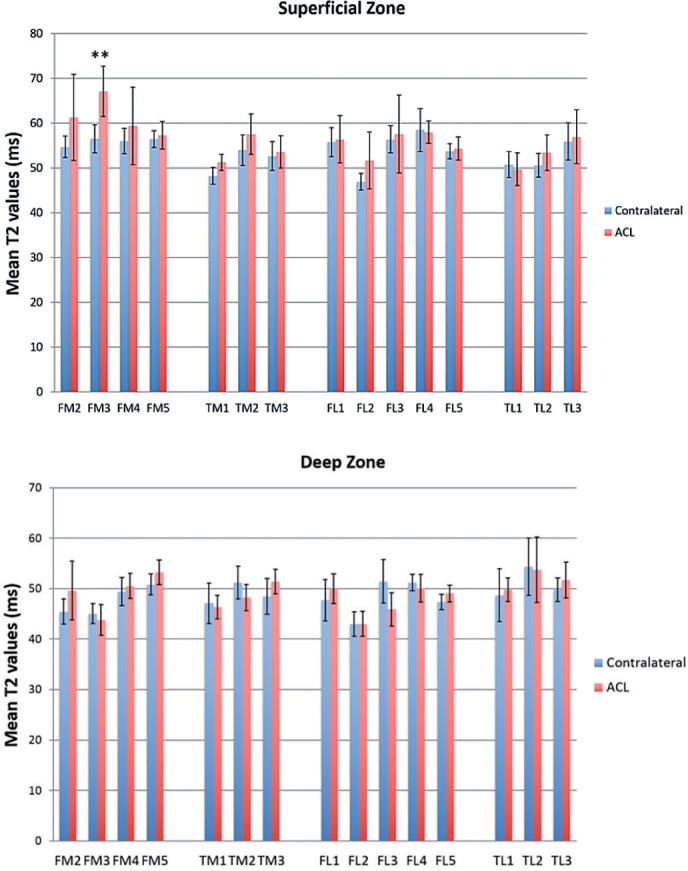
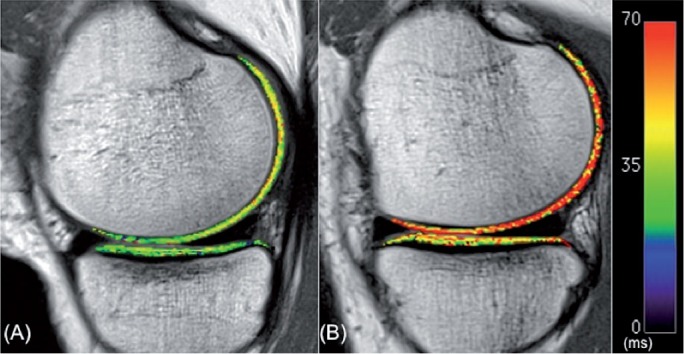
Higher T2 values were observed in 1 or more sub-compartmental areas of each ACL-reconstructed knee compared to the uninjured contralateral side. Most of the T2 increases were observed at the superficial zones of the cartilage, especially at the medial compartment. At the medial compartment of the ACL-reconstructed knee, the T2 values of the femoral and tibial cartilage were increased by 3-81% compared to the uninjured contralateral side, at the superficial zones of the weight-bearing areas. T2 values in the superficial zone of the central medial femoral condyle differed between the 2 groups (p = 0.002).
The articular cartilage of ACL-reconstructed knees, although clinically satisfactory, had higher T2 values in the superficial zone of the central medial femoral condyle than in the uninjured contralateral side 3 years after surgery. Further studies are warranted to determine whether these patients would undergo cartilage degeneration over time.
T1ρ或T2弛豫成像已越来越多地用于评估膝关节软骨。我们使用T2弛豫时间对前交叉韧带(ACL)重建术后3年的膝关节软骨进行了研究。
对10例临床单侧ACL重建成功的患者在术后3年进行检查。使用3T磁共振成像(MRI)扫描仪获取双膝的多回波快速自旋回波矢状位图像,用于胫股关节软骨的T2成像。分析胫股关节软骨表层和深层区域在亚区域的T2值,并在ACL重建侧与未受伤的对侧膝关节之间进行比较。
与未受伤的对侧相比,每个ACL重建膝关节的1个或更多亚区域观察到更高的T2值。大多数T2值增加出现在软骨的表层区域,尤其是内侧间室。在ACL重建膝关节的内侧间室,与未受伤的对侧相比,在负重区域的表层,股骨和胫骨软骨的T2值增加了3% - 81%。两组之间中央内侧股骨髁表层区域的T2值存在差异(p = 0.002)。
ACL重建膝关节的关节软骨,尽管临床效果良好,但术后3年中央内侧股骨髁表层区域的T2值高于未受伤的对侧。有必要进一步研究以确定这些患者是否会随着时间推移发生软骨退变。