Freitas Marta O, Francisco Tânia, Rodrigues Tony A, Lismont Celien, Domingues Pedro, Pinto Manuel P, Grou Cláudia P, Fransen Marc, Azevedo Jorge E
Organelle Biogenesis and Function Group, Instituto de Biologia Celular e Molecular (IBMC), Universidade do Porto, Porto, Portugal.
Organelle Biogenesis and Function Group, Instituto de Biologia Celular e Molecular (IBMC), Universidade do Porto, Porto, Portugal Instituto de Ciências Biomédicas Abel Salazar (ICBAS), Universidade do Porto, Porto, Portugal.
Open Biol. 2015 Apr;5(4):140236. doi: 10.1098/rsob.140236.
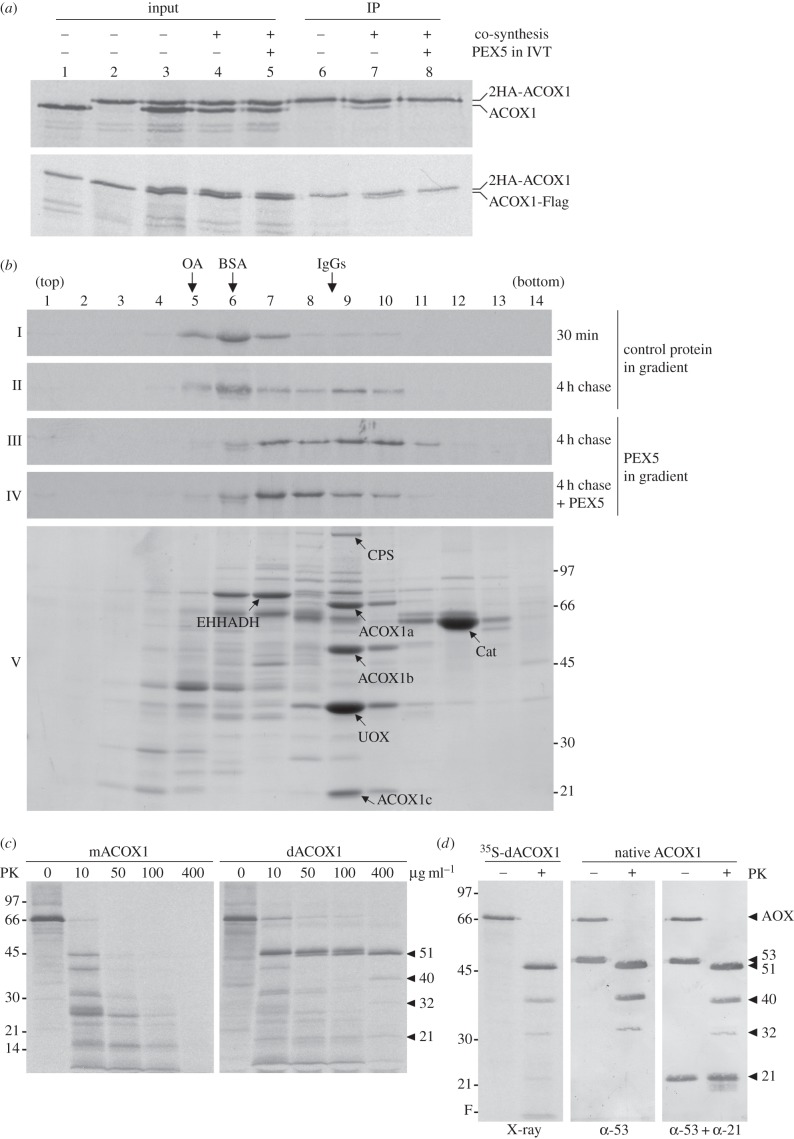
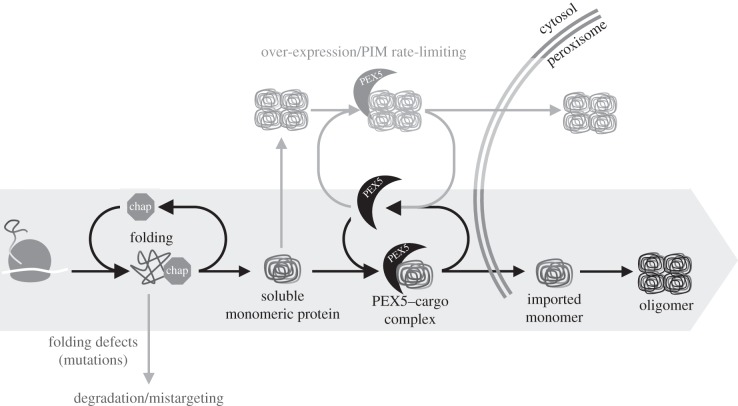
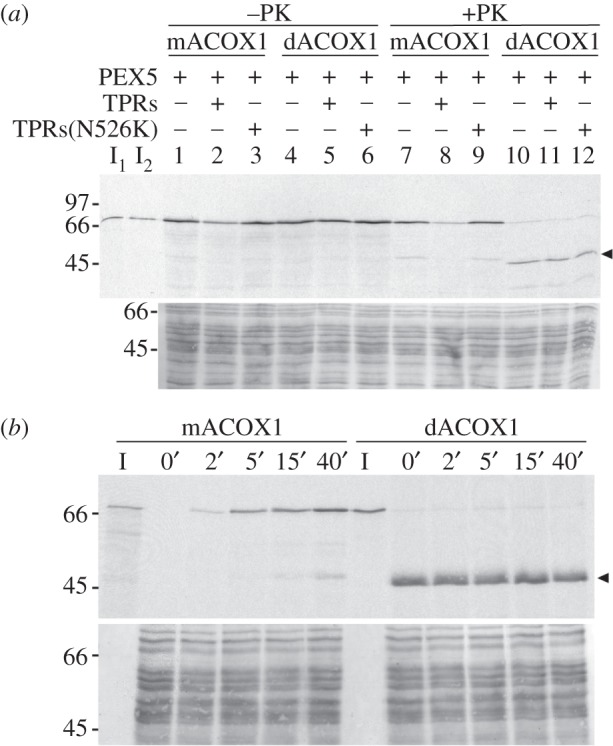
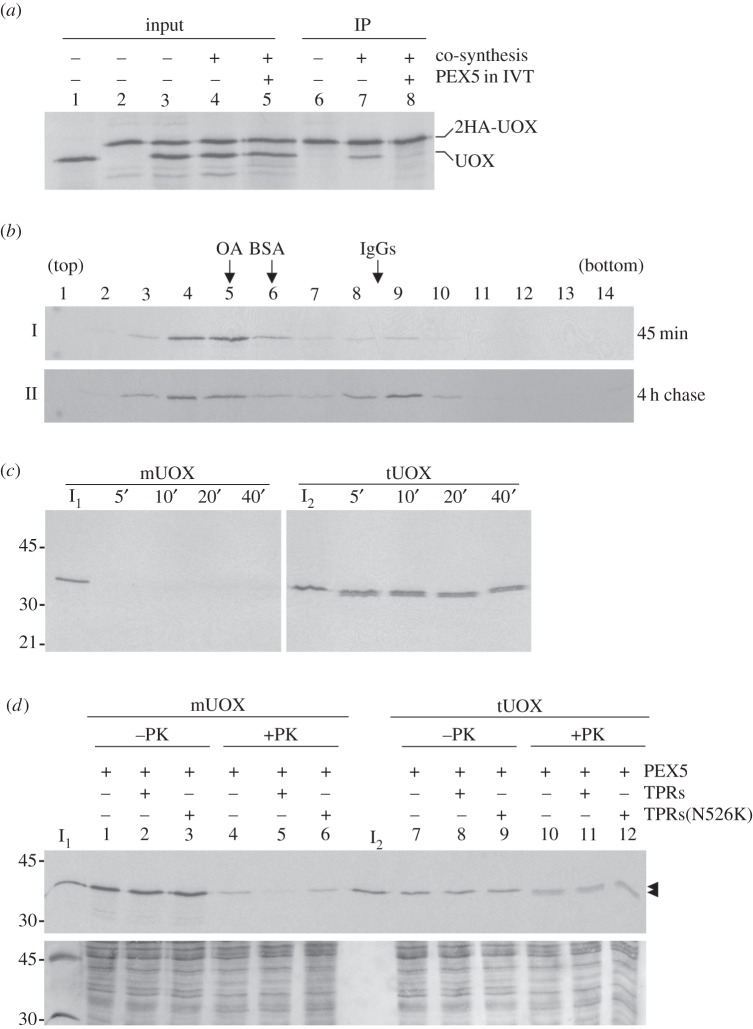
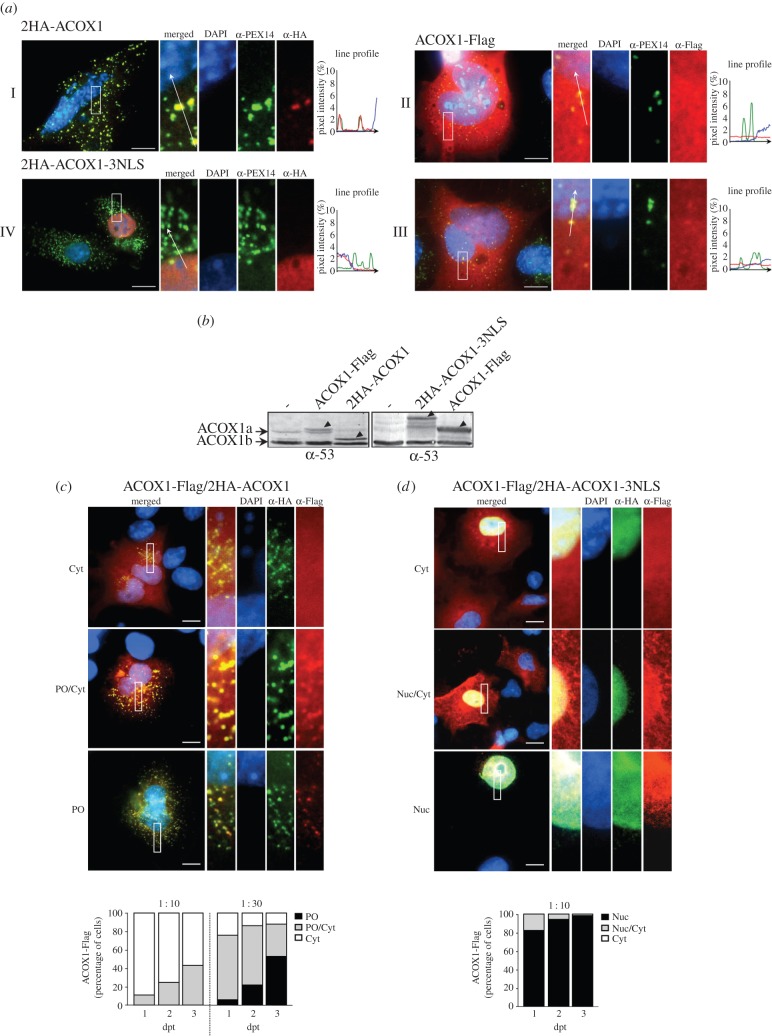
Peroxisomal matrix proteins are synthesized on cytosolic ribosomes and transported by the shuttling receptor PEX5 to the peroxisomal membrane docking/translocation machinery, where they are translocated into the organelle matrix. Under certain experimental conditions this protein import machinery has the remarkable capacity to accept already oligomerized proteins, a property that has heavily influenced current models on the mechanism of peroxisomal protein import. However, whether or not oligomeric proteins are really the best and most frequent clients of this machinery remain unclear. In this work, we present three lines of evidence suggesting that the peroxisomal import machinery displays a preference for monomeric proteins. First, in agreement with previous findings on catalase, we show that PEX5 binds newly synthesized (monomeric) acyl-CoA oxidase 1 (ACOX1) and urate oxidase (UOX), potently inhibiting their oligomerization. Second, in vitro import experiments suggest that monomeric ACOX1 and UOX are better peroxisomal import substrates than the corresponding oligomeric forms. Finally, we provide data strongly suggesting that although ACOX1 lacking a peroxisomal targeting signal can be imported into peroxisomes when co-expressed with ACOX1 containing its targeting signal, this import pathway is inefficient.
过氧化物酶体基质蛋白在胞质核糖体上合成,并通过穿梭受体PEX5转运至过氧化物酶体膜对接/易位机制,在那里它们被转运到细胞器基质中。在某些实验条件下,这种蛋白质导入机制具有接受已经寡聚化的蛋白质的显著能力,这一特性对目前关于过氧化物酶体蛋白质导入机制的模型产生了重大影响。然而,寡聚蛋白是否真的是这种机制的最佳和最常见的底物仍不清楚。在这项工作中,我们提供了三条证据表明过氧化物酶体导入机制对单体蛋白具有偏好性。首先,与之前关于过氧化氢酶的研究结果一致,我们发现PEX5结合新合成的(单体)酰基辅酶A氧化酶1(ACOX1)和尿酸氧化酶(UOX),有效地抑制它们的寡聚化。其次,体外导入实验表明,单体ACOX1和UOX比相应的寡聚形式是更好的过氧化物酶体导入底物。最后,我们提供的数据有力地表明,虽然缺乏过氧化物酶体靶向信号的ACOX1与含有其靶向信号的ACOX1共表达时可以导入过氧化物酶体,但这种导入途径效率低下。