Vidyasagar Trichur R, Jayakumar Jaikishan, Lloyd Errol, Levichkina Ekaterina V
Department of Optometry & Vision Sciences, University of Melbourne, Parkville, Victoria, Australia Melbourne Neuroscience Institute, University of Melbourne, Parkville, Victoria, Australia
Department of Optometry & Vision Sciences, University of Melbourne, Parkville, Victoria, Australia.
Physiol Rep. 2015 Apr;3(4). doi: 10.14814/phy2.12374.
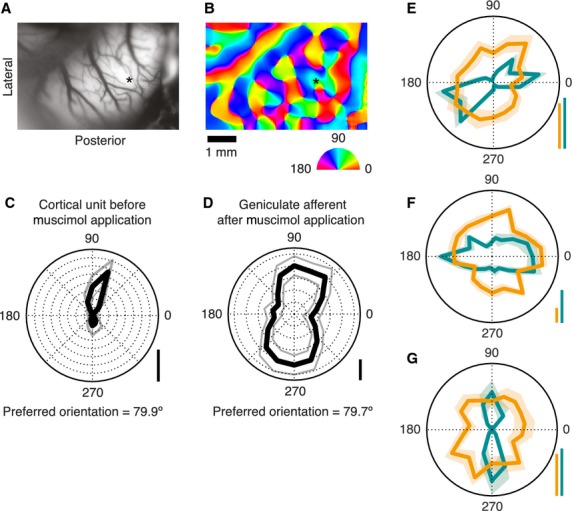
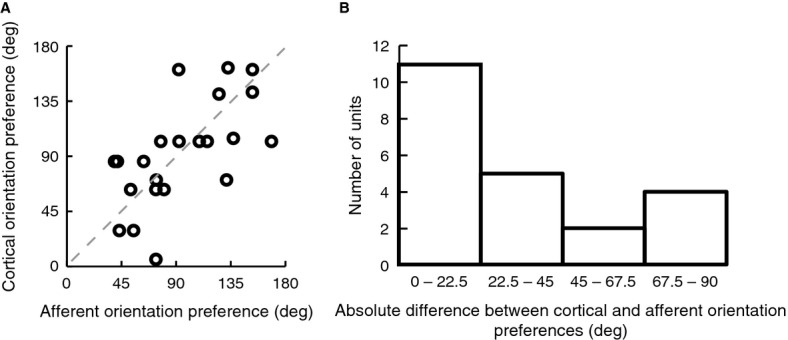
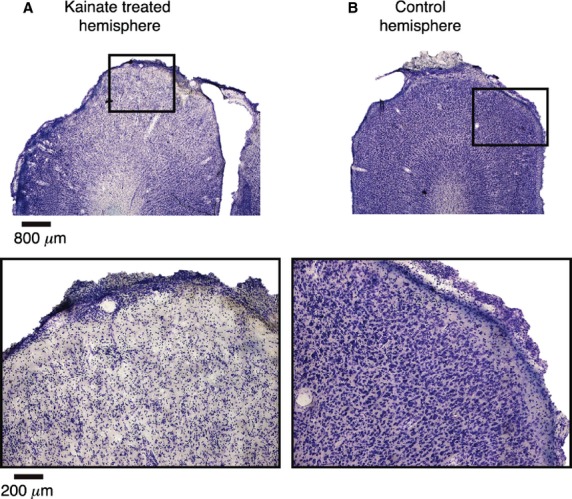
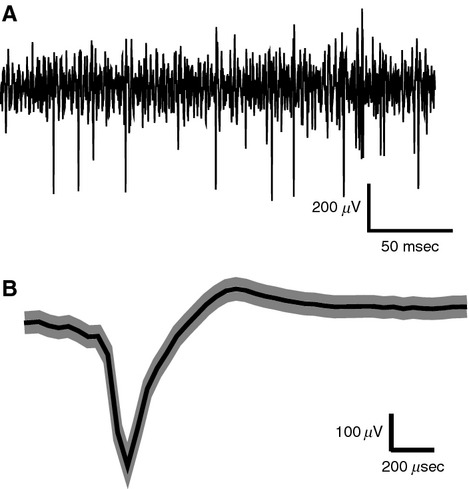
The primary visual cortex of carnivores and primates shows an orderly progression of domains of neurons that are selective to a particular orientation of visual stimuli such as bars and gratings. We recorded from single-thalamic afferent fibers that terminate in these domains to address the issue whether the orientation sensitivity of these fibers could form the basis of the remarkable orientation selectivity exhibited by most cortical cells. We first performed optical imaging of intrinsic signals to obtain a map of orientation domains on the dorsal aspect of the anaesthetized cat's area 17. After confirming using electrophysiological recordings the orientation preferences of single neurons within one or two domains in each animal, we pharmacologically silenced the cortex to leave only the afferent terminals active. The inactivation of cortical neurons was achieved by the superfusion of either kainic acid or muscimol. Responses of single geniculate afferents were then recorded by the use of high impedance electrodes. We found that the orientation preferences of the afferents matched closely with those of the cells in the orientation domains that they terminated in (Pearson's r = 0.633, n = 22, P = 0.002). This suggests a possible subcortical origin for cortical orientation selectivity.
食肉动物和灵长类动物的初级视觉皮层显示出神经元区域的有序排列,这些神经元对诸如线条和光栅等视觉刺激的特定方向具有选择性。我们记录了终止于这些区域的单根丘脑传入纤维,以探讨这些纤维的方向敏感性是否能构成大多数皮层细胞显著的方向选择性的基础。我们首先对内在信号进行光学成像,以获得麻醉猫17区背侧的方向域图。在通过电生理记录确认每只动物一两个区域内单个神经元的方向偏好后,我们通过药理学方法使皮层沉默,仅使传入终末保持活跃。通过灌流 kainic 酸或蝇蕈醇实现皮层神经元的失活。然后使用高阻抗电极记录单个膝状体传入纤维的反应。我们发现,传入纤维的方向偏好与它们终止的方向域中的细胞的方向偏好密切匹配(皮尔逊相关系数r = 0.633,n = 22,P = 0.002)。这表明皮层方向选择性可能起源于皮层下。