Sasaki Takashi, Seino Yutaka, Fukatsu Atsushi, Ubukata Michito, Sakai Soichi, Samukawa Yoshishige
Institute of Clinical Medicine and Research, The Jikei University School of Medicine, 163-1 Kashiwashita, Kashiwa, Chiba, 277-8567, Japan.
Adv Ther. 2015 Apr;32(4):319-40. doi: 10.1007/s12325-015-0200-x. Epub 2015 Apr 9.
Luseogliflozin, a potent, selective sodium glucose cotransporter 2 inhibitor, promotes urinary glucose excretion (UGE) and reduces plasma glucose concentrations. Luseogliflozin was approved for use in Japan after favorable pharmacokinetic, pharmacodynamic, and safety profiles were reported in healthy Japanese subjects and patients with type 2 diabetes mellitus (T2DM) in clinical development studies. We aimed to investigate the pharmacokinetics, pharmacodynamics, and safety of multiple doses of luseogliflozin administered once daily for 7 days in Japanese patients with T2DM.
We conducted a randomized, placebo-controlled, single-blind, parallel-group, clinical pharmacology study at the P-One Clinic, Keikokai Medical Corporation (Tokyo, Japan) between August 2009 and November 2009. Forty Japanese patients with T2DM were randomly assigned to receive once-daily 0.5, 1, 2.5 or 5 mg luseogliflozin or placebo for 7 days. We assessed the pharmacokinetics, pharmacodynamics (including changes in UGE and plasma glucose concentrations), and safety of luseogliflozin.
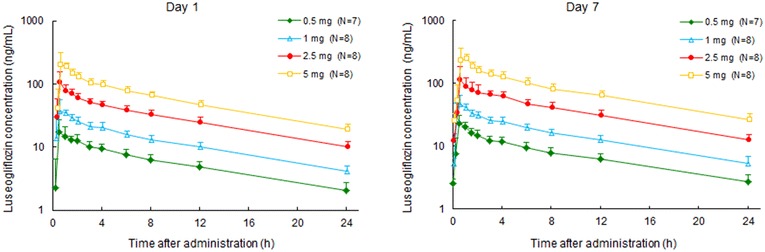
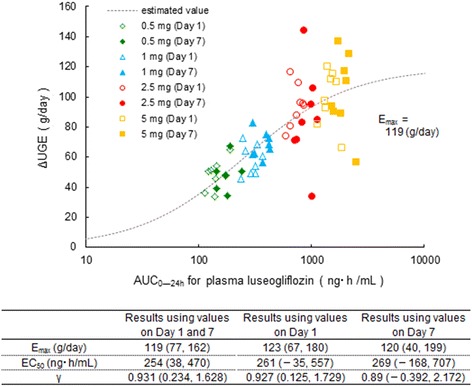
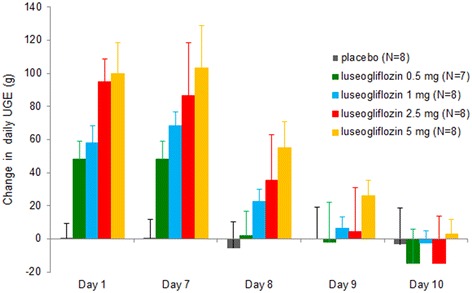
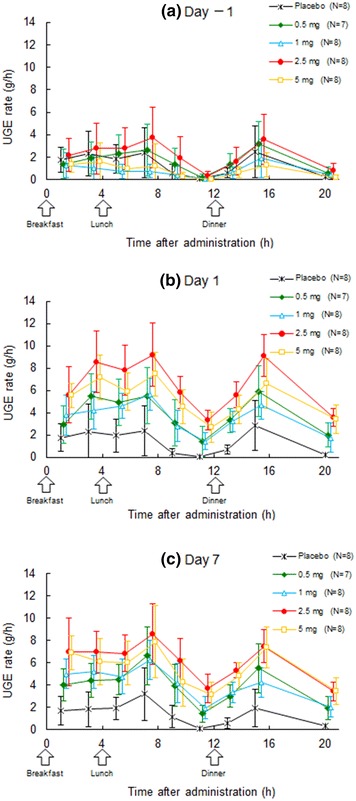
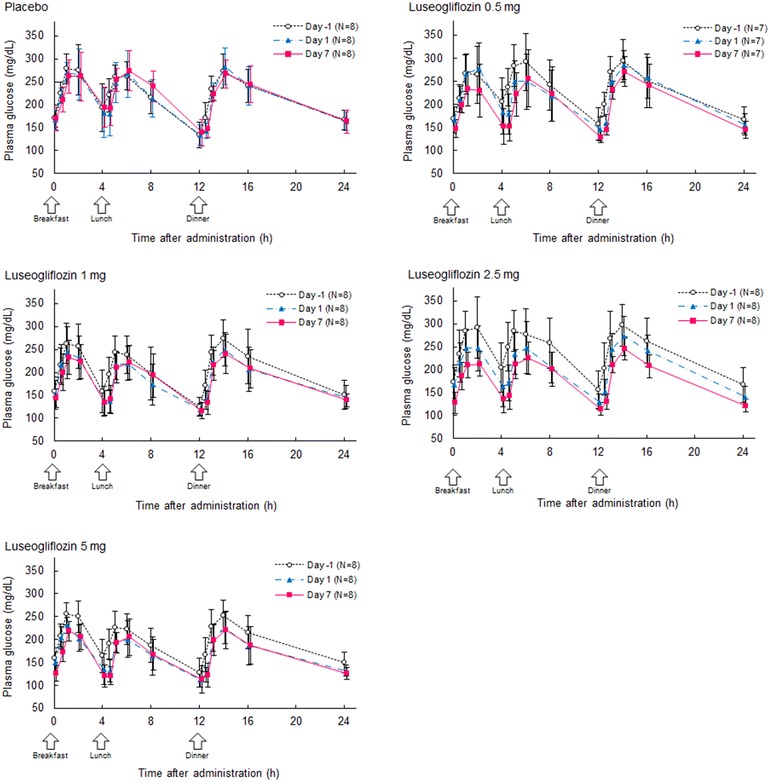
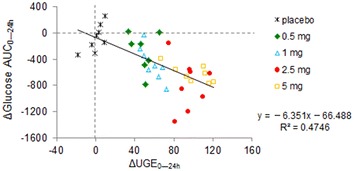
The plasma concentrations of luseogliflozin and its active metabolite, M2, were dose proportional, without accumulation. 24-h UGE was greater in all luseogliflozin groups versus placebo. Least-squares mean differences in 24-h UGE on Day 7 increased dose dependently in the luseogliflozin groups, with values of 49.2, 66.5, 89.4, and 101 g/day at 0.5, 1, 2.5, and 5 mg, respectively. On Day 7, the areas under the concentration-time curves for post-meal plasma glucose and the mean plasma glucose for 0-16 h were significantly lower in all luseogliflozin groups versus placebo. Seven patients had mild adverse events (AEs); all were resolved. No AEs led to study discontinuation.
Once-daily administration of luseogliflozin for 7 days increased 24-h UGE in a dose-dependent manner, reduced plasma glucose concentrations, and was well tolerated in Japanese patients with T2DM. The pharmacokinetic and pharmacodynamic profile of luseogliflozin observed in this study supports its once-daily dosing regimen.
Taisho Pharmaceutical Co., Ltd.
鲁格列净是一种强效、选择性钠-葡萄糖协同转运蛋白2抑制剂,可促进尿糖排泄(UGE)并降低血糖浓度。在临床开发研究中,鲁格列净在健康日本受试者和2型糖尿病(T2DM)患者中展现出良好的药代动力学、药效学和安全性特征后,于日本获批使用。我们旨在研究在日本T2DM患者中每日一次服用多剂量鲁格列净,连续服用7天的药代动力学、药效学及安全性。
2009年8月至2009年11月期间,我们在日本东京庆光会医疗集团P-One诊所开展了一项随机、安慰剂对照、单盲、平行组临床药理学研究。40例日本T2DM患者被随机分配,接受每日一次0.5、1、2.5或5mg鲁格列净或安慰剂治疗,为期7天。我们评估了鲁格列净的药代动力学、药效学(包括UGE和血糖浓度变化)及安全性。
鲁格列净及其活性代谢产物M2的血浆浓度呈剂量正比关系,无蓄积现象。所有鲁格列净组的24小时UGE均高于安慰剂组。鲁格列净组第7天24小时UGE的最小二乘均值差异呈剂量依赖性增加,0.5、1、2.5和5mg剂量组的值分别为49.2、66.5、89.4和101g/天。在第7天,所有鲁格列净组餐后血糖浓度-时间曲线下面积和0至16小时平均血糖均显著低于安慰剂组。7例患者出现轻度不良事件(AE);所有事件均已缓解。无AE导致研究中断。
在日本T2DM患者中,每日一次服用鲁格列净7天可使24小时UGE呈剂量依赖性增加,降低血糖浓度,且耐受性良好。本研究中观察到的鲁格列净药代动力学和药效学特征支持其每日一次给药方案。
大正制药株式会社