Department of Pharmacology, Faculty of Medicine, Kagawa University, 1750-1 Ikenobe, Miki-cho, Kita-gun, Kagawa 761-0793, Japan.
Int J Mol Sci. 2019 Feb 1;20(3):629. doi: 10.3390/ijms20030629.
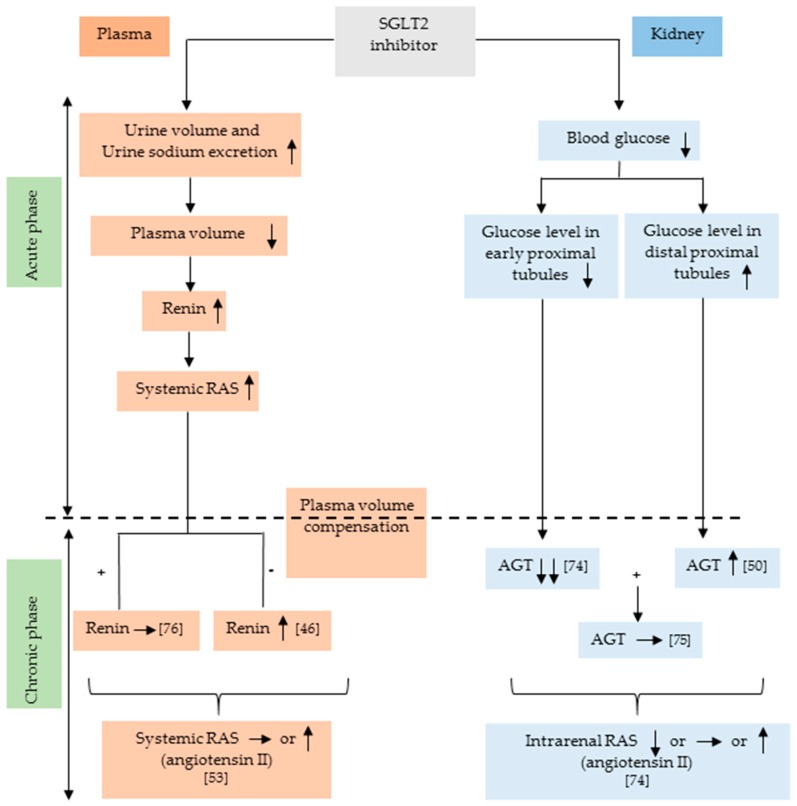
The renin-angiotensin system (RAS) plays an important role in regulating body fluids and blood pressure. However, inappropriate activation of the RAS contributes to the pathogenesis of cardiovascular and renal diseases. Recently, sodium glucose cotransporter 2 (SGLT2) inhibitors have been used as anti-diabetic agents. SGLT2 inhibitors induce glycosuria and improve hyperglycemia by inhibiting urinary reabsorption of glucose. However, in the early stages of treatment, these inhibitors frequently cause polyuria and natriuresis, which potentially activate the RAS. Nevertheless, the effects of SGLT2 inhibitors on RAS activity are not straightforward. Available data indicate that treatment with SGLT2 inhibitors transiently activates the systemic RAS in type 2 diabetic patients, but not the intrarenal RAS. In this review article, we summarize current evidence of the diuretic effects of SGLT2 inhibitors and their influence on RAS activity.
肾素-血管紧张素系统(RAS)在调节体液和血压方面发挥着重要作用。然而,RAS 的不适当激活会导致心血管和肾脏疾病的发病机制。最近,钠-葡萄糖共转运蛋白 2(SGLT2)抑制剂已被用作抗糖尿病药物。SGLT2 抑制剂通过抑制葡萄糖的尿重吸收诱导糖尿和改善高血糖。然而,在治疗的早期阶段,这些抑制剂经常导致多尿和利钠,这可能会激活 RAS。然而,SGLT2 抑制剂对 RAS 活性的影响并不简单。现有数据表明,SGLT2 抑制剂治疗可短暂激活 2 型糖尿病患者的全身 RAS,但不会激活肾内 RAS。在这篇综述文章中,我们总结了 SGLT2 抑制剂的利尿作用及其对 RAS 活性影响的现有证据。