Chai Juan, Feng Renjun, Shi Hourui, Ren Mengyun, Zhang Yindong, Wang Jingyi
Key Laboratory of Biology and Genetic Resources of Tropical Crops, Ministry of Agriculture, Institute of Tropical Bioscience and Biotechnology, Chinese Academy of Tropical Agricultural Sciences, Haikou, Hainan, China.
Key Laboratory of Biology and Genetic Resources of Tropical Crops, Ministry of Agriculture, Institute of Tropical Bioscience and Biotechnology, Chinese Academy of Tropical Agricultural Sciences, Haikou, Hainan, China; College of Agronomy, Hainan University, Haikou, Hainan, China.
PLoS One. 2015 Apr 9;10(4):e0123083. doi: 10.1371/journal.pone.0123083. eCollection 2015.
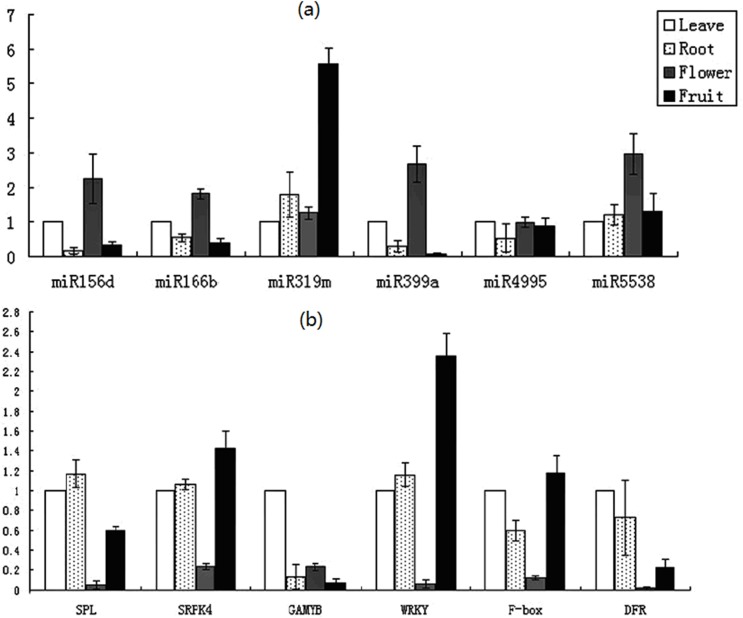
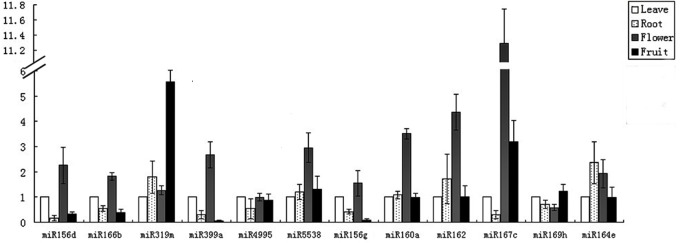
MicroRNAs (miRNAs) represent a class of endogenous non-coding small RNAs that play important roles in multiple biological processes by degrading targeted mRNAs or repressing mRNA translation. Thousands of miRNAs have been identified in many plant species, whereas only a limited number of miRNAs have been predicted in M. acuminata (A genome) and M. balbisiana (B genome). Here, previously known plant miRNAs were BLASTed against the Expressed Sequence Tag (EST) and Genomic Survey Sequence (GSS), a database of banana genes. A total of 32 potential miRNAs belonging to 13 miRNAs families were detected using a range of filtering criteria. 244 miRNA:target pairs were subsequently predicted, most of which encode transcription factors or enzymes that participate in the regulation of development, growth, metabolism, and other physiological processes. In order to validate the predicted miRNAs and the mutual relationship between miRNAs and their target genes, qRT-PCR was applied to detect the tissue-specific expression levels of 12 putative miRNAs and 6 target genes in roots, leaves, flowers, and fruits. This study provides some important information about banana pre-miRNAs, mature miRNAs, and miRNA target genes and these findings can be applied to future research of miRNA functions.
微小RNA(miRNA)是一类内源性非编码小RNA,通过降解靶标mRNA或抑制mRNA翻译在多种生物学过程中发挥重要作用。在许多植物物种中已鉴定出数千种miRNA,而在尖叶蕉(A基因组)和野蕉(B基因组)中仅预测到有限数量的miRNA。在此,将先前已知的植物miRNA与香蕉基因数据库表达序列标签(EST)和基因组调查序列(GSS)进行比对。使用一系列筛选标准共检测到属于13个miRNA家族的32个潜在miRNA。随后预测了244个miRNA:靶标对,其中大多数编码参与发育、生长、代谢和其他生理过程调控的转录因子或酶。为了验证预测的miRNA以及miRNA与其靶标基因之间的相互关系,应用qRT-PCR检测12个假定miRNA和6个靶标基因在根、叶、花和果实中的组织特异性表达水平。本研究提供了一些关于香蕉前体miRNA、成熟miRNA和miRNA靶标基因的重要信息,这些发现可应用于未来miRNA功能的研究。