Ejaz Sohail, Williamson David J, Jensen-Kondering Ulf, Ahmed Tahir, Sawiak Steve J, Baron Jean-Claude
Stroke Research Group, Department of Clinical Neurosciences, University of Cambridge , Cambridge , UK.
Department of Clinical Neurosciences, Wolfson Brain Imaging Centre, Addenbrooke's Hospital, University of Cambridge , Cambridge , UK.
Front Neurol. 2015 Mar 26;6:64. doi: 10.3389/fneur.2015.00064. eCollection 2015.
Selective neuronal loss (SNL) in the reperfused penumbra may impact clinical recovery and is thus important to investigate. Brief proximal middle cerebral artery occlusion (MCAo) results in predominantly striatal SNL, yet cortical damage is more relevant given its behavioral implications and that thrombolytic therapy mainly rescues the cortex. Distal temporary MCAo (tMCAo) does target the cortex, but the optimal occlusion duration that results in isolated SNL has not been determined. In the present study, we assessed different distal tMCAo durations looking for consistently pure SNL.
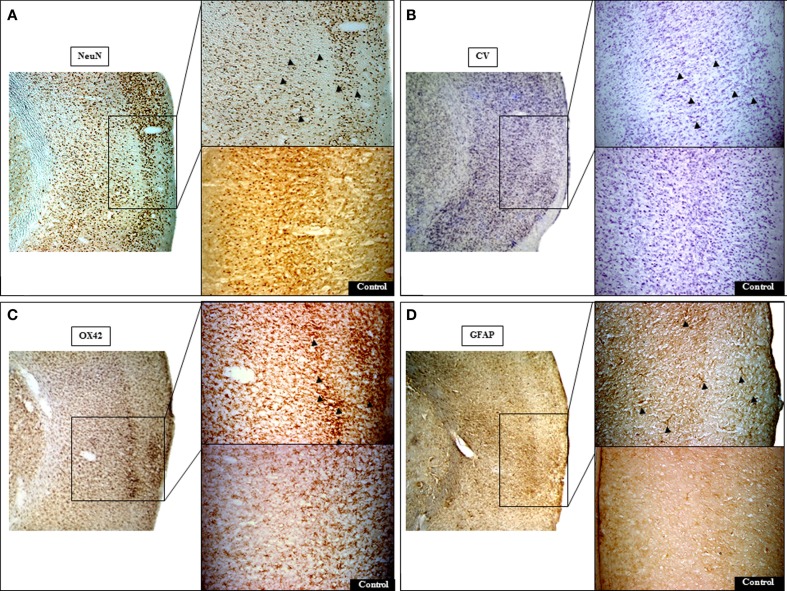
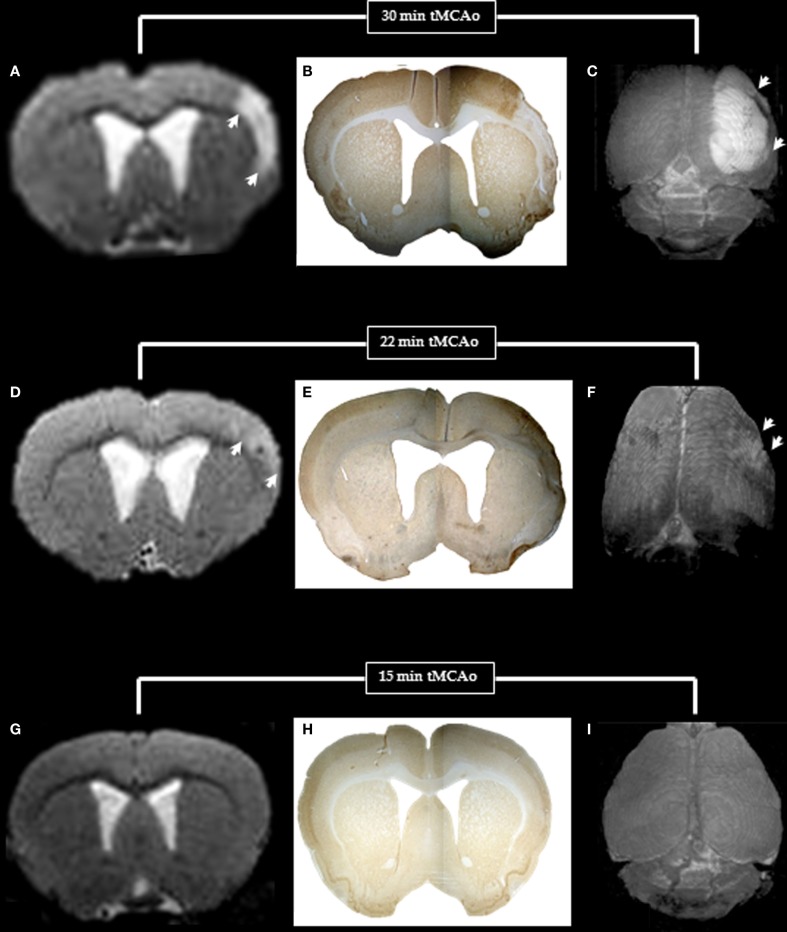
Microclip distal tMCAo (md-tMCAo) was performed in ~6-month old male spontaneously hypertensive rats (SHRs). We previously reported that 45 min md-tMCAo in SHRs results in pan-necrosis in the majority of subjects. Accordingly, three shorter MCAo durations were investigated here in decremental succession, namely 30, 22, and 15 min (n = 3, 3, and 7 subjects, respectively). Recanalization was confirmed by MR angiography just prior to brain collection at 28 days and T2-weighted MRI was obtained for characterization of ischemic lesions. NeuN, OX42, and GFAP immunohistochemistry appraised changes in neurons, microglia, and astrocytes, respectively. Ischemic lesions were categorized into three main types: (1) pan-necrosis; (2) partial infarction; and (3) SNL.
Pan-necrosis or partial infarction was present in all 30 min and 22 min subjects, but not in the 15 min group (p < 0.001), in which isolated cortical SNL was consistently present. MRI revealed characteristic hyperintense abnormalities in all rats with pan-necrosis or partial infarction, but no change in any 15 min subject.
We found that 15 min distal MCAo consistently resulted in pure cortical SNL, whereas durations equal or longer than 22 min consistently resulted in infarcts. This model may be of use to study the pathophysiology of cortical SNL and its prevention by appropriate interventions.
再灌注半暗带中的选择性神经元丢失(SNL)可能会影响临床恢复,因此对其进行研究很重要。短暂的大脑中动脉近端闭塞(MCAo)主要导致纹状体SNL,但考虑到其行为学意义以及溶栓治疗主要挽救的是皮质,皮质损伤更为相关。远端暂时性MCAo(tMCAo)确实以皮质为靶点,但导致孤立性SNL的最佳闭塞持续时间尚未确定。在本研究中,我们评估了不同的远端tMCAo持续时间,以寻找始终如一的单纯性SNL。
在约6个月大的雄性自发性高血压大鼠(SHR)中进行微夹远端tMCAo(md-tMCAo)。我们之前报道过,SHR中45分钟的md-tMCAo会导致大多数受试者出现全坏死。因此,在此研究了三个更短的MCAo持续时间,并依次递减,即30、22和15分钟(分别为n = 3、3和7只大鼠)。在28天时收集大脑之前,通过磁共振血管造影确认再灌注,并获取T2加权MRI以表征缺血性病变。分别用NeuN、OX42和GFAP免疫组织化学评估神经元、小胶质细胞和星形胶质细胞的变化。缺血性病变分为三种主要类型:(1)全坏死;(2)部分梗死;(3)SNL。
所有30分钟和22分钟组的大鼠均出现全坏死或部分梗死,但15分钟组未出现(p < 0.001),该组始终存在孤立的皮质SNL。MRI显示所有全坏死或部分梗死的大鼠均有特征性的高强度异常,但15分钟组的大鼠无变化。
我们发现,15分钟的远端MCAo始终导致单纯的皮质SNL,而等于或长于22分钟的持续时间始终导致梗死。该模型可能有助于研究皮质SNL的病理生理学及其通过适当干预的预防。