Wang Qi, Li Xuefei, Ren Shengxiang, Cheng Ningning, Zhao Mingchuan, Zhang Yishi, Li Jiayu, Cai Weijing, Zhao Chao, Cao Wa, Zhou Caicun
Department of Lung Cancer and Immunology, Shanghai Pulmonary Hospital, Tongji University, Tongji University Medical School Cancer Institute, Shanghai, People's Republic of China.
PLoS One. 2015 Apr 10;10(4):e0122792. doi: 10.1371/journal.pone.0122792. eCollection 2015.
POTEE (POTE ankyrin domain family, member E) is a newly identified cancer-testis antigen that has been found to be expressed in a wide variety of human cancers including cancers of the colon, prostate, lung, breast, ovary, and pancreas.
To measure the serum levels of POTEE in patients with non-small-cell lung cancer (NSCLC) and to explore the clinical significance of POTEE in NSCLC.
104 NSCLC patients, 66 benign lung disease patients and 80 healthy volunteers were enrolled in this study from May 2013 to February 2014. Serum POTEE levels were measured using enzyme-linked immunosorbent assay (ELISA). Numerical variables were recorded as means ± standard deviation (SD) and analyzed by independent t tests. Categorical variables were calculated as rates and were analyzed using a χ2 test or Fisher's exact test. Survival curves were estimated and compared using the Kaplan-Meier method and log-rank tests.
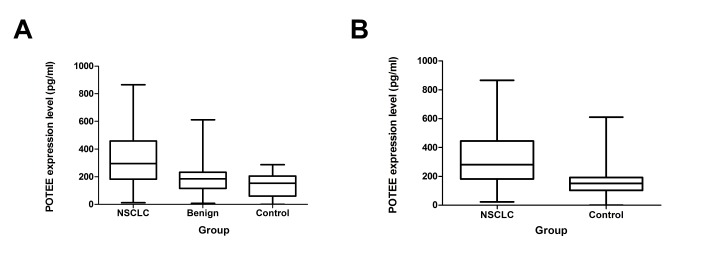
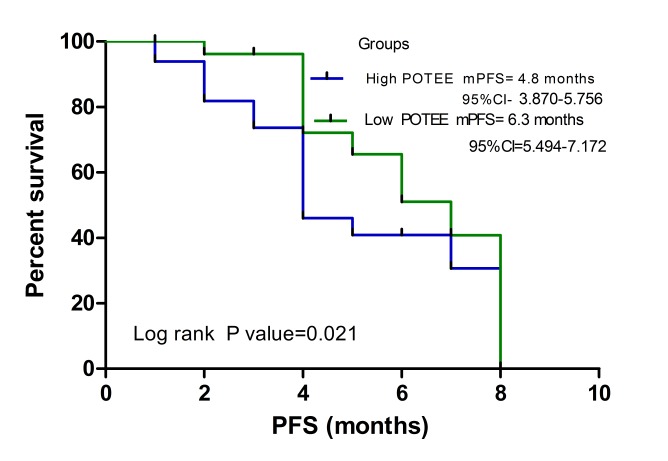
Serum POTEE levels were significantly higher in NSCLC patients than in benign lung disease patients and healthy controls (mean ± SD [pg/ml], 324.38± 13.84 vs. 156.93 ± 17.38 and 139.09 ± 15.80, P<0.001) and were significantly correlated with TNM stage. Survival analysis revealed that patients with low serum POTEE had longer progression-free survival (PFS) than those with high serum POTEE (P=0.021). Cox multivariate analysis indicated that POTEE was an independent prognostic factor of progression-free survival (P =0.009, hazard ratio, 2.440).
Serum POTEE level in NSCLC patients is associated with TNM stage and is a potential prognostic factor.
POTEE(POTE锚蛋白结构域家族成员E)是一种新发现的癌胚抗原,已发现在多种人类癌症中表达,包括结肠癌、前列腺癌、肺癌、乳腺癌、卵巢癌和胰腺癌。
检测非小细胞肺癌(NSCLC)患者血清中POTEE水平,并探讨POTEE在NSCLC中的临床意义。
2013年5月至2014年2月,本研究纳入104例NSCLC患者、66例良性肺病患者和80名健康志愿者。采用酶联免疫吸附测定(ELISA)法检测血清POTEE水平。数值变量记录为均值±标准差(SD),并通过独立t检验进行分析。分类变量计算为率,并使用χ2检验或Fisher精确检验进行分析。采用Kaplan-Meier法和对数秩检验估计和比较生存曲线。
NSCLC患者血清POTEE水平显著高于良性肺病患者和健康对照(均值±SD[pg/ml],324.38±13.84 vs.156.93±17.38和139.09±15.80,P<0.001),且与TNM分期显著相关。生存分析显示,血清POTEE水平低的患者无进展生存期(PFS)长于血清POTEE水平高的患者(P=0.021)。Cox多因素分析表明,POTEE是无进展生存期的独立预后因素(P =0.009,风险比,2.440)。
NSCLC患者血清POTEE水平与TNM分期相关,是一个潜在的预后因素。