Harlow P, Watkins E, Thornton R D, Nemer M
Institute for Cancer Research, Fox Chase Cancer Center, Philadelphia, Pennsylvania 19111.
Mol Cell Biol. 1989 Dec;9(12):5445-55. doi: 10.1128/mcb.9.12.5445-5455.1989.
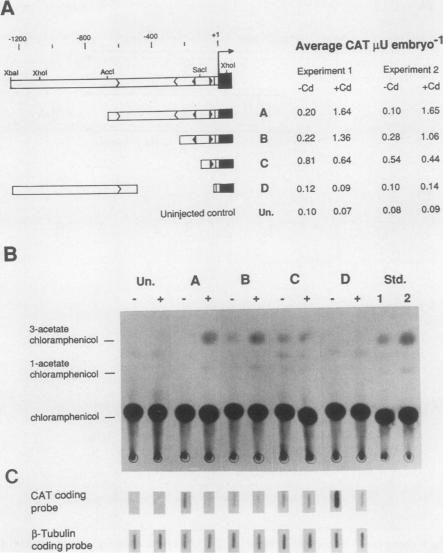
The metallothionein-A gene in the metallothionein gene family of the sea urchin Strongylocentrotus purpuratus (SpMTA gene) was sequenced and found to contain three coding exons plus a 3' entirely noncoding exon. Putative alpha and beta MT domains were encoded, by its exons 2 and 3, respectively, in reverse of the order in vertebrate metallothionein genes. The SpMTA promoter was characterized through the expression of recombinant constructs containing various portions of the proximal 678-base-pair (bp) 5'-flanking region of the SpMTA gene. Zygotes injected with constructs were cultured to the blastula stage in the presence of a heavy-metal chelator and then incubated in the presence or absence of cadmium. The longest constructs were expressed only when heavy-metal ion was present. Two putative metal-responsive elements (MREs a and b) within 240 bp of the transcription start site resembled mammalian MREs in their critical 8-bp cores (TGCRCNCS) and in their locations relative to each other and to the TATA box. Elimination of activity by site-specific mutations in MREs a and b, separately or in both, identified them as metal regulatory elements. Thus, MRE recognition in this invertebrate resembles that in vertebrates. Upstream sites with single-mismatched MREs neither acted as MREs nor amplified the activity of MREs a and b. The SpMTA, Spec1, and CyIIIa actin genes, which have the same ectodermal specificity, have common DNA elements at relatively similar locations in their promoter regions; however, these elements are insufficient in themselves to promote gene expression.
对紫海胆(Strongylocentrotus purpuratus)金属硫蛋白基因家族中的金属硫蛋白 -A 基因(SpMTA 基因)进行了测序,发现它包含三个编码外显子以及一个 3' 端完全非编码的外显子。其外显子 2 和 3 分别编码推定的α和β金属硫蛋白结构域,顺序与脊椎动物金属硫蛋白基因相反。通过含有 SpMTA 基因近端 678 个碱基对(bp)5' 侧翼区域不同部分的重组构建体的表达来表征 SpMTA 启动子。将注射了构建体的受精卵在重金属螯合剂存在的情况下培养至囊胚期,然后在有或没有镉的情况下孵育。最长的构建体仅在存在重金属离子时表达。转录起始位点 240 bp 内的两个推定的金属反应元件(MREs a 和 b)在其关键的 8 个碱基核心(TGCRCNCS)以及它们彼此之间和相对于 TATA 框的位置上类似于哺乳动物的 MREs。分别或同时对 MREs a 和 b 进行位点特异性突变消除活性,确定它们为金属调节元件。因此,这种无脊椎动物中的 MRE 识别与脊椎动物中的相似。具有单碱基错配 MREs 的上游位点既不充当 MREs,也不增强 MREs a 和 b 的活性。具有相同外胚层特异性的 SpMTA、Spec1 和 CyIIIa 肌动蛋白基因在其启动子区域相对相似的位置具有共同的 DNA 元件;然而,这些元件本身不足以促进基因表达。