Catov Janet M, Abatemarco Diane, Althouse Andrew, Davis Esa M, Hubel Carl
Department of Obstetrics, Gynecology & Reproductive Sciences, University of Pittsburgh School of Medicine, Pittsburgh, Pennsylvania, USA; Department of Epidemiology, University of Pittsburgh, Pittsburgh, Pennsylvania, USA.
Obesity (Silver Spring). 2015 May;23(5):1071-8. doi: 10.1002/oby.21006. Epub 2015 Apr 10.
Maternal obesity is associated with increased risk of large-for-gestational-age (LGA) and small-for-gestational-age (SGA) births. Both are related to childhood obesity. This study considers that the patterns of gestational weight gain (GWG) may help to disentangle these competing risks.
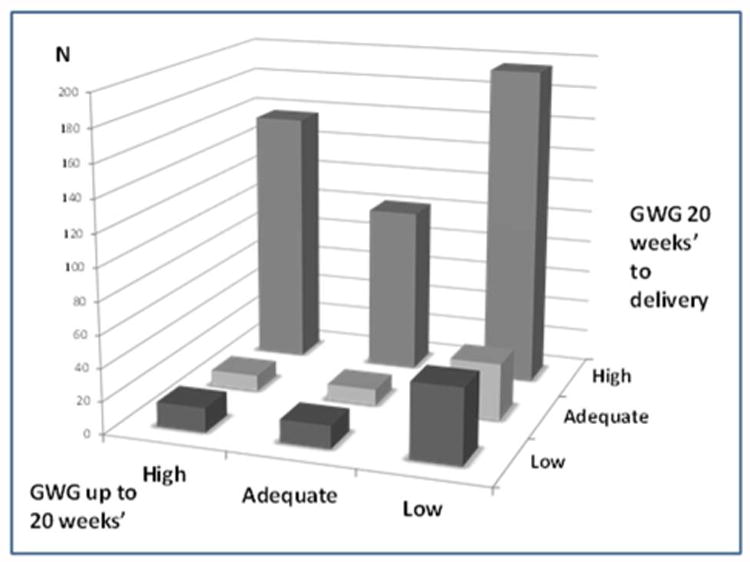
Patterns of GWG were characterized among a cohort of women with overweight or obesity (n = 651). Polytomous logistic regression models were tested for associations between GWG patterns and birth weight outcomes: SGA (<10th) and LGA (>90th percentile).
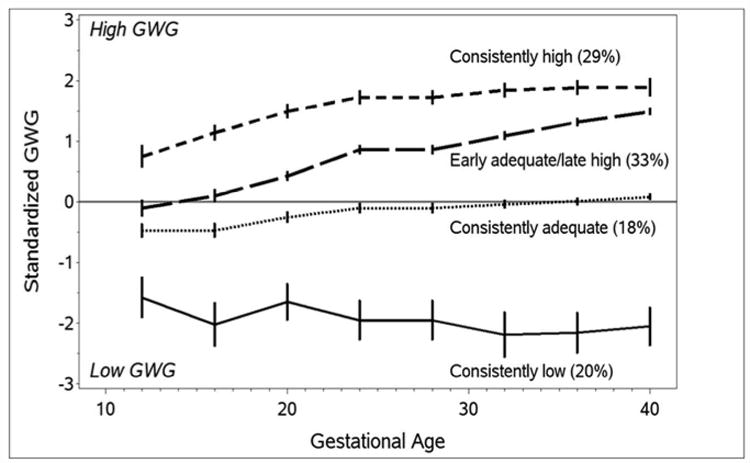
Rates of SGA were higher than those for LGA (14.9% vs. 7.8%). Four GWG patterns were identified: consistently high (29%), early adequate/late high (33%), consistently adequate (18%), and consistently low (20%). Risk of LGA was highest in women with consistently high GWG (adjusted odds ratio [OR] 4.62 [1.53, 13.96]), and risk was elevated, but with lower magnitude, among women with early adequate/late high gains (OR 3.07 [1.01, 9.37]). High GWG before 20 weeks, regardless of later gain, was related to LGA. Low gain before 20 weeks accompanied by high gain later may be associated with reduced SGA risk (0.55 [0.29, 1.07]).
The pattern of weight gain during pregnancy may be an important contributor to or marker of abnormal fetal growth among women with overweight or obesity.
孕妇肥胖与大于胎龄儿(LGA)和小于胎龄儿(SGA)出生风险增加相关。这两者均与儿童肥胖有关。本研究认为,孕期体重增加(GWG)模式可能有助于理清这些相互竞争的风险。
在一组超重或肥胖女性(n = 651)中对GWG模式进行了特征分析。采用多分类逻辑回归模型测试GWG模式与出生体重结局之间的关联:SGA(<第10百分位数)和LGA(>第90百分位数)。
SGA的发生率高于LGA(14.9%对7.8%)。确定了四种GWG模式:持续高增长(29%)、早期适当/晚期高增长(33%)、持续适当增长(18%)和持续低增长(20%)。GWG持续高增长的女性发生LGA的风险最高(调整优势比[OR]为4.62[1.53,13.96]),早期适当/晚期高增长的女性风险也有所升高,但幅度较小(OR为3.07[1.01,9.37])。孕20周前GWG高增长,无论后期增长情况如何,均与LGA有关。孕20周前增长低且后期增长高可能与SGA风险降低有关(0.55[0.29,1.07])。
孕期体重增加模式可能是超重或肥胖女性胎儿生长异常的重要促成因素或标志。