Mamy Laure, Patureau Dominique, Barriuso Enrique, Bedos Carole, Bessac Fabienne, Louchart Xavier, Martin-Laurent Fabrice, Miege Cecile, Benoit Pierre
INRA-AgroParisTech, UMR 1402 ECOSYS (Ecologie Fonctionnelle et Ecotoxicologie des Agroécosystèmes) , Versailles , France.
INRA, UR 0050 LBE (Laboratoire de Biotechnologie de l'Environnement) , Narbonne , France.
Crit Rev Environ Sci Technol. 2015 Jun 18;45(12):1277-1377. doi: 10.1080/10643389.2014.955627.
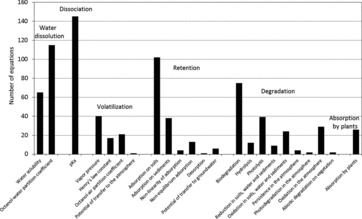
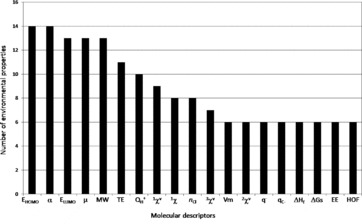
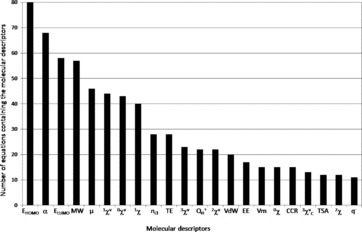
A comprehensive review of quantitative structure-activity relationships (QSAR) allowing the prediction of the fate of organic compounds in the environment from their molecular properties was done. The considered processes were water dissolution, dissociation, volatilization, retention on soils and sediments (mainly adsorption and desorption), degradation (biotic and abiotic), and absorption by plants. A total of 790 equations involving 686 structural molecular descriptors are reported to estimate 90 environmental parameters related to these processes. A significant number of equations was found for dissociation process (pK), water dissolution or hydrophobic behavior (especially through the K parameter), adsorption to soils and biodegradation. A lack of QSAR was observed to estimate desorption or potential of transfer to water. Among the 686 molecular descriptors, five were found to be dominant in the 790 collected equations and the most generic ones: four quantum-chemical descriptors, the energy of the highest occupied molecular orbital (E) and the energy of the lowest unoccupied molecular orbital (E), polarizability (α) and dipole moment (μ), and one constitutional descriptor, the molecular weight. Keeping in mind that the combination of descriptors belonging to different categories (constitutional, topological, quantum-chemical) led to improve QSAR performances, these descriptors should be considered for the development of new QSAR, for further predictions of environmental parameters. This review also allows finding of the relevant QSAR equations to predict the fate of a wide diversity of compounds in the environment.
开展了一项关于定量构效关系(QSAR)的全面综述,该关系可根据有机化合物的分子性质预测其在环境中的归宿。所考虑的过程包括水溶、解离、挥发、在土壤和沉积物上的滞留(主要是吸附和解吸)、降解(生物降解和非生物降解)以及植物吸收。共报告了790个涉及686个结构分子描述符的方程,用于估算与这些过程相关的90个环境参数。发现了大量关于解离过程(pK)、水溶或疏水行为(特别是通过K参数)、土壤吸附和生物降解的方程。观察到缺乏用于估算解吸或转移到水中的潜力的QSAR。在686个分子描述符中,发现有五个在收集的790个方程中占主导地位且最为通用:四个量子化学描述符,即最高占据分子轨道能量(E)和最低未占据分子轨道能量(E)、极化率(α)和偶极矩(μ),以及一个结构描述符,即分子量。鉴于属于不同类别(结构、拓扑、量子化学)的描述符的组合可提高QSAR性能,在开发新的QSAR以进一步预测环境参数时应考虑这些描述符。本综述还有助于找到相关的QSAR方程,以预测环境中多种化合物的归宿。