Bork U, Rahbari N N, Schölch S, Reissfelder C, Kahlert C, Büchler M W, Weitz J, Koch M
Department of GI, Thoracic and Vascular Surgery, University Hospital Carl-Gustav-Carus Dresden, Dresden, Germany.
1] Department of General, GI and Transplant Surgery, University Hospital Heidelberg, Heidelberg, Germany [2] Department of Cancer Biology, Metastasis Research Center, University of Texas MD Anderson Cancer Center, Houston, TX, USA.
Br J Cancer. 2015 Apr 14;112(8):1306-13. doi: 10.1038/bjc.2015.88. Epub 2015 Mar 31.
Circulating tumour cells (CTC) in the blood have been accepted as a prognostic marker in patients with metastatic colorectal cancer (CRC). Only limited data exist on the prognostic impact of CTC in patients with early stage CRC using standardised detection assays. The aim of this study was to elucidate the role of CTC in patients with non-metastatic CRC.
A total of 287 patients with potentially curable CRC were enrolled, including 239 patients with UICC stage I-III. CTC were measured in the blood using the CellSearch system preoperatively and on postoperative days 3 and 7. The complete patient group (UICC I-IV) and the non-metastatic cohort (UICC I-III) were analysed independently. Patients were followed for 28 (0-53) months. Prognostic factors for overall and progression-free survival were analysed using univariate and multivariate analyses.
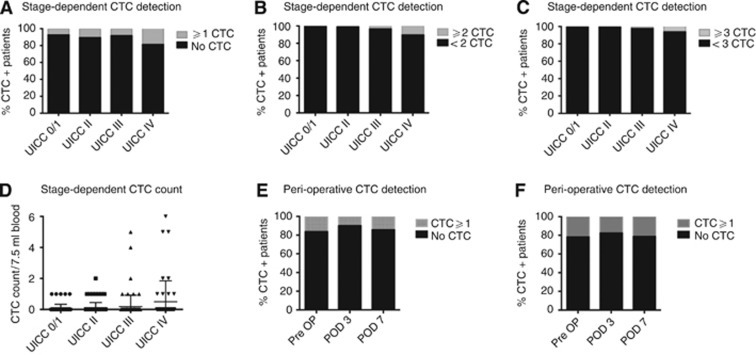
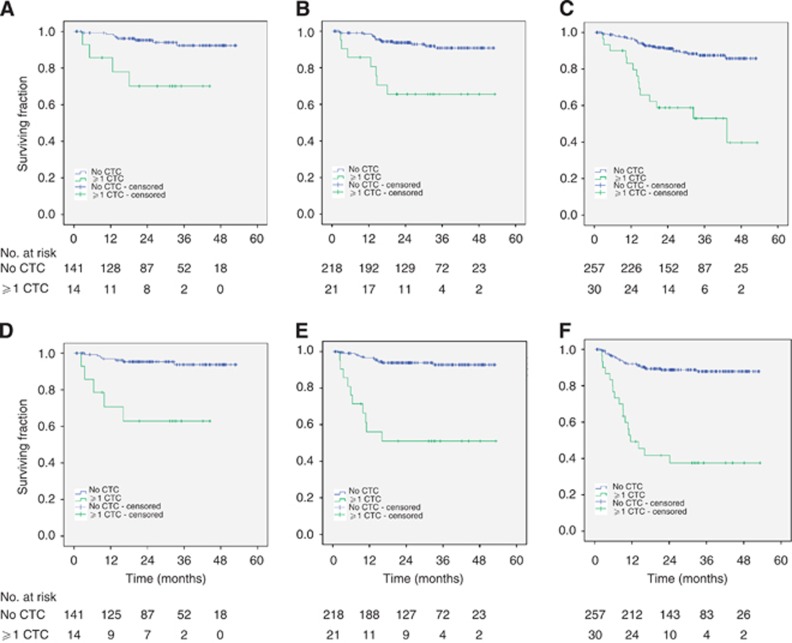
CTC were detected more frequently in patients with metastatic disease. No clinicopathological variables were associated with CTC detection in non-metastatic patients. CTC detection (⩾1 CTC per 7.5 ml blood) in the blood was significantly associated with worse overall survival (49.8 vs 38.4 months; P<0.001) in the non-metastatic group (UICC I-III), as well as in the complete cohort (48.4 vs 33.6 months; P<0.001). On multivariate analysis CTC were the strongest prognostic factor in non-metastatic patients (hazard ratio (HR) 5.5; 95% confidence interval (CI) 2.3-13.6) as well as in the entire study group (HR 5.6; 95% CI 2.6-12.0).
Preoperative CTC detection is a strong and independent prognostic marker in non-metastatic CRC.
血液中的循环肿瘤细胞(CTC)已被公认为转移性结直肠癌(CRC)患者的预后标志物。关于使用标准化检测方法检测早期CRC患者中CTC的预后影响的数据有限。本研究的目的是阐明CTC在非转移性CRC患者中的作用。
共纳入287例潜在可治愈的CRC患者,其中239例为国际抗癌联盟(UICC)I - III期患者。术前以及术后第3天和第7天使用CellSearch系统检测血液中的CTC。对整个患者组(UICC I - IV期)和非转移性队列(UICC I - III期)进行独立分析。对患者进行了28(0 - 53)个月的随访。使用单因素和多因素分析评估总生存期和无进展生存期的预后因素。
在转移性疾病患者中更频繁地检测到CTC。在非转移性患者中,没有临床病理变量与CTC检测相关。在非转移性组(UICC I - III期)以及整个队列中,血液中CTC检测(每7.5毫升血液中≥1个CTC)与较差的总生存期显著相关(49.8个月对38.4个月;P<0.001)(48.4个月对33.6个月;P<0.001)。多因素分析显示,CTC是非转移性患者(风险比(HR)5.5;95%置信区间(CI)2.3 - 13.6)以及整个研究组(HR 5.6;95% CI 2.6 - 12.0)中最强的预后因素。
术前CTC检测是非转移性CRC中一个强大且独立的预后标志物。