Yiannakou Yan, Piessevaux Hubert, Bouchoucha Michel, Schiefke Ingolf, Filip Rafal, Gabalec Libor, Dina Ion, Stephenson David, Kerstens René, Etherson Kevin, Levine Amy
Department of Gastroenterology, County Durham and Darlington NHS Foundation Trust, Durham, UK.
Cliniques Universitaires Saint-Luc, Université Catholique de Louvain, Brussels, Belgium.
Am J Gastroenterol. 2015 May;110(5):741-8. doi: 10.1038/ajg.2015.115. Epub 2015 Apr 14.
Prucalopride is effective at alleviating symptoms of chronic constipation in women. The aim of this study was to assess the efficacy of 12 weeks of prucalopride treatment compared with placebo in men with chronic constipation.
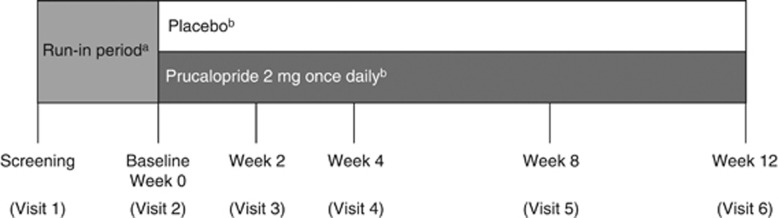
This was a multicenter, stratified, randomized, parallel-group, double-blind, placebo-controlled, phase 3 study (ClinicalTrials.gov identifier: NCT01147926). The primary end point was the proportion of patients with a mean of three or more spontaneous complete bowel movements (SCBMs) per week across the treatment period. Efficacy end points were assessed using daily electronic diaries, global assessment of the severity of constipation and efficacy of treatment, and Patient Assessment of Constipation-Symptoms (PAC-SYM) and Patient Assessment of Constipation-Quality of Life (PAC-QOL) questionnaires.
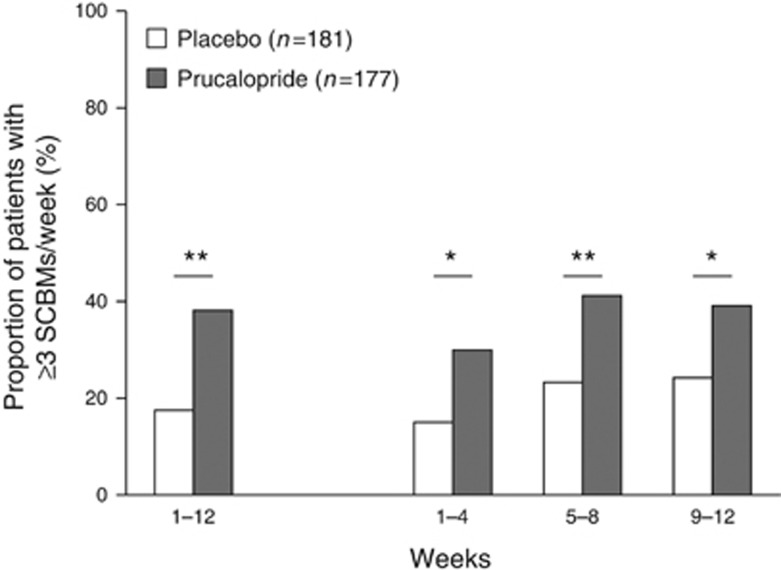
In total, 374 patients were enrolled in the study. Significantly more patients achieved a mean of three or more SCBMs per week in the prucalopride group (37.9%) than in the placebo group (17.7%, P<0.0001). The proportion of patients rating their constipation treatment as "quite a bit" to "extremely" effective at the final on-treatment visit was 46.7 and 30.4% in the prucalopride and placebo groups, respectively. The difference between treatment groups was statistically significant (P<0.0001). The proportion of patients with an improvement of at least 1 point in PAC-QOL satisfaction subscale score was 52.7 and 38.8% in the prucalopride and placebo groups, respectively (P=0.0035). Prucalopride had a good safety profile and was well tolerated.
Prucalopride is effective, has a good safety profile, and is well tolerated for the treatment of men with chronic constipation.
普芦卡必利可有效缓解女性慢性便秘症状。本研究旨在评估普芦卡必利治疗12周相较于安慰剂治疗对男性慢性便秘患者的疗效。
这是一项多中心、分层、随机、平行组、双盲、安慰剂对照的3期研究(ClinicalTrials.gov标识符:NCT01147926)。主要终点是在整个治疗期间每周平均有三次或更多次自发完全排便(SCBM)的患者比例。使用每日电子日记、便秘严重程度和治疗效果的整体评估以及便秘症状患者评估(PAC-SYM)和便秘生活质量患者评估(PAC-QOL)问卷来评估疗效终点。
共有374名患者纳入本研究。普芦卡必利组每周平均有三次或更多次SCBM的患者比例(37.9%)显著高于安慰剂组(17.7%,P<0.0001)。在最终治疗访视时,将便秘治疗评为“相当有效”至“极其有效”的患者比例,普芦卡必利组和安慰剂组分别为46.7%和30.4%。治疗组之间的差异具有统计学意义(P<0.0001)。普芦卡必利组和安慰剂组PAC-QOL满意度子量表得分至少提高1分的患者比例分别为52.7%和38.8%(P = 0.0035)。普芦卡必利具有良好的安全性,耐受性良好。
普芦卡必利对治疗男性慢性便秘有效,具有良好的安全性,且耐受性良好。