Breimaier Helga E, Halfens Ruud Jg, Lohrmann Christa
Institute of Nursing Science, Medical University of Graz, Billrothgasse 6, 8010 Graz, Austria.
Department of Health Services Research, CAPHRI, Maastricht University, Duboisdomein 30, 6229 GT Maastricht, The Netherlands.
BMC Nurs. 2015 Mar 31;14:18. doi: 10.1186/s12912-015-0064-z. eCollection 2015.
Research- and/or evidence-based knowledge are not routinely adopted in healthcare and nursing practice. It is also unclear which implementation strategies are effective in nursing practice and what expenditures of time and money are required for the successful implementation of clinical practice guidelines (CPGs). The aim in this study was to assess the effectiveness and required time investment of multifaceted and tailored strategies for implementing an evidence-based fall-prevention guideline (Falls CPG) into nursing practice in an acute care hospital setting.
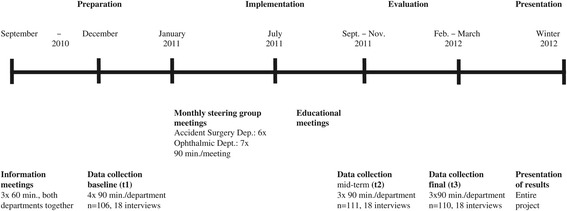
A before-and-after, mixed-method design was used within a participatory action research approach (PAR). The study was carried out in two departments of an Austrian university teaching hospital and included all graduate and assistant nurses. Data were collected through a questionnaire, group discussions and semi-structured interviews. Qualitative data were content-analysed using a template based on the Consolidated Framework for Implementation Research (CFIR), which also served as a theoretical framework for the study. Quantitative data were descriptively analysed using appropriate tests for independent groups.
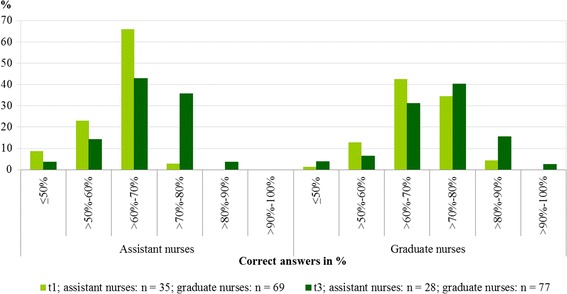
By applying multifaceted and tailored implementation strategies, the graduate and assistant nurses' knowledge on fall prevention, how to access the Falls CPG and the guideline itself increased significantly between baseline and final assessment (p ≤ .001). Qualitative data also revealed an increase in participant awareness of fall prevention. A baseline positive attitude towards guidelines improved significantly towards the end of the project (p = .001). Required fall prevention equipment like baby monitors or one-way glide sheets were available for use and any required environmental adaptations, e.g. a handrail in the corridor, were made. Hospital nursing personnel (approximately 150) invested a total of 1192 hours of working time over the course of the project.
Multifaceted strategies tailored to the specific setting within a PAR approach and guided by the CFIR enabled the effective implementation of a CPG into acute care nursing practice. Nursing managers now have sound knowledge of the time resources required for CPG implementation.
基于研究和/或证据的知识在医疗保健和护理实践中并未得到常规应用。目前尚不清楚哪些实施策略在护理实践中有效,以及成功实施临床实践指南(CPG)需要投入多少时间和资金。本研究的目的是评估多方面且量身定制的策略在急性护理医院环境中将基于证据的跌倒预防指南(跌倒CPG)应用于护理实践中的有效性和所需的时间投入。
在参与式行动研究方法(PAR)中采用前后对比的混合方法设计。该研究在奥地利一所大学教学医院的两个科室进行,纳入了所有研究生护士和助理护士。通过问卷调查、小组讨论和半结构化访谈收集数据。定性数据采用基于实施研究综合框架(CFIR)的模板进行内容分析,该框架也作为本研究的理论框架。定量数据使用适用于独立组的检验进行描述性分析。
通过应用多方面且量身定制的实施策略,研究生护士和助理护士在跌倒预防方面的知识、如何获取跌倒CPG以及指南本身在基线评估和最终评估之间有显著增加(p≤0.001)。定性数据还显示参与者对跌倒预防的认识有所提高。对指南的基线积极态度在项目结束时显著改善(p = 0.001)。如婴儿监视器或单向滑动床单等所需的跌倒预防设备可供使用,并且进行了任何所需的环境改造,例如走廊安装扶手。医院护理人员(约150人)在项目过程中总共投入了1192小时的工作时间。
在PAR方法中针对特定环境量身定制并以CFIR为指导的多方面策略能够使CPG有效应用于急性护理实践。护理管理人员现在对CPG实施所需的时间资源有了充分了解。