Brock Timothy M, Sprowson Andrew P, Muller Scott, Reed Mike R
NIHR academic clinical fellow and orthopaedic registrar, Wansbeck General Hospital, Woodhorn Lane, Northumberland, NE63 9JJ, UK.
Consultant Orthopaedic Surgeon, Warwick Medical School, University of Warwick, Coventry, CV4 7AL, UK.
Trials. 2015 Mar 11;16:87. doi: 10.1186/s13063-015-0618-0.
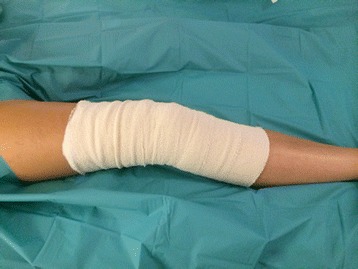
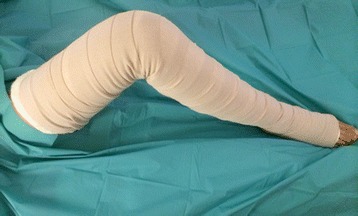
Enhanced recovery programmes in total knee arthroplasty are well established. Post-operative knee swelling is common and impairs early post-operative function. The use of a short-stretch, inelastic compression bandage is hypothesised to reduce knee swelling and improve pain and early function. A study was designed to test feasibility with a view to informing a larger, future trial and to provide preliminary data.
METHODS/DESIGN: This is a randomised controlled feasibility study. Fifty consecutive patients selected for primary total knee arthroplasty will be enrolled in the trial. Patients with a BMI >35, latex allergy or neurological or peripheral vascular disease are excluded. Patients are randomised by distance randomisation to receive a compression bandage for 24 hours after surgery or a standard wool and crepe bandage. The bandages are applied by one of two consultant surgeons who have had training with their application. Knee swelling, range of motion and pain scores will be compared pre-operatively and at day 1, day 2 and at 6 weeks between groups. The Oxford knee score and EQ-5D health status will be compared pre-operatively and at 6 months between groups. Recruitment rates, retention rates, resource allocation, completeness of data collection, and tolerance and complications with the compression bandage are recorded. Descriptive statistics are used to calculate a standard deviation for post-operative knee swelling in the groups and to perform a power calculation incorporating anticipated patient retention rates to inform a future trial. Preliminary data will be analysed using the independent samples t-test for equal distributions and the Mann-Whitney U for unequal distributions with the significance denoted at P <0.05.
Enhanced recovery programmes have revolutionized the management of total knee arthroplasty. There is a paucity of clinical data regarding the efficacy of compression bandages. Large, randomised controlled trials are uncommon in orthopaedic surgery. The results of this study will provide feasibility and preliminary data prior to the construction of a larger, multicentre study.
The study was registered with Current Controlled Trials ( ISRCTN86903140 ) on 30 May 2013.
全膝关节置换术中的强化康复计划已得到广泛认可。术后膝关节肿胀很常见,会影响术后早期功能。据推测,使用短拉伸、无弹性的加压绷带可减轻膝关节肿胀,改善疼痛和早期功能。本研究旨在测试其可行性,为未来更大规模的试验提供信息并提供初步数据。
方法/设计:这是一项随机对照可行性研究。将连续选取50例计划行初次全膝关节置换术的患者纳入试验。排除体重指数(BMI)>35、乳胶过敏或患有神经或周围血管疾病的患者。通过距离随机化将患者随机分为术后接受24小时加压绷带组或标准羊毛和绉布绷带组。绷带由两名接受过绷带应用培训的顾问外科医生之一进行包扎。比较两组术前、术后第1天、第2天和第6周时的膝关节肿胀情况、活动范围和疼痛评分。比较两组术前和术后6个月时的牛津膝关节评分和EQ-5D健康状况。记录招募率、保留率、资源分配、数据收集的完整性以及加压绷带的耐受性和并发症情况。采用描述性统计方法计算两组术后膝关节肿胀的标准差,并结合预期的患者保留率进行功效计算,为未来试验提供参考。使用独立样本t检验对正态分布数据进行分析,使用曼-惠特尼U检验对非正态分布数据进行分析,显著性水平设定为P<0.05。
强化康复计划彻底改变了全膝关节置换术的管理方式。关于加压绷带疗效的临床数据较少。大型随机对照试验在骨科手术中并不常见。本研究结果将在开展更大规模的多中心研究之前提供可行性和初步数据。
该研究于2013年5月30日在当前受控试验(ISRCTN86903140)注册。