Morrison Rory J M, Bunn Deborah, Gray William K, Baker Paul N, White Craig, Rangan Amar, Rankin Kenneth S, Reed Mike R
Department of Orthopaedics, Northumbria Healthcare NHS Foundation Trust, Woodhorn Lane, Ashington, Northumberland, NE63 9JJ, UK.
University of Newcastle, Newcastle upon Tyne, NE1 7RU, UK.
Trials. 2017 Nov 2;18(1):514. doi: 10.1186/s13063-017-2255-2.
Vitamin D deficiency has been linked to poor outcomes after total hip replacement (THR) or total knee replacement (TKR), including lower patient-reported outcome measures (PROMs), peri-prosthetic infection and longer hospital stay. We present a randomised feasibility trial protocol designed to prospectively investigate the influence of vitamin D testing, and subsequent supplementation for deficiency, prior to THR/TKR.
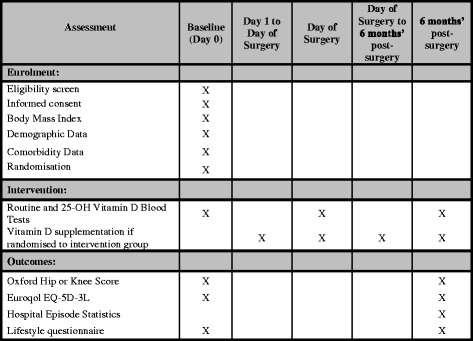
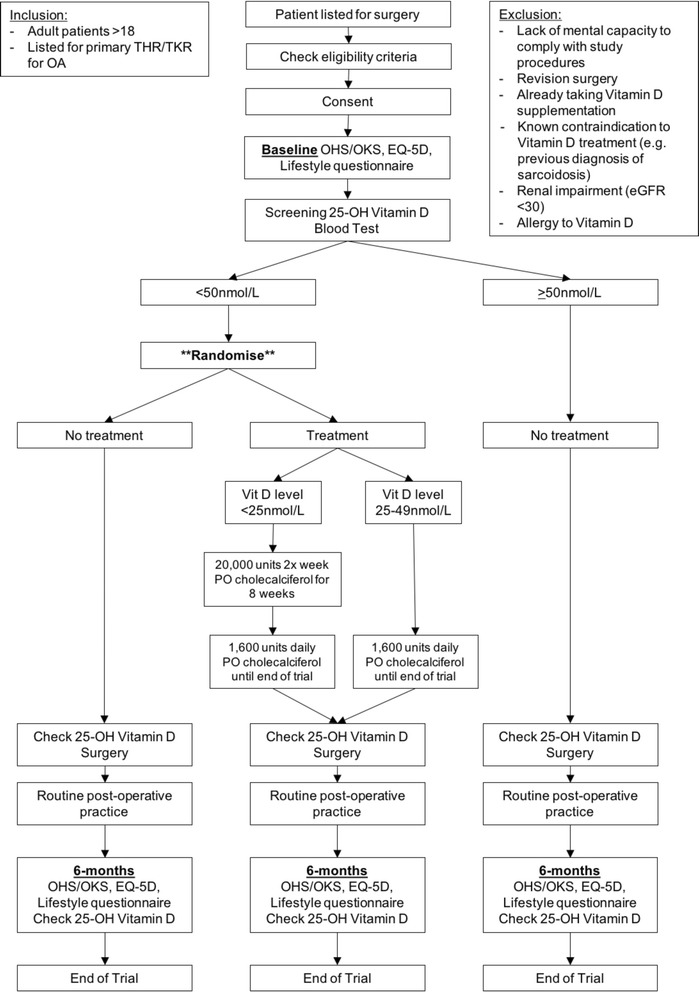
METHODS/DESIGN: One hundred adult patients undergoing primary THR/TKR for osteoarthritis at two NHS hospital trusts in North East England will be recruited. Exclusion criteria include lack of mental capacity, revision surgery, participants already taking vitamin D/calcium supplements, or a known contraindication to vitamin D treatment. Participants will be ineligible for the trial if they have an estimated glomerular filtration rate < 30 ml/minute. We will measure patients' vitamin D levels at baseline, and those identified as deficient (vitamin D < 50 nmol/L) will be randomised to receive either vitamin D supplementation or no supplementation prior to, and for 6 months following, surgery. Patients with a normal vitamin D level (≥50 nmol/L) will receive no supplementation. Vitamin D levels will be rechecked on the day of surgery and again at 6 months. Patients will also complete a lifestyle questionnaire, as well as the Oxford hip or knee and EQ-5D-3 L PROM questionnaires, at baseline and at 6 months following surgery. The aims are to determine the feasibility of the methodology and to gather data to inform the conduct of a future, larger trial to investigate if supplementation with vitamin D, in those who are deficient, prior to THR/TKR improves outcomes as measured by PROM scores.
Previous reports have measured vitamin D levels and correlated this to outcome, but we can find no randomised trial in which researchers investigated the effect of supplementation. The aim of this trial is to determine if vitamin D deficiency is a modifiable risk factor for poor outcome after THR/TKR.
ISRCTN Registry, ISRCTN14533082 . Registered on 3 April 2017.
维生素D缺乏与全髋关节置换术(THR)或全膝关节置换术(TKR)后的不良预后相关,包括患者报告的结局指标(PROMs)较低、假体周围感染和住院时间延长。我们提出一项随机可行性试验方案,旨在前瞻性研究THR/TKR术前维生素D检测及随后对缺乏者进行补充的影响。
方法/设计:将招募100名在英格兰东北部两个国民保健服务(NHS)医院信托机构接受原发性THR/TKR治疗骨关节炎的成年患者。排除标准包括缺乏精神能力、翻修手术、参与者已在服用维生素D/钙补充剂或已知对维生素D治疗有禁忌症。如果估计肾小球滤过率<30毫升/分钟,参与者将不符合试验条件。我们将在基线时测量患者的维生素D水平,被确定为缺乏(维生素D<50纳摩尔/升)的患者将被随机分配在手术前及术后6个月接受维生素D补充或不补充。维生素D水平正常(≥50纳摩尔/升)的患者将不接受补充。将在手术当天和6个月时再次检查维生素D水平。患者还将在基线时和术后6个月完成一份生活方式问卷,以及牛津髋关节或膝关节和EQ-5D-3L PROM问卷。目的是确定该方法的可行性,并收集数据以指导未来更大规模试验的开展,以调查在THR/TKR术前对缺乏维生素D的患者进行补充是否能改善PROM评分所衡量的结局。
既往报告测量了维生素D水平并将其与结局相关联,但我们未找到研究人员调查补充效果的随机试验。本试验的目的是确定维生素D缺乏是否是THR/TKR后不良结局的一个可改变的风险因素。
国际标准随机对照试验编号(ISRCTN)注册库,ISRCTN14533082。于2017年4月3日注册。