Olejniczak Marta, Urbanek Martyna O, Krzyzosiak Wlodzimierz J
Department of Molecular Biomedicine, Institute of Bioorganic Chemistry, Polish Academy of Sciences, Noskowskiego 12/14, 61-704 Poznan, Poland.
Mediators Inflamm. 2015;2015:873860. doi: 10.1155/2015/873860. Epub 2015 Mar 22.
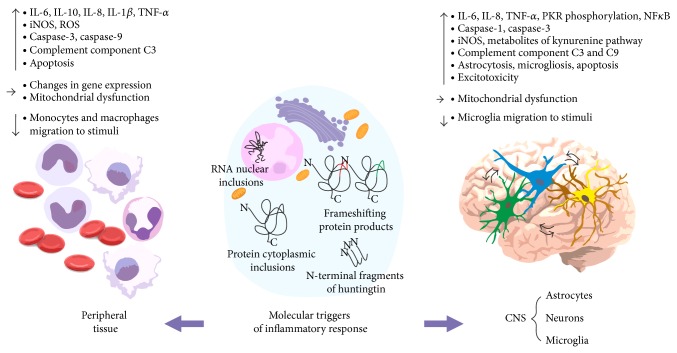
Trinucleotide repeat expansion disorders (TREDs) are a group of dominantly inherited neurological diseases caused by the expansion of unstable repeats in specific regions of the associated genes. Expansion of CAG repeat tracts in translated regions of the respective genes results in polyglutamine- (polyQ-) rich proteins that form intracellular aggregates that affect numerous cellular activities. Recent evidence suggests the involvement of an RNA toxicity component in polyQ expansion disorders, thus increasing the complexity of the pathogenic processes. Neurodegeneration, accompanied by reactive gliosis and astrocytosis is the common feature of most TREDs, which may suggest involvement of inflammation in pathogenesis. Indeed, a number of immune response markers have been observed in the blood and CNS of patients and mouse models, and the activation of these markers was even observed in the premanifest stage of the disease. Although inflammation is not an initiating factor of TREDs, growing evidence indicates that inflammatory responses involving astrocytes, microglia, and the peripheral immune system may contribute to disease progression. Herein, we review the involvement of the immune system in the pathogenesis of triplet repeat expansion diseases, with particular emphasis on polyglutamine disorders. We also present various therapeutic approaches targeting the dysregulated inflammation pathways in these diseases.
三核苷酸重复扩增疾病(TREDs)是一组由相关基因特定区域不稳定重复序列扩增引起的显性遗传神经疾病。各基因翻译区域中CAG重复序列的扩增会导致富含聚谷氨酰胺(polyQ)的蛋白质形成,这些蛋白质会形成细胞内聚集体,影响众多细胞活动。最近的证据表明RNA毒性成分参与了聚谷氨酰胺扩增疾病,从而增加了致病过程的复杂性。神经退行性变伴有反应性胶质增生和星形细胞增多是大多数TREDs的共同特征,这可能表明炎症参与了发病机制。事实上,在患者和小鼠模型的血液和中枢神经系统中观察到了许多免疫反应标志物,甚至在疾病的临床前期就观察到了这些标志物的激活。虽然炎症不是TREDs的起始因素,但越来越多的证据表明,涉及星形胶质细胞、小胶质细胞和外周免疫系统的炎症反应可能促进疾病进展。在此,我们综述免疫系统在三联体重复扩增疾病发病机制中的作用,特别强调聚谷氨酰胺疾病。我们还介绍了针对这些疾病中失调的炎症途径的各种治疗方法。