Kuroki Hiroshi, Inomata Naoki, Hamanaka Hideaki, Higa Kiyoshi, Chosa Etsuo, Tajima Naoya
Department of Orthopaedic Surgery, National Hospital Organization Miyazaki Higashi Hospital, 4374-1 Tayoshi Ooaza, Miyazaki, 880-0911 Japan.
Department of Orthopaedic Surgery, University of Miyazaki Faculty of Medicine, Miyazaki, Japan.
Scoliosis. 2015 Apr 10;10:11. doi: 10.1186/s13013-015-0038-7. eCollection 2015.
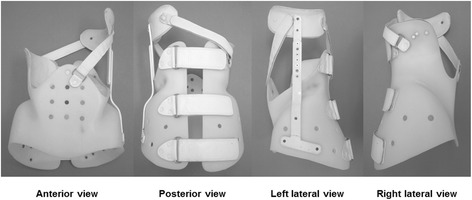
Factors influencing clinical course of brace treatment apply to adolescent idiopathic scoliosis (AIS) patients remain unclear. By making clear them, we may select suitable patients for brace treatment and alleviate overtreatment. The purpose of this study was to explore predictive factors of Osaka Medical College (OMC) brace treatment for AIS patients in accordance with the modified standardized criteria proposed by the Scoliosis Research Society (SRS) committee on bracing and non-operative management.
From 1999 through 2010, 31 consecutive patients with AIS who were newly prescribed the OMC brace and met the modified SRS criteria were studied. The study included 2 boys and 29 girls with a mean age of 12 years and 0 month. We investigated the clinical course and evaluated the impacts of compliance, initial brace correction rate, curve flexibility, curve pattern, Cobb angle, chronological age, and Risser stage to clinical outcomes. The clinical course of the brace treatment was considered progression if ≥6° curvature increase occurred and improvement if ≥6° curvature decrease occurred according to SRS judgment criteria.
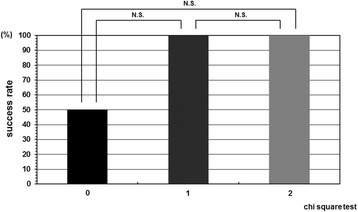
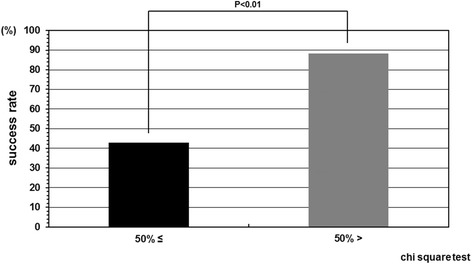
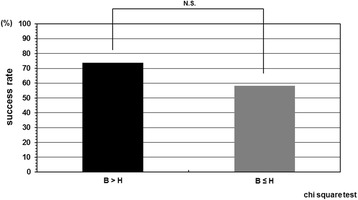
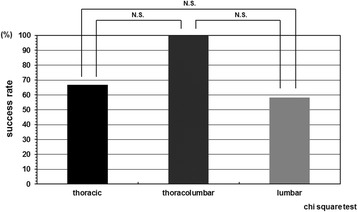
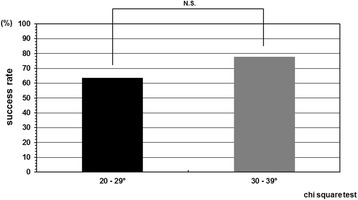
The curve progressed in 10 cases, the curve improved in 6 cases, and the curve remained unchanged in 15 cases (success rate: 67.7%). The success rate was statistically higher in the patient group whose instruction adherence rate was greater than 50% as compared with in those 50% or less. Initial brace correction rate, curve flexibility, curve pattern, the magnitude of Cobb angle, chronological age, and Risser stage did not have any significant effect for clinical courses. However, success rate was insignificantly higher in the cases whose Cobb angle in brace was smaller than that in hanging position.
OMC brace treatment could alter the natural history of AIS, however, that was significantly affected by compliance of brace wear.
影响青少年特发性脊柱侧凸(AIS)患者支具治疗临床过程的因素仍不明确。明确这些因素后,我们可以选择合适的患者进行支具治疗并减少过度治疗。本研究的目的是根据脊柱侧凸研究学会(SRS)支具与非手术治疗委员会提出的改良标准化标准,探索大阪医科大学(OMC)支具治疗AIS患者的预测因素。
从1999年至2010年,对31例新开具OMC支具且符合改良SRS标准的连续AIS患者进行研究。研究包括2名男孩和29名女孩,平均年龄为12岁0个月。我们调查了临床过程,并评估了依从性、初始支具矫正率、曲线柔韧性、曲线类型、Cobb角、实足年龄和Risser分期对临床结果的影响。根据SRS判断标准,如果曲率增加≥6°,则认为支具治疗的临床过程为进展;如果曲率降低≥6°,则认为是改善。
10例患者曲线进展,6例患者曲线改善,15例患者曲线保持不变(成功率:67.7%)。与指导依从率为50%或更低的患者组相比,指导依从率大于50%的患者组成功率在统计学上更高。初始支具矫正率、曲线柔韧性、曲线类型、Cobb角大小、实足年龄和Risser分期对临床过程没有任何显著影响。然而,支具内Cobb角小于悬吊位Cobb角的病例成功率略高。
OMC支具治疗可改变AIS的自然病程,然而,这受到支具佩戴依从性的显著影响。