Chen Feng, Tan Yin-Feng, Li Hai-Long, Qin Zhen-Miao, Cai Hong-Die, Lai Wei-Yong, Zhang Xiao-Po, Li Yong-Hui, Guan Wei-Wei, Li You-Bin, Zhang Jun-Qing
Hainan Provincial Key Laboratory of R&D of Tropical Herbs, School of Pharmacy, Hainan Medical University, Haikou, 571199 China.
Nanjing University of Chinese Medicine, Nanjing, 210046 China.
Chem Cent J. 2015 Mar 31;9:14. doi: 10.1186/s13065-015-0092-5. eCollection 2015.
Galangin (3,5,7-trihydroxyflavone) is present in high concentrations in herbal medicine such as Alpinia officinarum Hance. Galangin shows multifaceted in vitro and in vivo biological activities. The number and position of hydroxyl groups in this molecule play an important role in these biological activities. However, these hydroxyl groups undergo glucuronidation and sulfation in in vitro assay system. However, the systemic exposure to galangin after dosing in animals and/or humans remains largely unknown. Thus it is not clear whether the galangin exists in the body at concentrations high enough for the biological effects. Furthermore, the metabolite identification and the corresponding plasma pharmacokinetics need to be characterized.
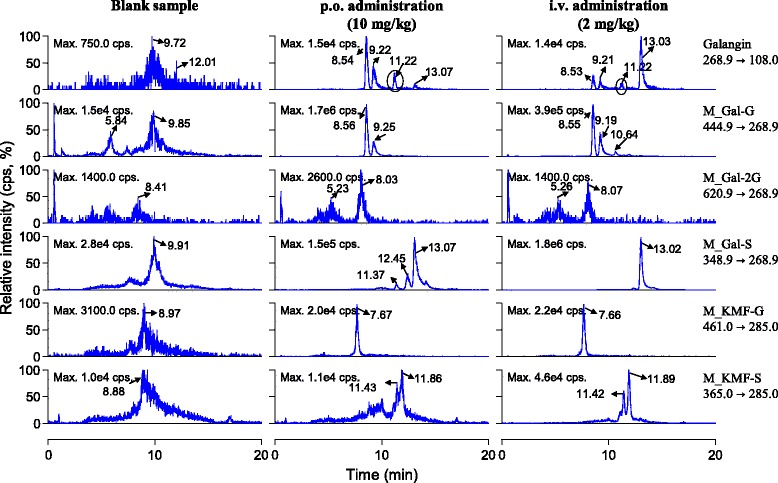
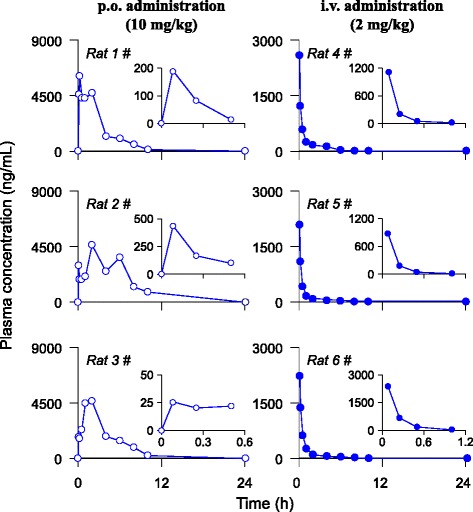
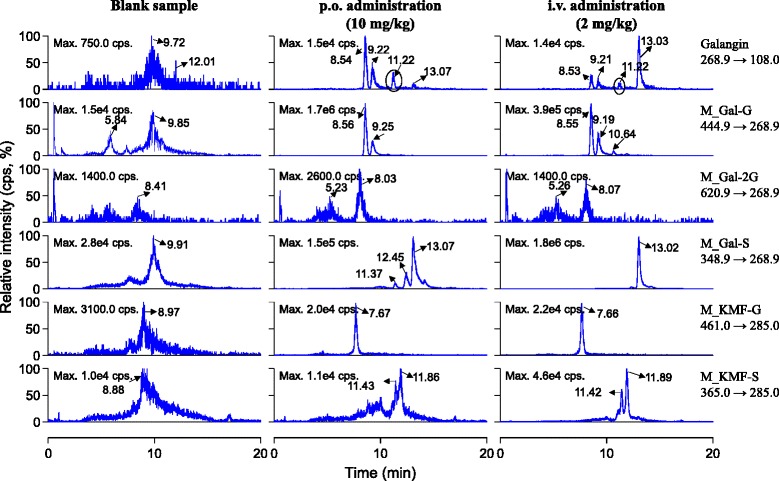
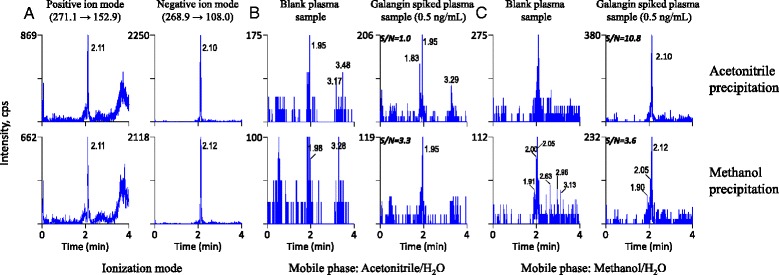
Two LC-MS/MS methods were developed and validated and successfully applied to analyze the parent drug molecules and aglycones liberated from plasma samples via β-glucuronidase hydrolysis. Our major findings were as follows: (1) The routes of administration showed significant influences on the systemic exposure of galangin and its metabolites. (2) Galangin was preferentially glucuronidated after p.o. dosing but sulfated after i.v. medication. (3) Kaempferol conjugates were detected demonstrating that oxidation reaction occurred; however, both glucuronidation and sulfation were more efficient. (4) Oral bioavailability of free parent galangin was very low.
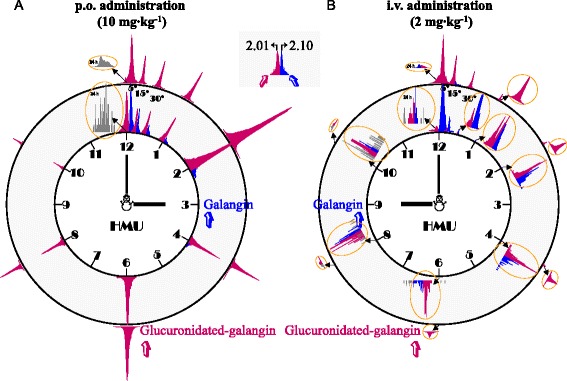
Systemic exposure to galangin and its metabolites was different in rat plasma between oral and intravenous administration. Further research is needed to characterize the structures of galangin conjugates and to evaluate the biological activities of these metabolites. Graphical abstractGalangin was preferentially glucuronidated after p.o. dosing but sulfated after i.v. medication.
高良姜素(3,5,7 - 三羟基黄酮)在诸如高良姜等草药中含量很高。高良姜素在体外和体内均表现出多方面的生物活性。该分子中羟基的数量和位置在这些生物活性中起重要作用。然而,在体外分析系统中,这些羟基会发生葡萄糖醛酸化和硫酸化。然而,在动物和/或人类给药后高良姜素的全身暴露情况仍 largely 未知。因此,尚不清楚高良姜素在体内是否以足够高的浓度存在以产生生物学效应。此外,需要对代谢物进行鉴定并表征相应的血浆药代动力学。
开发并验证了两种液相色谱 - 串联质谱法,并成功应用于分析经β - 葡萄糖醛酸酶水解从血浆样品中释放出的母体药物分子和苷元。我们的主要发现如下:(1)给药途径对高良姜素及其代谢物的全身暴露有显著影响。(2)口服给药后高良姜素优先进行葡萄糖醛酸化,但静脉给药后进行硫酸化。(3)检测到山奈酚缀合物,表明发生了氧化反应;然而,葡萄糖醛酸化和硫酸化都更有效。(4)游离母体高良姜素的口服生物利用度非常低。
大鼠血浆中口服和静脉给药后高良姜素及其代谢物的全身暴露情况不同。需要进一步研究来表征高良姜素缀合物的结构并评估这些代谢物的生物学活性。图形摘要口服给药后高良姜素优先进行葡萄糖醛酸化,但静脉给药后进行硫酸化。