Michalak Marek, Gye Myung Chan
Department of Biochemistry, University of Alberta, Edmonton, AB, Canada.
Department of Life Science and Institute of Natural Sciences, College of Natural Sciences, Hanyang University, Seoul, Korea.
Clin Exp Reprod Med. 2015 Mar;42(1):1-7. doi: 10.5653/cerm.2015.42.1.1. Epub 2015 Mar 31.
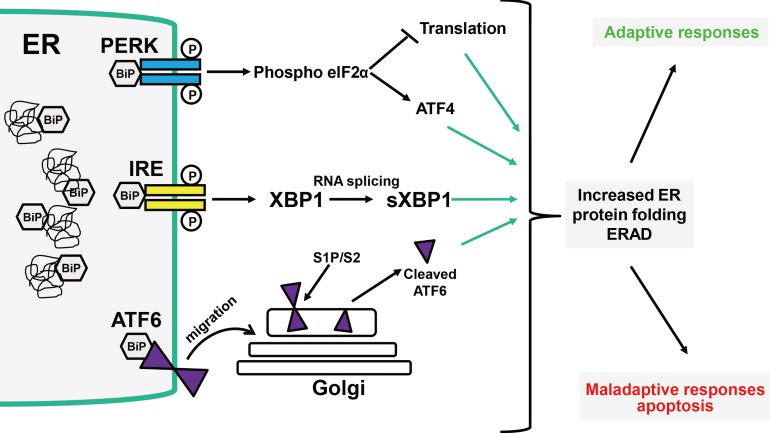
Stress coping mechanisms are critical to minimize or overcome damage caused by ever changing environmental conditions. They are designed to promote cell survival. The unfolded protein response (UPR) pathway is mobilized in response to the accumulation of unfolded proteins, ultimately in order to regain endoplasmic reticulum (ER) homeostasis. Various elements of coping responses to ER stress including Perk, Ask1, Bip, Chop, Gadd34, Ire1, Atf4, Atf6, and Xbp1 have been identified and were found to be inducible in oocytes and preimplantation embryos, suggesting that, as a normal part of the cellular adaptive mechanism, these coping responses, including the UPR, play a pivotal role in the development of preimplantation embryos. As such, the UPR-associated molecules and pathways may become useful markers for the potential diagnosis of stress conditions for preimplantation embryos. After implantation, ER stress-induced coping responses become physiologically important for a normal decidual response, placentation, and early organogenesis. Attenuation of ER stress coping responses by tauroursodeoxycholate and salubrinal was effective for prevention of cell death of cultured embryos. Further elucidation of new and relevant ER stress coping responses in periimplantation embryos might contribute to a comprehensive understanding of the regulation of normal development of embryonic development and potentiation of embryonic development in vitro.
应激应对机制对于将不断变化的环境条件所造成的损害降至最低或予以克服至关重要。它们旨在促进细胞存活。未折叠蛋白反应(UPR)通路会因未折叠蛋白的积累而被激活,最终目的是恢复内质网(ER)的稳态。已确定内质网应激应对反应的各种元件,包括蛋白激酶RNA样内质网激酶(Perk)、凋亡信号调节激酶1(Ask1)、结合免疫球蛋白蛋白(Bip)、生长停滞及DNA损伤诱导蛋白34(Gadd34)、肌醇需求酶1(Ire1)、活化转录因子4(Atf4)、活化转录因子6(Atf6)和X盒结合蛋白1(Xbp1),并发现它们在卵母细胞和植入前胚胎中具有诱导性,这表明,作为细胞适应性机制的正常组成部分,这些应对反应,包括未折叠蛋白反应,在植入前胚胎的发育中起关键作用。因此,与未折叠蛋白反应相关的分子和通路可能成为植入前胚胎应激状况潜在诊断的有用标志物。植入后,内质网应激诱导的应对反应对于正常的蜕膜反应、胎盘形成和早期器官发生在生理上具有重要意义。牛磺熊去氧胆酸和水杨醛对内质网应激应对反应的减弱可有效预防培养胚胎的细胞死亡。进一步阐明植入前后胚胎中新的相关内质网应激应对反应可能有助于全面理解胚胎发育正常调控以及体外胚胎发育的增强。