• 文献检索
  • 文档翻译
  • 深度研究
  • 学术资讯
  • Suppr Zotero 插件Zotero 插件
  • 邀请有礼
  • 套餐&价格
  • 历史记录
应用&插件
Suppr Zotero 插件Zotero 插件浏览器插件Mac 客户端Windows 客户端微信小程序
定价
高级版会员购买积分包购买API积分包
服务
文献检索文档翻译深度研究API 文档MCP 服务
关于我们
关于 Suppr公司介绍联系我们用户协议隐私条款
关注我们

Suppr 超能文献

核心技术专利:CN118964589B侵权必究
粤ICP备2023148730 号-1Suppr @ 2026

文献检索

告别复杂PubMed语法,用中文像聊天一样搜索,搜遍4000万医学文献。AI智能推荐,让科研检索更轻松。

立即免费搜索

文件翻译

保留排版,准确专业,支持PDF/Word/PPT等文件格式,支持 12+语言互译。

免费翻译文档

深度研究

AI帮你快速写综述,25分钟生成高质量综述,智能提取关键信息,辅助科研写作。

立即免费体验

为什么女性会在家分娩?基于埃塞俄比亚全国人口与健康调查数据的多层次建模。

Why do women deliver at home? Multilevel modeling of Ethiopian National Demographic and Health Survey data.

作者信息

Yebyo Henock, Alemayehu Mussie, Kahsay Alemayehu

机构信息

Department of Public Health, College of Health Sciences, Mekelle University, Mekelle, Ethiopia.

出版信息

PLoS One. 2015 Apr 15;10(4):e0124718. doi: 10.1371/journal.pone.0124718. eCollection 2015.

DOI:10.1371/journal.pone.0124718
PMID:25874886
原文链接:https://pmc.ncbi.nlm.nih.gov/articles/PMC4398378/
Abstract

BACKGROUND

Despite of the existing intensive efforts to improve maternal health in Ethiopia, the proportion of birth delivered at home remains high and is still the top priority among the national health threats.

OBJECTIVE

The study aimed to examine effects of individual women and community-level factors of women's decision on place of delivery in Ethiopia.

METHODS

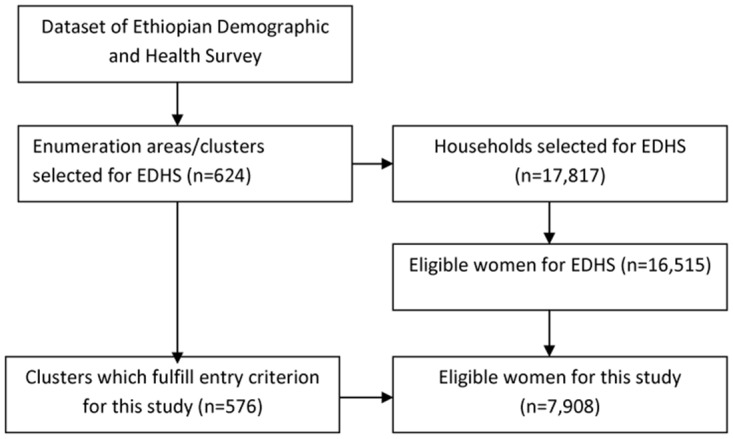
Data were obtained from the nationally representative 2011 Ethiopian Demographic and Health Survey (EDHS) which used a two-stage cluster sampling design with rural-urban and regions as strata. The EDHS collected data from a big sample size but our study focused on a sample of 7,908 women whose most recent birth was within five years preceding 2011 and 576 communities in which the women were living in. The data were analyzed using a two-level mixed-effects logistic regression to determine fixed-effects of individual- and community-level factors and random-intercept of between-cluster characteristics.

RESULTS

In the current study, 6980 out of 7908 deliveries (88.3%) took place at home. Lower educational levels (OR=2.74, 95%CI:1.84,4.70; p<0.0001), making no or only a limited number of ANC visits (OR=3.72,95%CI:2.85, 4.83; p<0.0001), non-exposure to media (OR=1.51, 95%CI 1.13, 2.01; p=0.004), higher parity (OR=2.68, 95%CI:1.96,3.68; p<0.0001), and perceived distance problem to reach health facilities (OR=1.29, 95%CI:1.03,1.62; p=0.022) were positively associated with home delivery. About 75% of the total variance in the odds of giving birth at home was accounted for the between-community differences of characteristics (ICC=0.75, p<0.0001). With regard to community-level characteristics, rural communities (OR=4.67, 95%CI:3.06,7.11; p<0.0001), pastoralist communities (OR=4.53, 95%CI:2.81,7.28; p<0.0001), communities with higher poverty levels (OR=1.49 95%CI:1.08,2.22; p=0.048), with lower levels of ANC utilization (OR=2.01, 95%CI:1.42,2.85; p<0.0001) and problem of distance to a health facility (OR=1.29, 95%CI:1.03,1.62; p=0.004) had a positive influence on women to give birth at home.

CONCLUSIONS

Not only individual characteristics of women, but also community-level factors determine women's decision to deliver at home.

摘要

背景

尽管埃塞俄比亚在改善孕产妇健康方面付出了巨大努力,但在家分娩的比例仍然很高,并且仍然是国家健康威胁中的首要问题。

目的

本研究旨在探讨埃塞俄比亚女性个体因素和社区层面因素对女性分娩地点决策的影响。

方法

数据来自具有全国代表性的2011年埃塞俄比亚人口与健康调查(EDHS),该调查采用两阶段整群抽样设计,以城乡和地区为分层变量。EDHS收集了大量样本数据,但我们的研究聚焦于7908名女性的样本,这些女性最近一次分娩发生在2011年之前的五年内,以及她们所居住的576个社区。使用两级混合效应逻辑回归分析数据,以确定个体和社区层面因素的固定效应以及集群间特征的随机截距。

结果

在本研究中,7908例分娩中有6980例(88.3%)在家中进行。较低的教育水平(OR = 2.74,95%CI:1.84, 4.70;p < 0.0001)、产前检查次数少或没有进行产前检查(OR = 3.72,95%CI:2.85, 4.83;p < 0.0001)、未接触媒体(OR = 1.51,95%CI 1.13, 2.01;p = 0.004)、较高的胎次(OR = 2.68,95%CI:1.96, 3.68;p < 0.0001)以及认为前往医疗机构存在距离问题(OR = 1.29,95%CI:1.03, 1.62;p = 0.022)与在家分娩呈正相关。在家分娩几率的总方差中约75%可由社区间特征差异解释(ICC = 0.75,p < 0.0001)。关于社区层面特征,农村社区(OR = 4.67,95%CI:3.06, 7.11;p < 0.0001)、牧民社区(OR = 4.53,95%CI:2.81, 7.28;p < 0.0001)、贫困水平较高的社区(OR = 1.49,95%CI:1.08, 2.22;p = 0.048)、产前检查利用率较低的社区(OR = 2.01,95%CI:1.42, 2.85;p < 0.0001)以及距离医疗机构较远的社区(OR = 1.29,95%CI:1.03, 1.62;p = 0.004)对女性在家分娩有积极影响。

结论

不仅女性的个体特征,而且社区层面因素也决定了女性在家分娩的决策。

https://cdn.ncbi.nlm.nih.gov/pmc/blobs/5340/4398378/b97964d6f6df/pone.0124718.g001.jpg

相似文献

1
Why do women deliver at home? Multilevel modeling of Ethiopian National Demographic and Health Survey data.为什么女性会在家分娩?基于埃塞俄比亚全国人口与健康调查数据的多层次建模。
PLoS One. 2015 Apr 15;10(4):e0124718. doi: 10.1371/journal.pone.0124718. eCollection 2015.
2
Decision-making for birth location among women in Pakistan: evidence from national survey.巴基斯坦女性分娩地点选择的决策:来自全国性调查的证据。
BMC Pregnancy Childbirth. 2018 Jun 14;18(1):226. doi: 10.1186/s12884-018-1844-8.
3
Skilled delivery care service utilization in Ethiopia: analysis of rural-urban differentials based on national demographic and health survey (DHS) data.埃塞俄比亚熟练接生护理服务的利用情况:基于全国人口与健康调查(DHS)数据的城乡差异分析
Afr Health Sci. 2014 Dec;14(4):974-84. doi: 10.4314/ahs.v14i4.29.
4
Spatio-temporal distribution and associated factors of home delivery in Ethiopia. Further multilevel and spatial analysis of Ethiopian demographic and health surveys 2005-2016.埃塞俄比亚居家分娩的时空分布及相关因素。对埃塞俄比亚 2005-2016 年人口与健康调查的进一步多水平和空间分析。
BMC Pregnancy Childbirth. 2020 Jun 3;20(1):342. doi: 10.1186/s12884-020-02986-w.
5
Health facility or home delivery? Factors influencing the choice of delivery place among mothers living in rural communities of Eritrea.医疗机构分娩还是在家分娩?影响厄立特里亚农村社区母亲分娩地点选择的因素。
J Health Popul Nutr. 2018 Oct 22;37(1):22. doi: 10.1186/s41043-018-0153-1.
6
Determinants of institutional delivery service utilization in Ethiopia: a population based cross sectional study.埃塞俄比亚利用机构分娩服务的决定因素:基于人群的横断面研究。
BMC Public Health. 2020 Jul 8;20(1):1077. doi: 10.1186/s12889-020-09125-2.
7
Magnitude of home delivery and associated factors among child bearing age mothers in Sherkole District, Benishangul Gumuz regional state-Western-Ethiopia.舍科勒区育龄产妇家庭分娩的程度及其相关因素——埃塞俄比亚西部本尚古勒-古马兹州
BMC Public Health. 2020 May 27;20(1):796. doi: 10.1186/s12889-020-08919-8.
8
Utilization of decentralized health facilities and factors influencing women's choice of a delivery site in Gida Ayana Woreda, western Ethiopia.分散式卫生设施的利用及其对女性分娩地点选择的影响——以埃塞俄比亚西部吉达阿亚纳地区为例。
PLoS One. 2019 May 17;14(5):e0216714. doi: 10.1371/journal.pone.0216714. eCollection 2019.
9
Facility delivery and postnatal care services use among mothers who attended four or more antenatal care visits in Ethiopia: further analysis of the 2016 demographic and health survey.在埃塞俄比亚,有 4 次及以上产前检查的母亲使用分娩和产后护理服务的情况:2016 年人口与健康调查的进一步分析。
BMC Pregnancy Childbirth. 2019 Feb 11;19(1):64. doi: 10.1186/s12884-019-2216-8.
10
Multilevel analysis of factors associated with assistance during delivery in rural Nigeria: implications for reducing rural-urban inequity in skilled care at delivery.多水平分析与尼日利亚农村地区分娩时援助相关的因素:减少分娩时熟练护理城乡不平等的意义。
BMC Pregnancy Childbirth. 2018 Nov 8;18(1):438. doi: 10.1186/s12884-018-2074-9.

引用本文的文献

1
Home birth and its associated factors among mothers aged 15-49 years in Somalia: a nationwide population-based cross-sectional study.索马里15至49岁母亲的家庭分娩及其相关因素:一项基于全国人口的横断面研究。
BMC Womens Health. 2025 Aug 15;25(1):394. doi: 10.1186/s12905-025-03781-5.
2
Machine-learning algorithm to predict home delivery after antenatal care visit among reproductive age women in East Africa.用于预测东非育龄妇女产前检查后家庭分娩情况的机器学习算法
Front Glob Womens Health. 2025 Jun 5;6:1461475. doi: 10.3389/fgwh.2025.1461475. eCollection 2025.
3
Association Between Sociodemographic Characteristics and Assisted Childbirth by Qualified Personnel in Madagascar.

本文引用的文献

1
Predictors of safe delivery service utilization in arsi zone, South-East ethiopia.埃塞俄比亚东南部阿尔西地区安全分娩服务利用的预测因素
Ethiop J Health Sci. 2011 Aug;21(Suppl 1):95-106.
2
Health workers' perceptions of facilitators of and barriers to institutional delivery in Tigray, Northern Ethiopia.埃塞俄比亚北部提格雷地区卫生工作者对机构分娩的促进因素和障碍的看法。
BMC Pregnancy Childbirth. 2014 Apr 10;14:137. doi: 10.1186/1471-2393-14-137.
3
Determinants of antenatal and delivery care utilization in Tigray region, Ethiopia: a cross-sectional study.
马达加斯加社会人口学特征与合格人员助产之间的关联
J Family Reprod Health. 2024 Dec;18(4):261-268. doi: 10.18502/jfrh.v18i4.17427.
4
Home delivery among women with adequate antenatal care: insights from a multilevel analysis of the 2019 Ethiopian mini demographic and health survey.接受充分产前护理的女性的家庭分娩:来自2019年埃塞俄比亚小型人口与健康调查多层次分析的见解
Reprod Health. 2025 Apr 7;22(1):49. doi: 10.1186/s12978-025-01970-x.
5
Home delivery among women who receive antenatal care in Ethiopia, design-based logistic regression analysis.埃塞俄比亚接受产前护理的妇女中的家庭分娩,基于设计的逻辑回归分析。
BMJ Public Health. 2024 Feb 28;2(1):e000399. doi: 10.1136/bmjph-2023-000399. eCollection 2024 Jun.
6
Association of facility-based normal delivery healthcare services access with health facility factors: evidence from linked population and health facility survey data in Bangladesh.基于机构的正常分娩医疗服务可及性与医疗机构因素的关联:来自孟加拉国人口与医疗机构调查关联数据的证据
BMC Health Serv Res. 2025 Feb 15;25(1):258. doi: 10.1186/s12913-025-12402-8.
7
Prevalence and Determinants of Home Delivery among Women with Easy Access to Health Facilities in Sub‑Saharan African Countries: A Multi‑level Mixed Effect Analysis.撒哈拉以南非洲国家中容易获得卫生设施的妇女在家分娩的患病率及其决定因素:多层次混合效应分析
Ann Glob Health. 2025 Jan 24;91(1):5. doi: 10.5334/aogh.4615. eCollection 2025.
8
Spatial variation and associated factors of home delivery among reproductive age group women in Ethiopia, evidence from Performance Monitoring for Action Ethiopia Survey 2019, spatial and multilevel logistic regression analysis.埃塞俄比亚育龄妇女在家分娩的空间差异及相关因素:来自2019年埃塞俄比亚行动绩效监测调查的证据,空间和多水平逻辑回归分析
Front Glob Womens Health. 2024 Dec 16;5:1474762. doi: 10.3389/fgwh.2024.1474762. eCollection 2024.
9
Mapping the prevalence and covariates associated with home delivery in Bangladesh: A multilevel regression analysis.绘制孟加拉国家庭分娩的流行情况及其相关因素图谱:一项多层次回归分析。
PLoS One. 2024 Nov 12;19(11):e0313606. doi: 10.1371/journal.pone.0313606. eCollection 2024.
10
Predictors of delayed health seeking for febrile children: multi-level analysis of cross-sectional study data from southern Ethiopia.发热儿童延迟就医的预测因素:来自埃塞俄比亚南部的横断面研究数据的多水平分析。
Front Public Health. 2024 Sep 9;12:1417638. doi: 10.3389/fpubh.2024.1417638. eCollection 2024.
埃塞俄比亚提格雷地区产前和分娩护理利用的决定因素:一项横断面研究。
Int J Equity Health. 2013 May 14;12:30. doi: 10.1186/1475-9276-12-30.
4
Preference for institutional delivery and caesarean sections in Bangladesh.孟加拉国对机构分娩和剖腹产的偏好。
J Health Popul Nutr. 2013 Mar;31(1):96-109. doi: 10.3329/jhpn.v31i1.14754.
5
Determinants of delivery practices among Afar pastoralists of Ethiopia.埃塞俄比亚阿法尔牧民分娩方式的决定因素。
Pan Afr Med J. 2012;13 Suppl 1(Suppl 1):17. Epub 2012 Dec 26.
6
Prevalence of institutional delivery and associated factors in Dodota Woreda (district), Oromia regional state, Ethiopia.埃塞俄比亚奥罗米亚州多德塔沃雷区(行政区)机构分娩的流行情况及其相关因素。
Reprod Health. 2012 Dec 15;9:33. doi: 10.1186/1742-4755-9-33.
7
What influences the decision to undergo institutional delivery by skilled birth attendants? A cohort study in rural Andhra Pradesh, India.是什么影响了由熟练接生员进行机构分娩的决策?印度安得拉邦农村地区的一项队列研究。
Rural Remote Health. 2012;12:2311. Epub 2012 Nov 9.
8
Institutional delivery service utilization in Munisa Woreda, South East Ethiopia: a community based cross-sectional study.在埃塞俄比亚东南 Munisa 区,利用机构分娩服务:一项基于社区的横断面研究。
BMC Pregnancy Childbirth. 2012 Oct 8;12:105. doi: 10.1186/1471-2393-12-105.
9
Institutional delivery service utilization and associated factors among mothers who gave birth in the last 12 months in Sekela District, north west of Ethiopia: a community-based cross sectional study.在埃塞俄比亚西北部 Sekela 区,过去 12 个月内分娩的产妇使用机构分娩服务及其影响因素:一项基于社区的横断面研究。
BMC Pregnancy Childbirth. 2012 Jul 31;12:74. doi: 10.1186/1471-2393-12-74.
10
The Influence of Individual and Contextual Socioeconomic Status on Obstetric Care Utilization in the Democratic Republic of Congo: A Population-based Study.个人及背景社会经济地位对刚果民主共和国产科护理利用情况的影响:一项基于人群的研究。
Int J Prev Med. 2012 Apr;3(4):278-85.