Statistics Discipline, Khulna University, Khulna, Bangladesh.
School of Medicine and Dentistry, Griffith University, Gold Coast, Australia.
PLoS One. 2024 Nov 12;19(11):e0313606. doi: 10.1371/journal.pone.0313606. eCollection 2024.
Bangladesh has made an intense effort to improve maternal healthcare facilities including facility delivery, but the number of home deliveries is still very high. Therefore, this study aims to find out district-wise prevalence and determine the individual and community-level predictors of home delivery among women in Bangladesh.
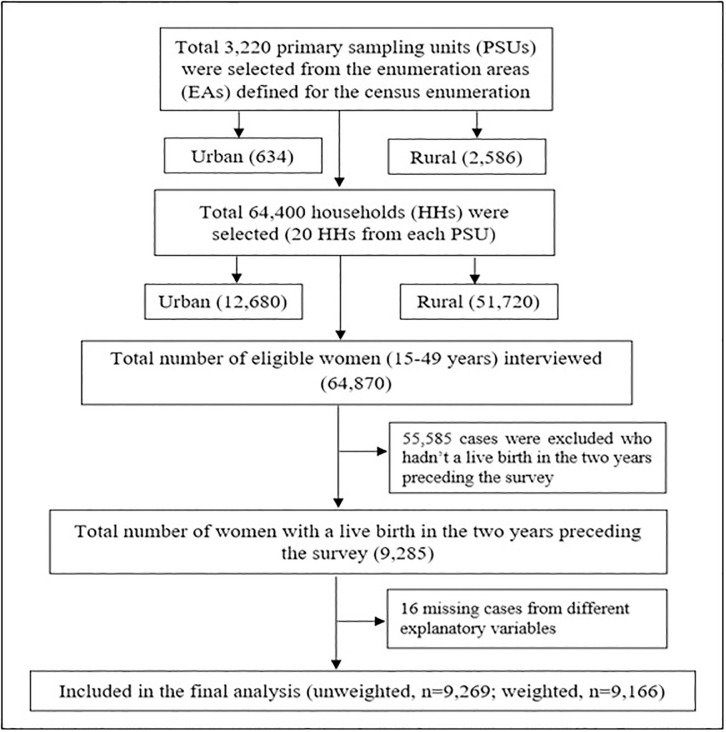
Data were derived from the Multiple Indicator Cluster Survey (MICS) 2019, a nationwide cross-sectional survey in Bangladesh. A final sample of 9,166 (weighted) women who gave birth in the two years preceding the survey were included in this study. Considering the two-stage cluster sampling strategy adopted by MICS, we used multilevel (2-level) logistic regression analysis to find out the correlates of home delivery.
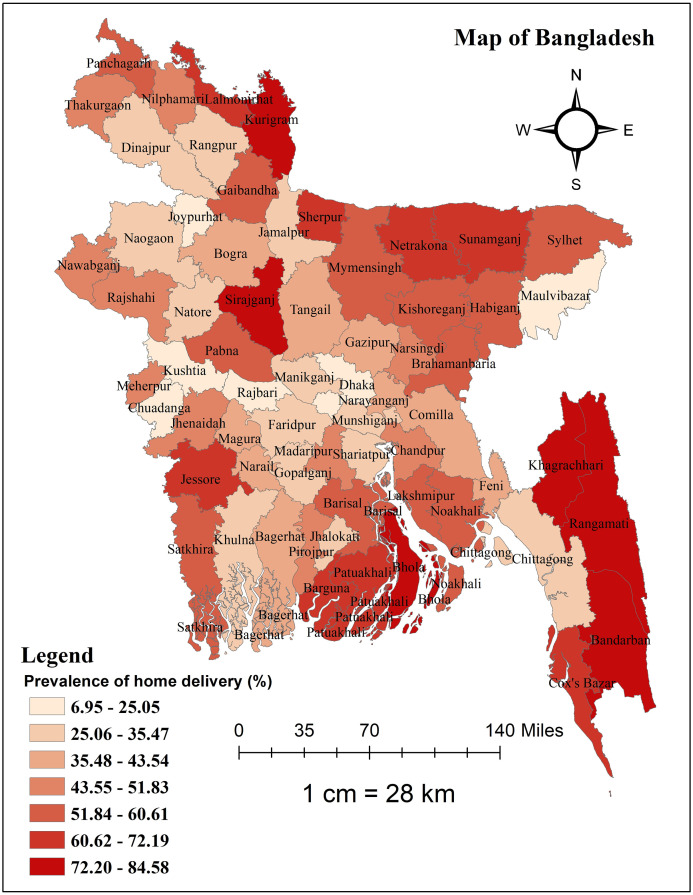
The overall weighted prevalence of home delivery was 46.41% (95% confidence interval [CI]: 45.39-47.43). The highest prevalence was observed in Bandarban district (84.58%), while the lowest was found in Meherpur district (6.95%). The intercept-only regression model demonstrates that the likelihood of women from various clusters having home delivery varied significantly (variance: 1.47, standard error [SE]: 0.117), indicating the applicability of multilevel regression modeling. The multilevel regression analysis showed that women with higher education, wealth status and ANC visit, and those aged >18 years at first marriage/union were associated with lower odds of delivering child at home compared to their counterparts. While women from age group of 35-49 years, whose last pregnancy was unintended were more likely to deliver child at home. In addition, those respondents belonging to a community that had higher wealth status, women's education level, and exposure to media showed lower odds of having delivery at home.
The finding indicates that delivery at home is still high in Bangladesh. Targeted interventions to reduce home delivery are urgently needed in Bangladesh to tackle adversities during deliveries and save mothers from the consequences.
孟加拉国在改善产妇保健设施方面做出了巨大努力,包括提供分娩服务,但家庭分娩的数量仍然很高。因此,本研究旨在确定孟加拉国按地区划分的家庭分娩率,并确定影响家庭分娩的个人和社区层面的因素。
数据来自 2019 年多指标类集调查(MICS),这是孟加拉国的一项全国性横断面调查。本研究共纳入了 9166 名(加权)在调查前两年内分娩的妇女。考虑到 MICS 采用的两阶段聚类抽样策略,我们使用多水平(2 水平)逻辑回归分析来确定家庭分娩的相关因素。
家庭分娩的总体加权流行率为 46.41%(95%置信区间[CI]:45.39-47.43)。家庭分娩率最高的是班达班县(84.58%),最低的是梅赫尔布尔县(6.95%)。仅包含截距的回归模型表明,来自不同聚类的妇女进行家庭分娩的可能性存在显著差异(方差:1.47,标准误差[SE]:0.117),表明多水平回归模型的适用性。多水平回归分析显示,与对照组相比,受教育程度较高、经济状况较好、接受过 ANC 检查且初婚/初育年龄>18 岁的妇女,以及年龄在 35-49 岁之间、上次怀孕非计划内的妇女,家庭分娩的可能性较低。此外,属于财富状况较高、妇女教育程度较高和接触媒体程度较高的社区的受访者,家庭分娩的可能性较低。
研究结果表明,家庭分娩在孟加拉国仍然很高。孟加拉国迫切需要针对家庭分娩的干预措施,以解决分娩过程中的困难,使产妇免受不良后果的影响。