Passos Michelle T, Nishida Sonia K, Câmara Niels O S, Shimizu Maria Heloisa, Mastroianni-Kirsztajn Gianna
Department of Medicine, Division of Nephrology, Federal University of Sao Paulo, Sao Paulo-SP, Brazil.
Department of Medicine, Division of Nephrology, Federal University of Sao Paulo, Sao Paulo-SP, Brazil; Department of Immunology, Institute of Biomedical Sciences, University of Sao Paulo, Sao Paulo-SP, Brazil.
PLoS One. 2015 Apr 13;10(4):e0123753. doi: 10.1371/journal.pone.0123753. eCollection 2015.
The glomerular filtration rate (GFR) is considered an especially important tool for the measurement of renal function. Inulin clearance (InCl) is the classic reference method for this purpose, although it is associated with a number of disadvantages; thus, other markers have been proposed, including iohexol. Determination of iohexol clearance (IoCl) has been established for clinical use; however, its application as a GFR marker in experimental rat models has not been reported.
This study aims to standardize a methodology for the measurement of iohexol clearance and to evaluate its applicability as a marker of GFR in rats with induced toxic acute renal failure (ARF), using InCl as the gold standard.
Twenty-six Wistar male rats (200-300 g) were divided into the following two groups: a control group (n=7) and an ARF group (n=19). ARF was induced by the subcutaneous administration of cisplatin (5 mg/kg); IoCl and InCl were determined simultaneously, and plasma creatinine (pCreat) dosage was measured colorimetrically.
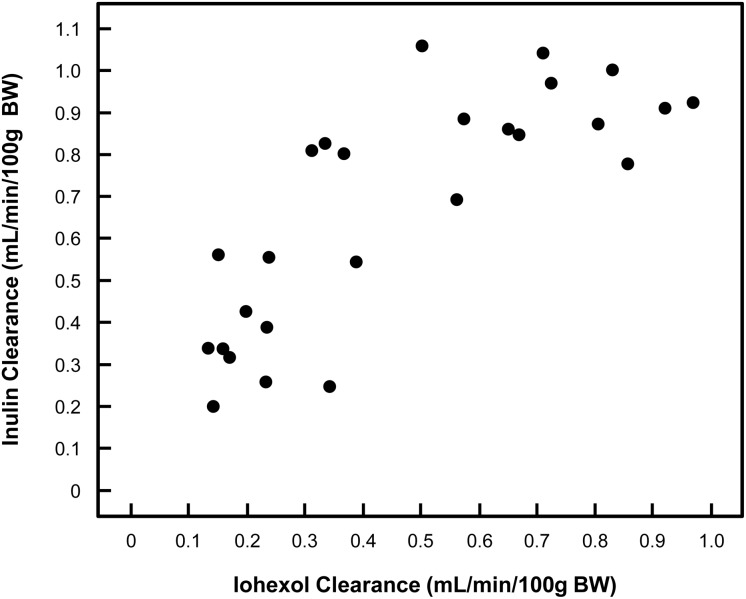
The pCreat, InCl and IoCl levels were consistent with the expected values for the renal function ranges of the evaluated animals, and the IoCl and InCl levels were significantly correlated (r=0.792). An inverse moderate linear correlation between the IoCl and pCreat measurements (r=-0.587) and between the InCl and pCreat measurements (r=-0.722) were observed.
These results confirm a correlation between IoCl and the gold standard of GFR, InCl measurement. IoCl offers a relevant advantage over InCl because determination of the former allows the animal to live after the procedure.
肾小球滤过率(GFR)被认为是评估肾功能的一项特别重要的指标。菊粉清除率(InCl)是用于此目的的经典参考方法,尽管它存在一些缺点;因此,人们提出了其他标志物,包括碘海醇。碘海醇清除率(IoCl)的测定已被确立用于临床;然而,其作为实验大鼠模型中GFR标志物的应用尚未见报道。
本研究旨在规范碘海醇清除率的测量方法,并以InCl作为金标准,评估其作为诱导性中毒性急性肾衰竭(ARF)大鼠GFR标志物的适用性。
26只雄性Wistar大鼠(200 - 300克)被分为以下两组:对照组(n = 7)和ARF组(n = 19)。通过皮下注射顺铂(5毫克/千克)诱导ARF;同时测定IoCl和InCl,并采用比色法测量血浆肌酐(pCreat)剂量。
pCreat、InCl和IoCl水平与所评估动物肾功能范围的预期值一致,且IoCl和InCl水平显著相关(r = 0.792)。观察到IoCl与pCreat测量值之间呈中度负线性相关(r = -0.587),InCl与pCreat测量值之间也呈中度负线性相关(r = -0.722)。
这些结果证实了IoCl与GFR的金标准InCl测量之间存在相关性。与InCl相比,IoCl具有显著优势,因为测定前者后动物在实验过程后仍可存活。