Xiao Dan, Wu Kejian, Tan Xin, Le Jing, Li Haitao, Yan Yongping, Xu Zhikai
Department of Epidemiology, School of Public Health, Fourth Military Medical University, Xi'an, China.
Department of Mathematics and Physics, School of Biomedical and Engineering, Fourth Military Medical University, Xi'an, China.
PLoS One. 2015 Apr 13;10(4):e0123166. doi: 10.1371/journal.pone.0123166. eCollection 2015.
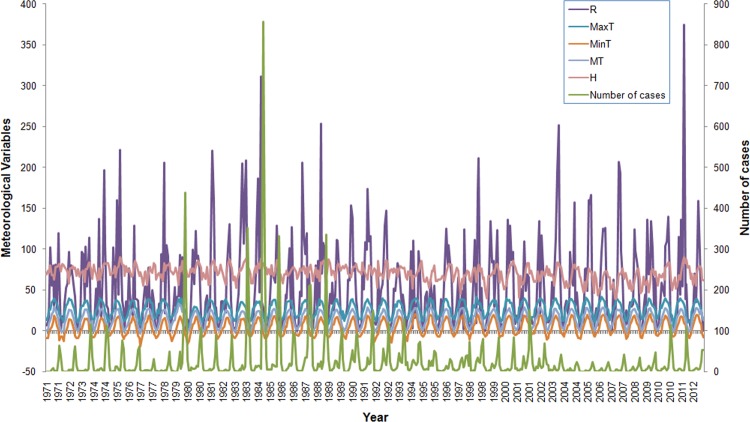
Hu County is a serious hemorrhagic fever with renal syndrome (HFRS) epidemic area, with notable fluctuation of the HFRS epidemic in recent years. This study aimed to explore the optimal model for HFRS epidemic prediction in Hu.
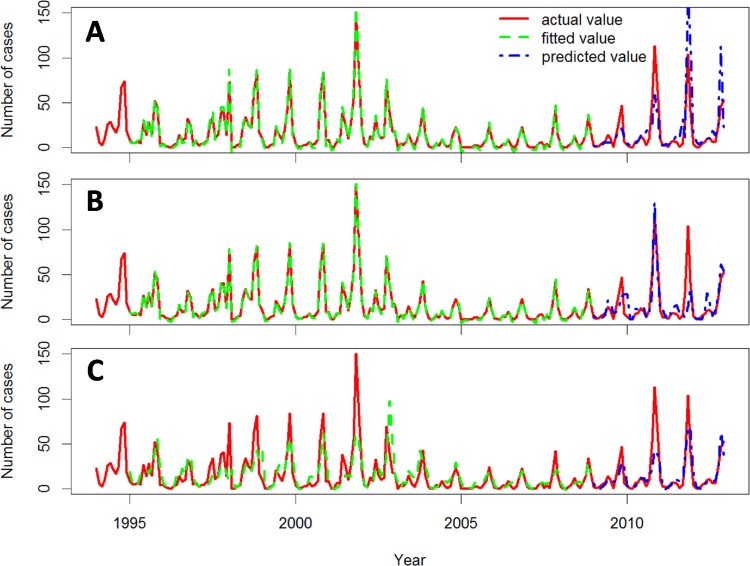
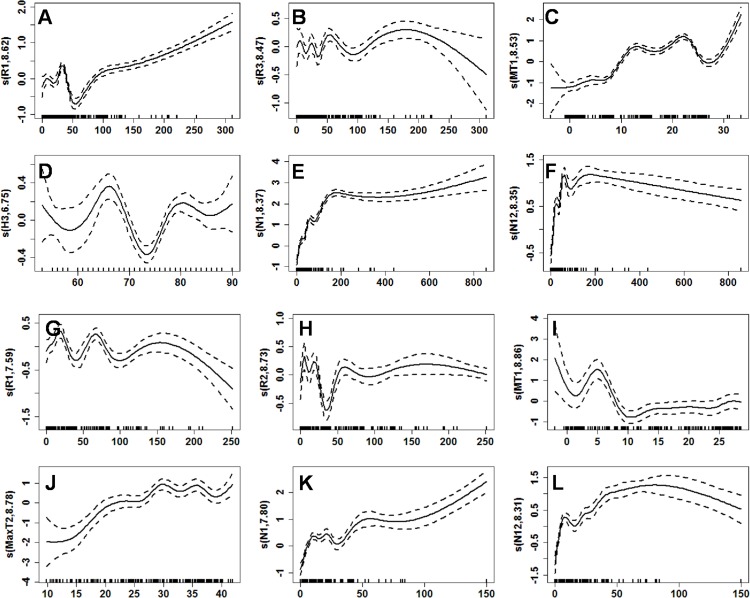
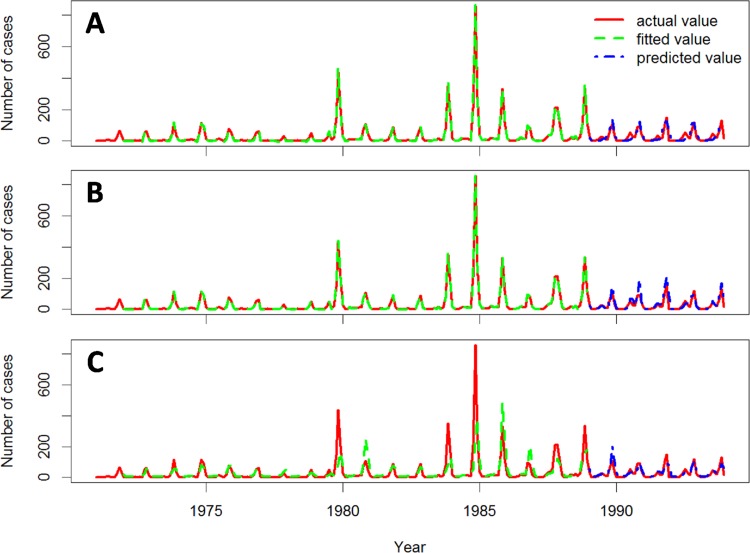
Three models were constructed and compared, including a generalized linear model (GLM), a generalized additive model (GAM), and a principal components regression model (PCRM). The fitting and predictive adjusted R2 of each model were calculated. Ljung-Box Q tests for fitted and predicted residuals of each model were conducted. The study period was stratified into before (1971-1993) and after (1994-2012) vaccine implementation epochs to avoid the confounding factor of vaccination.
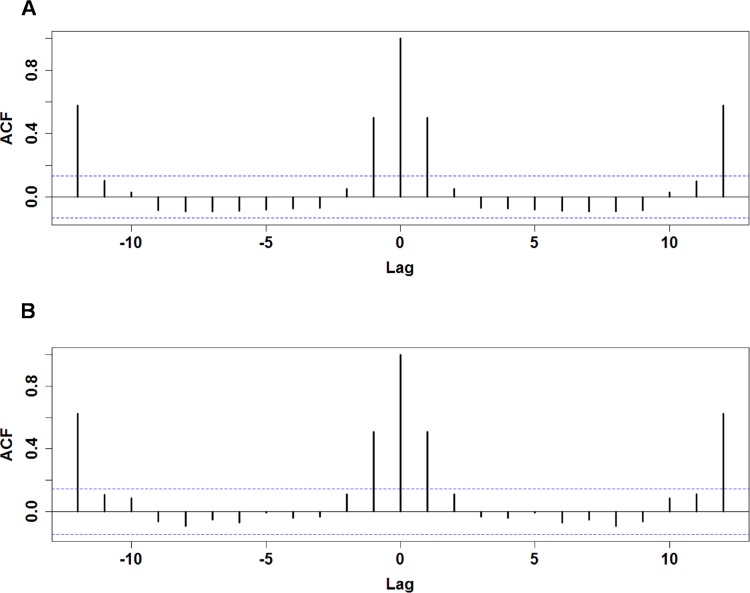
The autocorrelation of fitted and predicted residuals of the GAM in the two epochs were not significant (Ljung-Box Q test, P>.05). The adjusted R2 for the predictive abilities of the GLM, GAM, and PCRM were 0.752, 0.799, and 0.665 in the early epoch, and 0.669, 0.756, and 0.574 in the recent epoch. The adjusted R2 values of the three models were lower in the early epoch than in the recent epoch.
GAM is superior to GLM and PCRM for monthly HFRS case number prediction in Hu County. A shift in model reliability coincident with vaccination implementation demonstrates the importance of vaccination in HFRS control and prevention.
户县是肾综合征出血热(HFRS)的严重流行区,近年来HFRS疫情波动明显。本研究旨在探索户县HFRS疫情预测的最优模型。
构建并比较了三种模型,包括广义线性模型(GLM)、广义相加模型(GAM)和主成分回归模型(PCRM)。计算了每个模型的拟合度和预测调整R2。对每个模型的拟合和预测残差进行了Ljung-Box Q检验。为避免疫苗接种这一混杂因素,将研究期分为疫苗接种实施前(1971 - 1993年)和实施后(1994 - 2012年)两个阶段。
两个阶段中GAM拟合和预测残差的自相关性均不显著(Ljung-Box Q检验,P>0.05)。早期阶段GLM、GAM和PCRM预测能力的调整R2分别为0.752、0.799和0.665,近期阶段分别为0.669、0.756和0.574。三个模型的调整R2值在早期阶段均低于近期阶段。
在预测户县HFRS月病例数方面,GAM优于GLM和PCRM。模型可靠性随疫苗接种实施的变化表明了疫苗接种在HFRS防控中的重要性。